
What if a gamma-ray burst scorched Earth from a collapsing star?
The Invisible Arrow | Acid Veil | Ember Rebirth

The Invisible Arrow
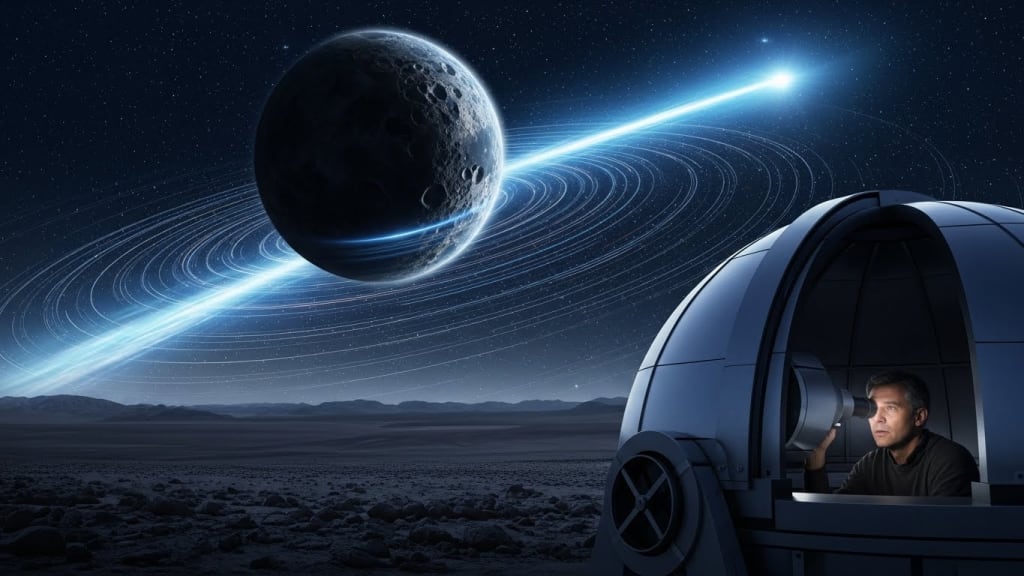
High atop Mauna Kea, the thin air carried a razor-sharp chill that seeped through observatory walls. Dr. Mira Solari nursed a mug of tepid tea, its bergamot scent faint against the sterile hum of cooling systems. Starlight poured through the open dome, silvering the massive mirror of the Keck telescope as it tracked a distant galaxy cataloged as WR-47b.
Routine data streamed in—until it didn't.
A spike. Unprecedented flux in hard gamma. Mira's fingers froze mid-sip. She cross-referenced archives: Wolf-Rayet star, massive, unstable, two billion light-years distant. Its death throes captured long ago now reached Earth as a focused beam—collimated by the star's rotation into a lethal jet.
She ran the geometry. Earth's orbital position placed it squarely in the cone's edge. Impact: eight hours, fourteen minutes.
No siren blared. No flash warned. Gamma rays would arrive invisible, silent, stripping ozone in minutes.
Mira initiated the global alert protocol, her voice steady over encrypted channels: "This is Solari, Mauna Kea. Confirmed GRB impact trajectory. Hemisphere-facing exposure critical. Evacuate to nightside shelters immediately."
Screens lit worldwide. In Tokyo, salarymen paused mid-commute, phones buzzing with emergency glyphs. In Lagos, markets hushed as radios crackled warnings. Parents in Santiago bundled children toward basements, flashlights cutting through sudden darkness of fear.
Mira's sister Elena rang from Sydney, voice trembling over satellite lag. "Mira? Is it true? The sky's going to burn?"
"Get underground," Mira urged, throat tight. "Deep as you can. Lead shielding if possible."
First effects whispered in: ionosphere ionized, radio blackouts rolling like a wave. Satellites winked out in cascades, orbital debris glinting briefly before tumbling.
Outside the dome, the Milky Way blazed unconcerned. But high-altitude sensors registered the vanguard—ultraviolet surging as ozone dissociated, air molecules splitting with faint pops undetectable to human ears.
Mira watched spectral lines shift: nitrogen oxides forming, precursors to acid rain that would scour the surface clean.
Her hands shook as she logged the final calculation. The burst wasn't full-on; Earth grazed the beam's periphery. Half the planet spared direct sterilization.
But the nightside would soon rotate into the fallout zone.
And deep in the data, a colder truth emerged: the nitric acid precursors were already precipitating, seeding clouds that gleamed unnatural red under moonlight.
The invisible arrow had struck. The real wounding was only beginning.
Acid Veil
Brown rain hammered the convoy’s lead vehicle, windshield wipers smearing corrosive streaks that etched spiderwebs into the glass. Mira Solari gripped the dashboard, knuckles white, as the armored truck lurched through abandoned Hawaiian highways lined with skeletal palms, fronds dissolved into dripping lace. Each breath through the respirator tasted of vinegar and rust; outside, the downpour hissed against asphalt, bubbling like acid on flesh.
In the trailer behind, her team monitored collapsing ecosystems—satellite feeds showing Amazon canopies curling black, coral reefs bleaching to bone-white in seconds. A young biologist retched quietly, mask fogging with tears, whispering, “The plankton… they’re gone. Oxygen drop in weeks.”
Mira’s radio sputtered with fragmented pleas from global holdouts: Parisian catacombs echoing with coughs, Antarctic stations rationing air as filters clogged with nitrate crystals. Her sister’s frequency remained dead silence, a void sharper than any scream.
Desperation birthed ingenuity. From a launchpad in French Guiana, surviving rockets roared skyward, payloads bursting into stratospheric veils of sulfur dioxide—artificial volcanoes to blot the lethal sun. Engines thundered against poisoned wind, contrails spreading like bruised wings.
High-altitude drones captured the miracle beneath horror: abyssal trenches glowing electric blue, extremophiles exploding in frenzied evolution, pumping oxygen from sulfur cycles never meant for surface life.
Then seismographs spiked. Supervolcano calderas, destabilized by atmospheric mass loss, rumbled awake beneath Yellowstone and Toba, magma surging toward daylight.
Mira stared at the trembling horizon. “We bought time,” she murmured, voice raw. “But the planet’s answering back.”
Ember Rebirth
Decades blurred in the crimson half-light of Icelandic lava tubes, where geothermal vents exhaled warm, mineral-rich breath that fogged the reinforced visors of the last generation. Mira Solari moved slowly now, joints stiffened by low-level radiation, her footsteps echoing softly against basalt walls etched with murals—faded depictions of blue skies and green fields painted by children who had never seen them.
Above, the surface world lay silent under perpetual ashfall, wind sculpting dunes of gray across the bones of old cities. Yet sensors hummed with impossible data: oxygen curves ticking upward, slow but relentless, fed by vast oceanic mats of engineered cyanobacteria descended from vent survivors.
Mira gathered the council in the central cavern, bioluminescent algae casting gentle teal glows across young faces—pale skin, wide pupils adapted to dimness. Her niece, Liora, now twenty, held the floor. “The probes confirm it,” she said, voice clear over the distant rumble of cooling magma. “Continental shelves are greening. Forests of tube-like organisms, photosynthesizing in infrared.”
Tears tracked clean lines through dust on Mira's cheeks. She remembered Elena's final silence, the billions erased in acid and starvation. But here, in the warm dark, new songs rose—hybrid lullabies blending old languages with clicks and whistles learned from resurfaced cetaceans.
When the great seal finally opened, filtered sunlight—dimmer, redder—spilled into the cavern like sacred wine. They emerged into a world of black sand and glowing foliage, vast insects drifting on thermal updrafts, their wings shimmering like stained glass.
Mira sat on a cooled lava flow, Liora beside her, watching auroras weave gentle greens and purples across a cleaner sky. The gamma burst had cauterized the old Earth, but in its wound, something fiercer had taken root.
She exhaled once, long and steady, as the wind carried spores of new life across an empty, radiant horizon.
The stars looked down, indifferent as ever.
And for the first time in generations, humanity looked back—small, changed, and quietly alive.
About the Creator
crypto | Science
Crypto enthusiast exploring free earning methods in 2025 | Sharing beginner guides, real withdraw stories & tips | No investment journeys from zero to payouts | Let's learn and earn together! 🚀💰 #Crypto #FreeEarning #Web3
Keep reading
More stories from crypto | Science and writers in Education and other communities.
What if quantum entanglement linked all minds across the globe instantly?
The Sudden Merge Fluorescent bulbs hummed in the cavernous halls of CERN's accelerator complex, buried deep beneath the Swiss-French border. Dr. Kai Lin adjusted the collider's parameters one last time, his gloved fingers hovering over the console like a pianist poised for the opening chord. The team around him—physicists in crisp white coats, eyes glued to monitors—held their collective breath. This run aimed to stabilize a chain of entangled bosons, probing the edges of quantum coherence at unprecedented scales.
By crypto | Science2 months ago in Education
Natural Ways to Clear Blackheads and Whiteheads
Blackheads and whiteheads are very common skin problems that affect people of all ages. They usually appear on the nose, chin, forehead, and sometimes on the cheeks. These small bumps form when the pores of the skin become clogged with oil, dead skin cells, and dirt. Blackheads appear dark because the clogged material inside the pore reacts with air and becomes oxidized, while whiteheads remain covered by skin, giving them a white or flesh-colored appearance.
By DigitalAddi5 days ago in Education
Why Didn't Anyone Tell Us
Men, move along. This is not for you. This is for the women. I was forty-five when I began menopause. It is pretty young for that to be going on in a woman’s life, but I had undiagnosed PCOS, my entire life. Thank you to all the gynecologists I had seen my entire life. That in itself should encourage women to keep seeking second opinions, especially when you are not getting correct answers or any at all.
By Alexandra Grant2 days ago in Humans



Comments
There are no comments for this story
Be the first to respond and start the conversation.