
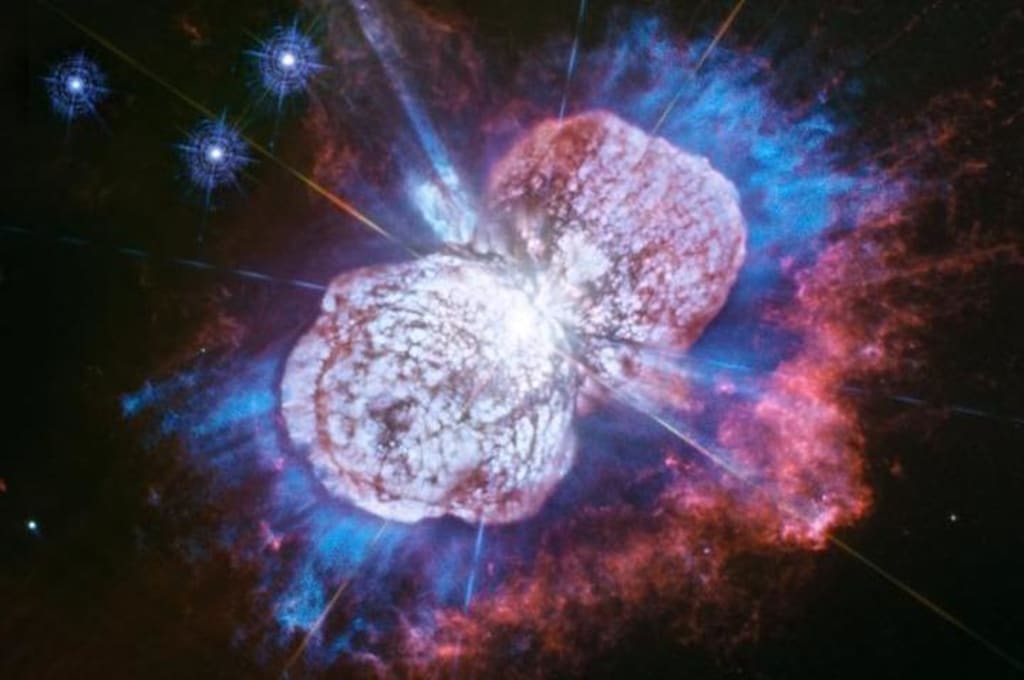
A team of international astronomers recently made a fascinating discovery in the vast expanse of the Tarantula Nebula, located within the Large Magellanic Cloud, approximately 160,000 light years away from Earth. Amidst this stellar nursery, they found two colossal stars engaged in what can only be described as a cosmic embrace. This discovery sheds light on a rare phenomenon where two massive stars, born in close proximity, engage in an intricate dance due to their mutual gravitational attraction.
Typically, the life cycle of a solitary star is relatively straightforward: born from vast clouds of gas, they burn through their fuel over millions to billions of years before culminating in a dramatic supernova explosion. However, when stars are born near each other, their gravitational interactions can lead to a more complex fate. This particular pair of stars, nearly identical in size and together constituting a mass 57 times that of our Sun, orbit each other at an astonishing rate of once per day. Their centers are a mere 7.4 miles apart, creating an intense gravitational field that allows them to share up to 30% of their material across a bridge formed between them.
This intimate stellar arrangement not only affects their physical proximity but also significantly alters their life spans and ultimate destinies. While the initial mixing of their energy may suggest they could burn fuel more efficiently and potentially live longer, the long-term outcomes are more dramatic. Astronomers speculate two main scenarios for their future: the stars could merge into a single, massive entity that would eventually explode as a supernova, or they could each explode separately and potentially evolve into binary black holes orbiting each other. Either way, their fate is sealed by the laws of physics, leading eventually to their destruction, unless they end up as separate drifting black holes.
Beyond the Tarantula Nebula, similar cosmic phenomena are observed around supermassive black holes, such as the one at the center of our Milky Way galaxy. Here, astronomers have discovered enigmatic objects known as G objects, behaving like gas clouds but potentially being remnants of binary stars that merged due to the immense gravitational forces exerted by the black hole. These G objects, including G1 and G2, have provided astronomers with a rare opportunity to study the dynamics of stars in close proximity to a supermassive black hole without being swallowed by it.
G2, in particular, exhibited a unique signature during its closest approach to the black hole, showing elongation and significant gas stripping as it neared the event horizon. This event, akin to an impressive fireworks display, occurs when the material torn from the G objects heats up and emits radiation before crossing the point of no return into the black hole's event horizon. Recently, four more G objects have been discovered within a mere 0.13 light years from the black hole, suggesting that these objects might have once been binary stars that merged due to the black hole's gravitational influence.
Variable stars, another intriguing cosmic phenomenon, exhibit changes in brightness over time, offering astronomers valuable insights into stellar evolution and dynamics. These stars, unlike the static image we often have of celestial bodies, demonstrate fluctuations in their luminosity over days, months, or even years, revealing underlying processes within them.
Furthermore, binary systems such as vampire stars and zombie stars highlight the complex interactions between stars in close proximity. Vampire stars, composed of a red giant and a white dwarf in a binary system, showcase a scenario where the smaller, denser white dwarf draws hydrogen from its larger companion, rejuvenating itself and appearing more vibrant. In contrast, zombie stars are remnants of red giants that explode but leave behind a white dwarf that can accrete material and potentially reignite as a hydrogen-burning star, albeit temporarily, before meeting a fiery end.
Stellar clusters, akin to social groups among stars, are bound together by gravitational forces and consist of stars of similar ages and types. These clusters provide a glimpse into the cooperative behavior of stars within a defined space, sharing common origins and trajectories through the cosmos.
In essence, these cosmic phenomena underscore the dynamic and interconnected nature of stars, challenging the perception of them as static, unchanging objects. They remind us that stars, like humans, can form relationships, undergo transformations, and even meet dramatic ends, weaving a tapestry of complexity and beauty across the universe. As astronomers continue to probe deeper into these celestial mysteries, each discovery unveils new facets of stellar evolution, gravitational dynamics, and the profound interplay between stars and their cosmic environments.
In conclusion, the discovery of the binary stars in the Tarantula Nebula and the enigmatic G objects near the supermassive black hole in our galaxy exemplify the intricate dance of celestial bodies in the cosmos. These discoveries not only deepen our understanding of stellar evolution and gravitational interactions but also inspire awe at the vast and varied phenomena unfolding across the universe. As we gaze upon the night sky, we are reminded that stars, much like us, are born, evolve, and eventually fade away, leaving behind a legacy of wonder and discovery for generations to come.
About the Creator
Ai Basics Everyone Should Know for the Future
Artificial Intelligence (AI) is no longer a distant concept reserved for scientists or tech companies. It’s already shaping how we work, learn, communicate, and make decisions. From recommendation systems on streaming platforms to AI assistants that help write emails, analyze data, or generate images, AI has quietly become part of everyday life.
By Anthony Bahamonde7 days ago in Education
ISO 9001 in Abu Dhabi: What Auditors Check Most Often (Simple Checklist)
If your business is based in Abu Dhabi, an ISO 9001 audit can feel stressful for one simple reason, it’s not only about “having a system.” It’s about proving that your system is working in real daily operations.
By Umar Quality Jounal5 days ago in Education



Comments
There are no comments for this story
Be the first to respond and start the conversation.