
What happened after the 9/11 attack
Most destructive attack in history
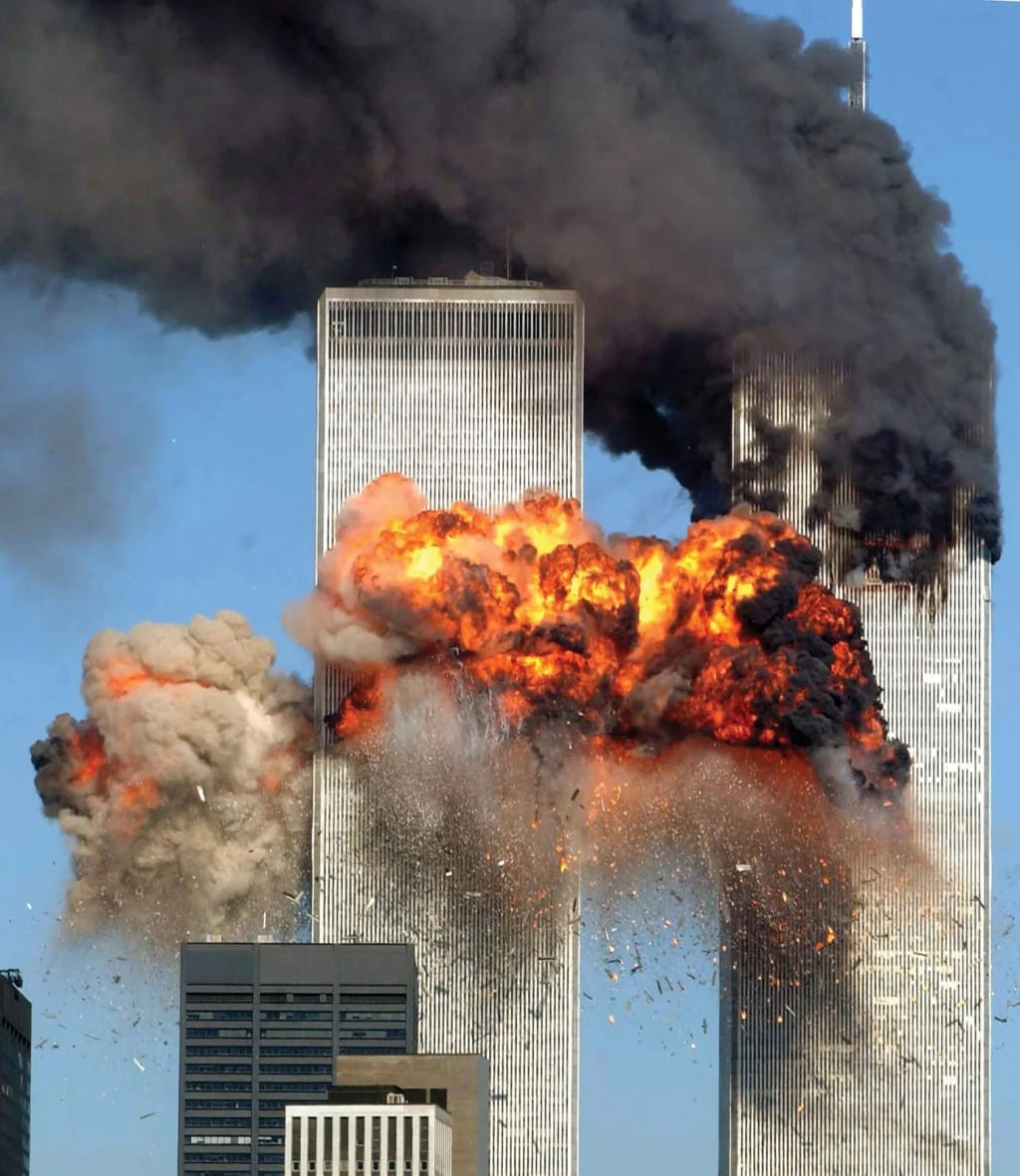
On September 11th, 2001, terrorists struck the United States and launched the world into a new era- the Global War on Terror.
After decades of Cold War preparations, the US and its allies found themselves unprepared for this new, asymmetric war, but they were very quick learners.
First though, the US had to deal with the literal wreckage from the attack.
Both the Pentagon and the World Trade Center had suffered catastrophic damage, but the Pentagon was only partially destroyed.
The World Trade Center would be a near total loss.
Immediately upon realizing that the homeland was under attack, the United States took the unprecedented steps of ordering all civilian aircraft in US airspace to land at the nearest available airport.
Hundreds of aircraft from various nations were all forced to land or face the wrath of the US Air Force, which was not in the mood for discussion that day.
Tens of thousands of travelers had their travel plans hopelessly disrupted as aircraft landed on the nearest available air field all across the US.
French tourists on their way to Hawaii were suddenly stuck in Montana, and the shutdown of air traffic affected incoming aircraft as well.
US Air Force F-15s and F-16s, loaded for air to air combat, immediately took up air defense patrols over the American west and east coasts, as well as the air space west of Alaska and north of North America.
The United States implemented DEFCON 3, or Defense Condition 3, across all of its military facilities around the world.
This meant that US forces, specially the air force, had to be ready to mobilize at a moment's notice, with all air force combat planes ready to take to the skies within 15 minutes of alert.
The US wasn't just worried about further terrorist attacks using civilian air liners, it was sending a clear and strong signal to any would be adversary that while the US had just taken a nasty sucker punch to the face, it was still on its feet and ready to fight.
Any attempt to capitalize of US confusion and weakness in the immediate aftermath of the attacks would be met with immediate and overwhelming force- including nuclear if need be.
Civilian aircraft incoming to the United States were immediately ordered to divert and barred from entering American airspace.
Anyone wishing to complain could take it up with Air Force F-15s- nobody did. Planes were diverted to Canada and Mexico, causing a global aviation logjam and chaos that would last for days.
The first priority were search and rescue efforts at both the Pentagon and the World Trade Center.
The Pentagon had been a priority target, though each hijacker had been instructed that if they couldn't reach their intended targets they had the freedom to use their own initiative and choose secondary targets.
Anyone who couldn't do either or experienced any difficulties was to immediately crash their planes.
As the very visual symbol of American global power, the Pentagon had been high on the list of targets, but the attack did only relatively minor damage to the huge structure. 125 Pentagon workers were killed in the attack, seventy civilians and 55 military personnel-mostly US Army or US Navy employees.
The highest ranking casualty was Lieutenant General Timothy Maude, an Army Deputy Chief of Staff.
Thanks to reinforced construction techniques though, the Pentagon was a particularly tough target to take on, and the damage was limited considering the incredible amount of energy released in the impact.
At the World Trade Center site though, things were far more grim.
Firefighters from the New York City Fire Department rushed to the scene of the attack and braved the smoke, dust, and raging firestorm above their heads.
Falling debris made the task even more difficult even after the towers collapsed in on themselves.
Engine 10 and Ladder 10 were the first to arrive on scene since their firehouse was directly across the street, and at 8:50 AM an incident command post was established in the lobby of the North Tower.
However due to safety concerns, the command post was moved across West Street.
This would end up saving the lives of many senior officials, though many more died asthe North Tower lobby was still being used to coordinate rescue operations when the tower collapsed.
Tragically, a repeater system meant to help with radio communications during an emergency had failed due to the attack, and fire chiefs were unable to contact many of their men when the order to evacuate had been given.
As a result many firefighters and first responders, some who had no radios and had simply shown up in their off duty hours to assist, were lost in the collapse.
343 firefighters would die from both tower collapses.
The command post on West Street was taken out by falling debris, which also killed New York Fire Departrment Chief Peter Ganci.
A new command post was set up in a firehouse in Greenwich Village, from where a response by half of all New York fire department units, as well as volunteers from Nassau, West Chester County and others could be managed.
Other volunteers who did not make it to the site instead went to the firehouses now short on personnel in order to cover their duties for the duration of the search and rescue efforts.
Just hours after the collapse though, Firefighters erected a flag taken from a nearby yacht on the scene of the attack, evocative of the famous Iwo Jima flag-raising photograph.
The medical response began immediately after the first impact, with a casualty staging area moved to the corner of Vesey and West streets.
Five triage areas would be set up around the entire site as volunteers flooded in to assist with the massive number of casualties being brought off the site.
Triage centers would be moved to the Chelsea Piers and Staten Island Ferry terminal in the wake of the collapse, while neighboring hospitals sped the flow of critical supplies.
Sadly, emergency medical services would end up treating very few individuals- mostly smoke inhalation patients.
The truth is that very few people would end up surviving the collapse of the towers.
Both medical triage areas were shut down the next day.
On the water, the US Coast Guard mobilized as many assets as it could to aid in evacuating people stranded on Manhattan Island.
Counter-terrorism patrols by watercraft were also conducted in an attempt to thwart any possible follow-up attacks on either civilians or the emergency responders themselves.
Short on resources, the Coast Guard sent out a call for ships to assist with the evacuation of Manhattan Island, while other ships such as the John J Harvey were critical in firefighting efforts.
With many water mains severed by the collapse, the John J. Harvey, a fireboat that had operated since 1930, would speed to the proximity of the site.
Alongside two other FDNY fireboats she pumped water to the site so that firefighters could fight the blaze amongst the wreckage for eighty hours until the water mains were repaired.
In eight hours following the attack, anywhere from half a million to a million people were evacuated from Manhattan, in effect America's own Dunkirk and considered to be the largest maritime evacuation in history.
To assist with communications, amateur radio operators set up emergency networks or joined the hundreds of volunteers forming bucket brigades.
With official emergency networks completely overwhelmed, their work was invaluable to New York authorities, and on December 12th, 2002, the New Jersey Legislature honored their work.
Rescue efforts at the site however were not progressing well.
Few had survived the collapse of the towers, and to get to them workers first had to dig through two feet of ash and soot.
Then heavy equipment had to be used to lift up massive blocks of concrete and random wreckage.
Incredibly, the day after the attack though eleven people would be rescued, includingsix firefighters and three police officers.
Two police officers had survived for a full 24 hours buried in thirty feet of rubble. But the discovery of survivors would not last long.
Only twenty people would be pulled alive from the wreckage, with the last survivor being rescued 27 hours after the collapse of the North Tower.
Some of the trapped were able to make cell calls to those above, but debris made it impossible to get to all of them in time.
Hundreds of volunteers and officials poured over the scene, with approximately 400 rescue dogs- the largest deployment of dogs in US history.
By the end of week one, over one thousand ironworkers alone arrived at the site, withthousands other specialists from the US, Canada, Mexico, and other nations.
Days after the attack, the focus was on investigation and clearing debris.
Bucket brigades were organized from thousands of volunteers, with each person passing along a five gallon bucket full of debris.
At the end of each line, investigators sifted through the debris for evidence and human remains, with the rest being deposited in a site known as 'the pile', as workers wanted to avoid using the term 'ground zero' due to connotations of a nuclear attack.
By September 24th, 100,000 tons of 1.8 million tons had been removed from the site, searched for clues or remains, and sent to the Fresh Kills landfill on Staten Island.
About the Creator
Knowledge about the world
I am very interested in improving my knowledge about the world and I know so are a lot of you, so welcome.
Keep reading
More stories from Knowledge about the world and writers in Education and other communities.
The actual reason samurai’s are extinct
The year is 1877. On Shiroyama Hill, a band of 40 samurai, most of them badly wounded, are facing Japan’s 30,000-man imperial army. The samurai leader, Saigō Takamori, started this battle with 4,000 men. After 99% of his troops are killed, he realizes defeat may be imminent.
By Knowledge about the world 3 years ago in Education
Mastering the Mental Game: Pro Poker Strategies to Eliminate Tilt for Good
Avoiding tilt is one of the most crucial elements for long-term success in poker. Tilt, the emotional state that leads to poor decision-making, can unravel even the most skilled player’s efforts. Professional poker players understand that maintaining a calm, composed mindset is as important as knowing the odds or mastering bluffing techniques. Here’s how the best in the game stay mentally sharp and emotionally resilient.
By Micah Raskin Poker 3 days ago in Education


Comments
There are no comments for this story
Be the first to respond and start the conversation.