
The actual reason samurai’s are extinct
Or they really extinct??
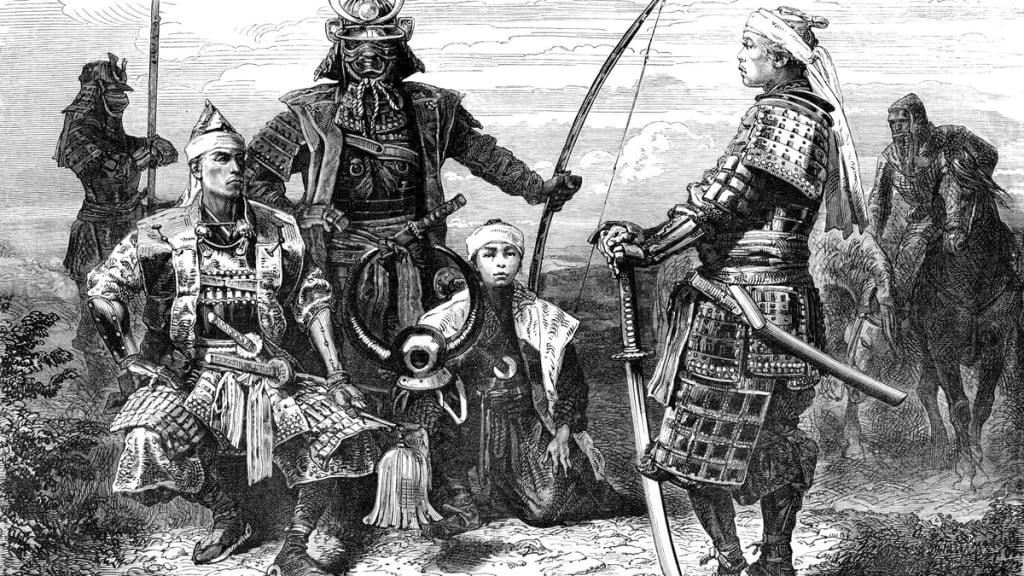
The year is 1877. On Shiroyama Hill, a band of 40 samurai, most of them badly wounded, are facing Japan’s 30,000-man imperial army. The samurai leader, Saigō Takamori, started this battle with 4,000 men. After 99% of his troops are killed, he realizes defeat may be imminent.
Disheartened and humiliated, he slowly raises his sword and prepares to commit seppuku,
thus ending the bloody last stand of the samurai. But how did it come to this in the first place?
In order to understand why the samurai went extinct,it’s important to understand who the samurai were in the first place.
In Japanese, the word “samurai” means “those who serve”, and it fits the original role of this warrior class to a tee.
Samurai started to become a thing during the feudal Heian Period (794-1185), employed by wealthy landowners to serve them and defend their land.
At that time, Japan was less of a unified empire, and more of a collection of militaristic clans under the emperor in Kyoto. The strongest clan at the time, the Fujiwara clan, shut out a lot of wealthy people throughout the empire who each thought they deserved more power.
In turn, these landowners were prepared to sacrifice countless lives to acquire it.
In the 1100s, the imperial court in Kyoto gradually lost power and wealthy heads of local clans and landowners - known as daimyō - started to rule over their different regions instead. With this new decentralized system of government, power struggles became common between the clans, and the samurai became indispensable, solidifying themselves as a separate social class.
The biggest conflict of all was The Gempei War, from 1180 to 1185,
between the Taira and Minamoto clans, who wanted to control the entire state of Japan. The glory the samurai acquired during that war leveled them up from warrior to ruling class. Thus,
the Kamakura Shogunate - essentially a military dictatorship - was established.
In order to maintain the elite status of the samurai, war hero and control freak
Minamoto Yoritomo decreed that no one could be called a samurai until Yoritomo himself had permitted it. He knew that he could only hold onto his rule through military strength and intimidation, so it was important for Yoritomo to create a powerful warrior class that would be looked up to and feared by the people.
This was around the time that Zen Buddhism was gaining traction in Japan, and the rules and moral codes of Buddhism seemed to align quite well with a disciplined military life. The austere,
simple life principles of Buddhism morphed with the samurai’s training to eventually become the bushido code of conduct, “the way of the warrior”. This code emphasized honor and loyalty to each samurai’s daimyō above all. This code also instituted the idea of seppuku, the ceremonial killing of oneself in order to preserve honor in the face of failure. As you can see, the samurai took their oath of loyalty very seriously.
From the 13th century onwards, Mongol invasions and clan rebellions would launch Japan into yet
another cycle of territorial clans battling for power. Eventually,
in the late 15th century, this led to another decentralization of power, which once again strengthened the role of lords and their samurai even further.
The problem is that the roots of the samurais’ eventual destruction were already present in this vicious cycle. The constant conflicts and transfers of power they depended on, the unwillingness to accept any central form of government, and their strict adherence to bushido planted the seeds of their eventual demise as a group.
Under the centralized Tokugawa Shogunate during the Edo Period, from 1603 to 1867, the samurai were still powerful, but in this time of relative peace, their day to day roles were slowly changing. Though they were still theoretically career military men,
they more often found themselves knee-deep in bureaucratic work and even farming activities than actually fighting.
They increasingly became unhappy about their lot in life,
unsurprising when you think that these men were trained to slash people down with swords but instead found themselves filling out government forms in triplicate.
In the midst of this gradual disintegration of the warrior class, the arrival of Commodore Matthew Perry to Japan in 1853 signaled the beginning of the end to the samurai way of life.
Perry’s offer to open up trade between Japan and the U.S. divided the country. On the one hand, Shogun Tokugawa Iemochi was in favor of opening up the ports.
On the other, Emperor Kōmei, who had largely become a figurehead at this point rather than holding any real power,
objected, issuing an order to “expel the barbarians''. Unsurprisingly, “the barbarians” did not listen. However, several samurai clans did. The Chōshū and Satsuma clans were already dissatisfied with the Shogun.
So when Shogun Tokugawa decided that Japan should open up to the West, the anti-foreigner Chōshū and Satsuma allied themselves with the Emperor…sort of a, “the enemy of my enemy is my friend” situation. The Chōshū attempted to take over Kyoto in order to restore the Emperor’s power over the Shogun,
but were instead attacked and defeated by Shogunate forces,
an event known as the Hamaguri Gate Rebellion.
The Shogunate forces chased and attacked the Chōshū in
retaliation. A couple of years later, they attacked the Chōshū clan again, which had joined forces with the Satsuma clan this time. With the extra manpower, the two clans defeated the Shogun’s army and thus countered his first victory.
If you’re already getting tired of this repetitive fighting, don’t worry,
so was the universe, as both Shogun Tokugawa Iemochi and Emperor Komei unexpectedly died right after this battle. Emperor Meiji and Shogun Tokugawa Yoshinobu stepped right up to fill their places, and initially it seemed like they would form a better relationship.
In 1867, the new Shogun declared his official resignation, retaining a working position in the government while deferring to the Emperor for decision-making power.
He hoped this action would keep the Tokugawa clan in the new emperor’s good graces, and for a while the clan worked closely with the emperor as part of his government.
This strange power-sharing carried on for a while until the 1868 Meiji Restoration, an event whose name you probably vaguely remember from high school history.
A coup made the emperor the sole, supreme authority of Japan. And yet, this further demotion in power for the Shogun still wasn’t enough for some.
The Chōshū and Satsuma clans, still mad about all those bloody battles and expeditions against them a couple of years ago, persuaded the Meiji government to take Shogun Tokugawa
Yoshinobu’s lands from him and strip him of the title of Shogun altogether.
As you might expect, the Shogun - former Shogun? - was incredibly unhappy about this development, especially as he had already voluntarily abdicated some power to appease the emperor.
The former Shogun decided that he wasn’t going to take the disrespect, and wanted his old position back. As the Emperor had a strict “no takesies backsies” rule, the clans who supported him readied themselves for battle. On January 27, 1868, the Shogun
led his troops against the Satsuma-Chōshū imperial alliance waiting for him at Kyoto.
Though the Shogun had the advantage when it came to numbers - they outnumbered the opposing clans three to one - they also had inferior weapons. The imperial army had picked up some brand new Gatling guns and Armstrong howitzers. The heavy
firepower took the Shogun’s forces by surprise and led to a stalemate.Eventually, the imperial clan alliance captured Edo and put the Shogun under house arrest. What the Satsuma and Chōshū clans didn’t yet know, is that their support of the emperor would lead to their own undoing.
Emperor Meiji was not like his predecessor, something the samurai clans might have figured out had they not proclaimed undying loyalty to the emperor’s throne. He decided he was
going to make some big changes in Japanese society in order to align with Western ideals.
First off, he declared that all classes were equal. As the samurai were part of the Japanese caste system, this decision caused some friction with the samurai class.
Secondly, in 1869, Emperor Meiji removed the local landowners,
the daimyō, from power, and in 1871 he made their former domains into Japanese prefectures.
As the samurai had largely existed to serve the daimyō,
this move rendered them even more useless than they had previously felt during peacetime.
Thirdly, the emperor made the decision to start using conscription for military service in order to create one large imperial army. Though this was meant to unify Japan even further,
it also defeated the samurais’ whole reason for existence. After all,
if every Japanese man could become a warrior, what made the samurai special? His last reform, and perhaps the most dishonorable in the view of the samurai,
the Haitorei Edict in 1876 made it illegal for samurai to carry swords
About the Creator
Knowledge about the world
I am very interested in improving my knowledge about the world and I know so are a lot of you, so welcome.
Keep reading
More stories from Knowledge about the world and writers in Education and other communities.
The Red Renaissance Uncorking the Future of Russian Wine in 2026
For decades, the global wine map was a predictable atlas of French Chateaus, Italian vineyards, and New World giants. However, as we move through 2026, a new and unexpected frontier has firmly established its presence: Russia. The Russian wine industry is currently undergoing a "Grand Renaissance," fueled by a combination of aggressive state support, massive private investment, and a geopolitical shift that has turned the domestic market inward. What was once seen as a secondary player, primarily known for mass-produced sparkling wines, has transformed into a sophisticated producer of premium, terroir-driven still wines that are winning over a new generation of health-conscious and patriotic consumers.
By Neeraj kumara day ago in Education
A Love Forboding
The chipped stone slope caused unbearable footing. I slid, skirting on my heels. I cast my shield, relinquishing my guard to stay upright. Left with my double-edge and a prayer to the maker, I skated toward my objective. The earthly stubble gave way to solid ground. I found myself restored, a trail of dust in my wake.
By James U. Rizziabout 21 hours ago in Fiction




Comments
There are no comments for this story
Be the first to respond and start the conversation.