
What Caused the Big Bang?
The Big Bang theory is the most widely accepted scientific explanation for the origin of the universe. According to modern cosmology, the universe began approximately 13.8 billion years ago from an extremely hot, dense state and has been expanding ever since. This model successfully explains the cosmic microwave background radiation, the abundance of light elements, and the large-scale structure of the cosmos. Yet one of the most profound questions in science remains unanswered: What caused the Big Bang? Did something exist before it? Was it triggered by a physical process, a quantum event, or something entirely unknown? Or is the question itself beyond the limits of science? This article explores current scientific ideas, theoretical models, and philosophical interpretations surrounding the cause of the Big Bang, written for educational purposes with clear explanations and up-to-date cosmological thinking.

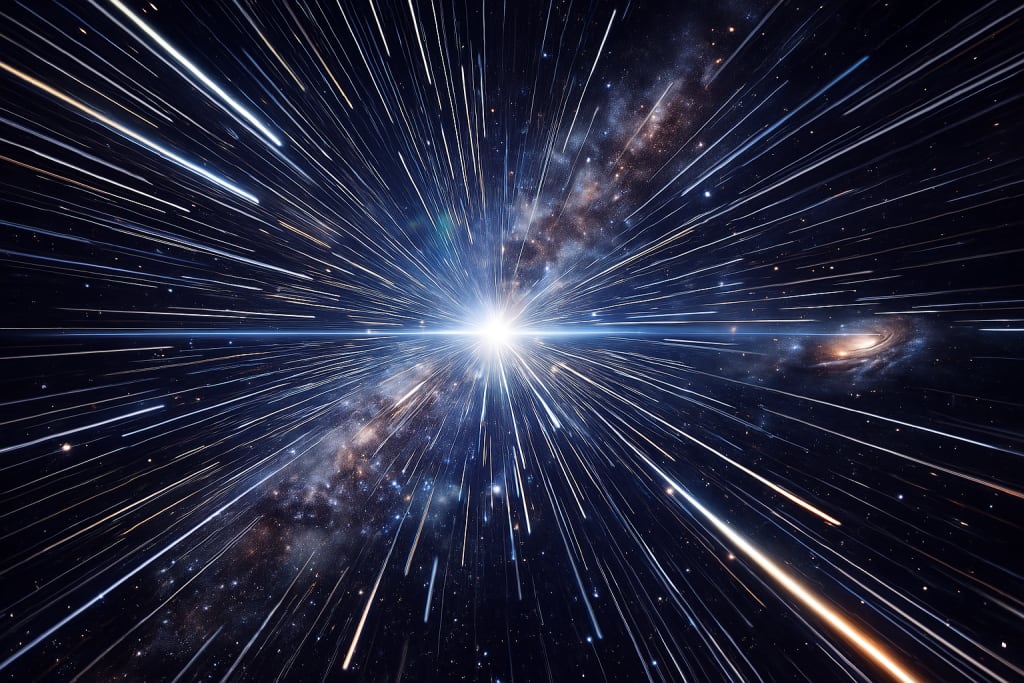
Understanding the Big Bang Theory
The Big Bang does not describe an explosion in space. Instead, it describes an expansion of space itself. At the beginning, all matter, energy, space, and time were compressed into an extremely small, hot, and dense state.
As the universe expanded:
• Temperatures cooled
• Fundamental particles formed
• Atoms developed
• Stars and galaxies emerged
Importantly, the Big Bang theory explains how the universe evolved, not necessarily why it began.
________________________________________
What the Big Bang Does Not Explain
A common misconception is that the Big Bang explains everything about the universe’s origin. In reality, it does not address:
• What existed before the Big Bang
• Why the Big Bang occurred
• What caused the initial expansion
• Whether time existed beforehand
These questions push science to its theoretical limits.
________________________________________
The Singularity Problem
When scientists trace the universe backward using Einstein’s equations, they reach a point known as a singularity—a state of infinite density and temperature.
At a singularity:
• Physics breaks down
• Gravity becomes infinite
• Known laws cannot operate
This indicates that our current theories—general relativity and quantum mechanics—are incomplete when describing the universe’s earliest moment.
Because of this, scientists believe the singularity is not the true beginning, but rather a sign that new physics is required.
________________________________________
Leading Scientific Theories About the Cause of the Big Bang
1. Quantum Fluctuation Theory
Quantum physics shows that empty space is not truly empty. Even in a vacuum, tiny energy fluctuations constantly appear and disappear.
Some physicists propose that:
• The universe emerged from a quantum fluctuation
• Space-time itself tunneled into existence
• No classical cause was required
In this view, the Big Bang was a natural quantum event governed by probabilistic laws.
________________________________________
2. Inflation Theory
Cosmic inflation suggests that the universe underwent an extremely rapid expansion fractionally after the Big Bang.
Some models propose that:
• Inflation may be eternal
• Our universe is one bubble among many
• The Big Bang marked the end of inflation locally
This implies the cause of the Big Bang may lie within an earlier inflationary state.
________________________________________
3. The Multiverse Hypothesis
The multiverse theory proposes that:
• Multiple universes exist
• Each universe has its own physical laws
• The Big Bang was the birth of our local universe
While mathematically consistent, the multiverse remains speculative due to lack of direct observational evidence.
________________________________________
4. Big Bounce Theory
The Big Bounce model suggests that the universe did not begin from nothing but emerged from a previous contracting universe.
According to this idea:
• A prior universe collapsed
• Quantum gravity prevented total collapse
• The contraction rebounded into expansion
This eliminates the need for an absolute beginning.
________________________________________
5. Cyclic Universe Models
In cyclic cosmology, the universe undergoes endless cycles:
• Expansion
• Cooling
• Contraction
• Rebirth
Each Big Bang is a transition rather than a true origin.
________________________________________
6. Loop Quantum Gravity
Loop quantum gravity attempts to unite general relativity and quantum mechanics.
It suggests:
• Space-time has a granular structure
• Singularities cannot exist
• The Big Bang was a quantum bounce
This approach offers a mathematically consistent alternative to the classical singularity.
________________________________________
7. String Theory Cosmology
String theory proposes that all particles are tiny vibrating strings existing in higher dimensions.
Some string-based models suggest:
• Collisions between higher-dimensional branes
• Energy released created the Big Bang
These ideas remain theoretical but actively researched.
________________________________________
Did Time Exist Before the Big Bang?
According to Einstein’s relativity, time and space are interconnected. If space began with the Big Bang, then time may have begun as well.
Stephen Hawking famously suggested that asking what came before the Big Bang is like asking what lies south of the South Pole—it may be a meaningless question within current physics.
However, quantum gravity theories allow for the possibility of a pre-Big Bang phase.
________________________________________
Could the Universe Have Come From Nothing?
In physics, “nothing” does not mean absolute emptiness.
Quantum nothingness still contains:
• Physical laws
• Energy fields
• Vacuum fluctuations
Some cosmologists argue that the universe could arise naturally from such a state without violating conservation laws.
This idea challenges traditional philosophical concepts of creation.
________________________________________
The Role of Dark Energy and Vacuum Energy
Dark energy currently drives the expansion of the universe.
Some theories suggest that:
• Vacuum energy triggered inflation
• The same mechanism may explain cosmic expansion
Understanding dark energy may ultimately explain the Big Bang’s origin.
________________________________________
Philosophical and Scientific Limits
Science relies on testable observations. Conditions before the Big Bang may lie permanently beyond observational access.
This does not mean science has failed—only that:
• Our theories are incomplete
• New discoveries may reshape understanding
Historically, many phenomena once considered unknowable were later explained.
________________________________________
Why the Big Bang Cause Matters in Education
Studying the origin of the universe:
• Encourages scientific curiosity
• Demonstrates theory development
• Integrates physics, mathematics, and astronomy
• Shows how evidence guides belief
For students, this topic illustrates the frontier of human knowledge.
________________________________________
What Science Currently Knows
Scientists can confidently say:
• The universe expanded from a hot, dense state
• Space and time evolved together
• Known physics cannot describe the earliest moment
But the ultimate cause remains unknown.
________________________________________
Conclusion
So, what caused the Big Bang?
At present, science does not have a single confirmed answer. Instead, multiple well-developed theories attempt to explain the universe’s beginning using quantum mechanics, gravity, and cosmology.
Possibilities include:
• Quantum fluctuations
• Cosmic inflation
• A previous universe
• Higher-dimensional interactions
• A timeless quantum state
Each theory points to one powerful conclusion: the Big Bang marks the boundary of current physics, not the end of explanation.
As new observations and theories emerge, humanity moves closer to understanding its deepest origin.
The question of what caused the Big Bang is not only about the universe—it is about the limits of knowledge itself.
________________________________________
what caused the big bang, big bang explanation, origin of the universe, cosmology for students, big bang theory explained, universe beginning, astrophysics education, early universe science
About the Creator
Keep reading
More stories from shahkar jalal and writers in Education and other communities.
Ghana's Arch and St. Louis Arch
As what I'm looking into this I am seeing that IShowSpeed is showing alot of cool things coming out of Africa. What really made me take a look twice was the Independence Arch in Ghana. As He is in Ghana today it really made me look at it like well I wonder why it's there and what it means. Here's what I found out.
By Erica Williamsa day ago in Education
The Clock That Forgot to Hurry
In the heart of an old marketplace stood a tiny watch-repair shop that almost no one noticed anymore. Bright digital billboards flashed above it. Smart stores sold devices that measured time with perfect precision. People hurried past the shop every day, glancing only at their phones, trusting machines to tell them when to run, when to stop, when to breathe. Inside that narrow shop lived an elderly watchmaker named Kareem. Kareem had repaired clocks for more than fifty years. His hands were thin, steady, and remarkably gentle. He treated every broken watch not as a machine, but as a small life that had lost its rhythm. What made his shop unusual was a sign hanging above the door: “Time repaired here. Hurry not included.” Most customers smiled at the line and ignored it. Only a few understood. Among them was a young woman named Sara. Sara worked in a fast-growing technology firm across the city. Her days were filled with deadlines, meetings, notifications, and endless planning. She measured life in tasks completed and emails answered. Success followed her closely — promotions, bonuses, praise — yet sleep avoided her, and peace had become a stranger. One evening, after a long day that refused to end, Sara noticed her wristwatch had stopped. Annoyed, she searched for the nearest repair shop and found herself standing before Kareem’s quiet door. The bell above it rang softly as she entered. Clocks covered every wall — large wooden ones, tiny silver ones, antique pocket watches, all ticking at different rhythms, like a choir that refused to sing in perfect unison. Kareem looked up and smiled. “My watch stopped,” Sara said quickly. “I need it fixed. Urgently.” Kareem nodded. “Of course. Please sit.” He examined the watch carefully, opening it with slow, deliberate movements. “You seem in a hurry,” he observed. “I always am,” Sara replied. “Time is expensive.” Kareem smiled gently. “No. Time is generous. We are the ones who are wasteful.” She frowned, uncertain whether he was joking. “Come back tomorrow,” he said. “It will be ready.” “Tomorrow?” she protested. “It’s a simple battery change.” “Not this one,” Kareem replied calmly. “This one has forgotten how to rest.” Something in his tone made her pause. The next evening, she returned. While Kareem worked, Sara noticed a large antique clock in the corner that had no hands. “How do you know the time on that one?” she asked. “I don’t,” Kareem replied. “It reminds me to look at life instead.” She laughed politely, though uneasily. Over the following weeks, her watch failed repeatedly — mysteriously, always after particularly stressful days. Each time, she returned to the tiny shop. Slowly, conversations replaced urgency. Kareem told her stories — of clocks that survived wars, of watches passed through generations, of people who came not to fix timepieces, but to escape time itself. One evening, he said, “Do you know why clocks break more often now than before?” “Because they’re cheap?” Sara guessed. “Because people force them to run faster than they were made to,” Kareem replied. The sentence followed her home. Gradually, Sara began to linger. She arrived earlier, sat longer, listened more. In the ticking chorus of the shop, her thoughts slowed. Her breathing softened. For the first time in years, she felt minutes pass without panic. One night, after a particularly quiet repair, Kareem handed her the watch and said, “This one is fixed. But you are not.” She smiled weakly. “I know.” He hesitated, then reached beneath the counter and placed a small brass pocket watch in her hand. “This was my wife’s,” he said softly. “She died young. For years, I blamed time for taking her too soon. Then I realized — time did not steal her. I simply forgot to cherish her while she was here.” Sara’s eyes filled with tears. “Keep this,” he said. “Not to count minutes. To remember them.” From that day, something changed. Sara stopped checking her phone during meals. She walked home instead of driving. She called her parents more often. She refused meetings that stole her nights. Her success did not disappear. But her life returned. Months later, she found the shop closed. The sign still hung there, but the door was locked. A neighbor told her quietly, “The watchmaker passed away last week. Peacefully. In his sleep.” Sara stood there for a long time. That night, she opened the small brass watch. Inside, engraved faintly, were the words: “The best moments are not measured. They are lived.” Years later, when Sara opened her own small café near the river, she placed that pocket watch above the counter. Beneath it, she hung a sign: “Time welcome here. Hurry left outside.” And people, without knowing why, always felt calmer when they entered
By Muhammad yaseen4 days ago in Education



Comments
There are no comments for this story
Be the first to respond and start the conversation.