
What Caused the Big Bang, and What Existed Before It? Exploring the Origins of the Universe
The question of the universe’s origin is one of the deepest and most intriguing mysteries in science. For decades, scientists have sought to understand what triggered the Big Bang, the event that led to the expansion of our universe, and whether anything existed before it. The Big Bang theory, which remains the most widely accepted explanation for the universe’s early development, describes how space, time, and matter emerged and evolved. But what caused it, and what, if anything, preceded it? This article explores the scientific theories, philosophical perspectives, and ongoing research surrounding the origins of the cosmos, offering insights into one of the most profound questions in human history.

1. Understanding the Big Bang
A. What the Big Bang Is
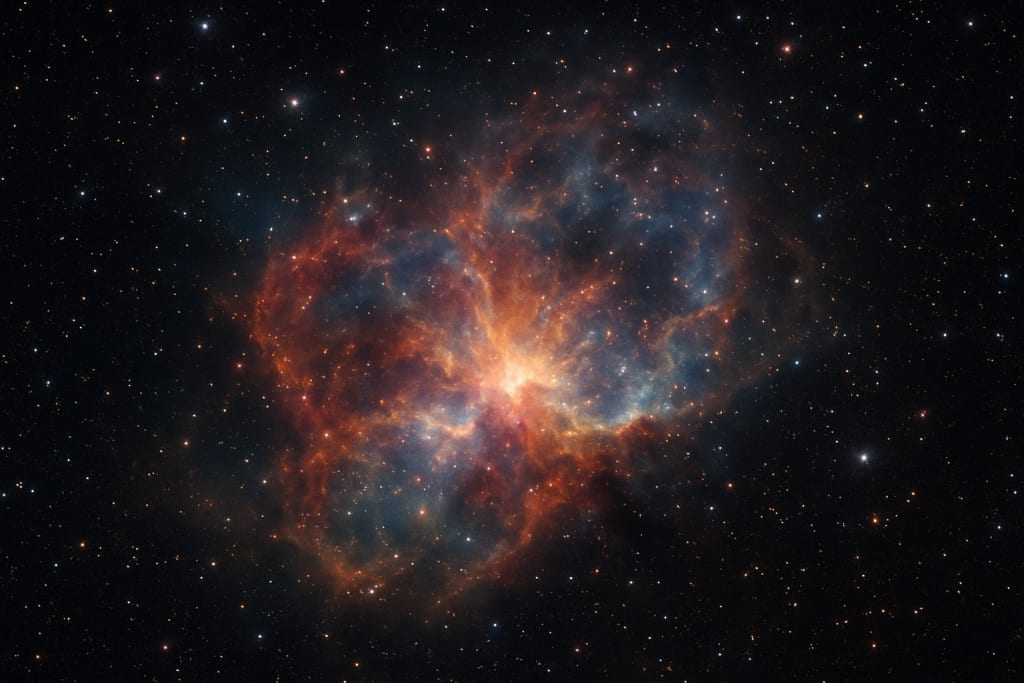
The Big Bang is not an explosion in the conventional sense but rather a rapid expansion of space itself. Approximately 13.8 billion years ago:
• All matter, energy, space, and even time were concentrated in an extremely dense and hot point known as a singularity.
• The universe began expanding from this singularity, cooling as it grew.
• This expansion continues today, observable in the redshift of distant galaxies.
B. Evidence for the Big Bang
1. Cosmic Microwave Background (CMB)
o Discovered in 1965, this faint radiation is the residual heat from the early universe.
o Its uniformity supports the theory of a hot, dense origin.
2. Abundance of Light Elements
o Predictions about hydrogen, helium, and lithium ratios match observations, confirming the early nuclear reactions after the Big Bang.
3. Expansion of the Universe
o Edwin Hubble’s observations show galaxies moving away from us, consistent with space stretching from an initial point.
________________________________________
2. Theories About What Caused the Big Bang
While the Big Bang describes how the universe expanded, it does not explain why it happened. Several scientific hypotheses attempt to address this question.
A. Quantum Fluctuations and the Vacuum
• Some physicists propose that the universe originated from a quantum fluctuation in a vacuum.
• In quantum mechanics, even “empty” space contains fleeting energy fluctuations.
• These fluctuations could, in theory, create a universe spontaneously, allowing space and time to emerge.
B. Inflationary Universe
• Proposed by Alan Guth in the 1980s, cosmic inflation suggests a rapid exponential expansion immediately after the Big Bang.
• A tiny region of space expanded faster than the speed of light, smoothing out irregularities and creating the large-scale structure of the universe.
• Inflation may be triggered by a high-energy quantum field called the inflaton field.
C. Cyclic and Bounce Models
• Some theories suggest the universe undergoes cycles of expansion and contraction.
• The Big Bang could have been a “bounce” after a previous universe collapsed.
• This idea addresses the problem of what existed “before” by proposing an eternal series of cosmic cycles.
D. Multiverse Theories
• In some models, our Big Bang was just one of many events in a multiverse.
• Other universes could exist in parallel, each with its own laws of physics and constants.
• The cause of our Big Bang might be linked to processes in a larger multiverse framework.
________________________________________
3. What Existed Before the Big Bang?
The concept of “before” the Big Bang is complicated because time itself began at the Big Bang:
• According to general relativity, space and time are linked.
• At the singularity, time as we understand it ceases to exist.
• Asking what existed “before” may be like asking what is north of the North Pole—time itself may not have existed in a meaningful way.
A. Philosophical Perspectives
1. Nothingness
o Some philosophers suggest that the universe emerged from a state of true nothingness.
o This challenges human intuition, as we are used to causality within time.
2. Pre-Big Bang Physics
o Some theories propose a pre-existing quantum state or “primordial universe” that gave rise to the Big Bang.
o Concepts like string theory or loop quantum gravity may provide models for what came before.
3. Timeless Universe
o Certain interpretations suggest time is an emergent property, not fundamental.
o In this view, asking what existed before the Big Bang may be meaningless because “before” relies on the existence of time itself.
________________________________________
4. Singularity and the Limits of Physics
The Big Bang singularity represents a point where:
• Density becomes infinite.
• Temperature is infinitely high.
• Classical physics breaks down.
At this extreme, quantum gravity is required to describe the universe. Scientists are working on:
• Loop Quantum Gravity: Suggests spacetime is quantized, avoiding true singularities.
• String Theory: Proposes fundamental strings could replace point-like singularities, providing a framework for pre-Big Bang physics.
________________________________________
5. Cosmic Inflation and the Early Universe
A. What Is Cosmic Inflation?
Inflation theory proposes that:
• The universe expanded exponentially in a tiny fraction of a second after the Big Bang.
• This explains why the universe appears homogeneous and isotropic on large scales.
• Tiny quantum fluctuations during inflation later became the seeds of galaxies.
B. Evidence for Inflation
• Temperature fluctuations in the CMB match predictions of inflation.
• Large-scale structure formation aligns with quantum fluctuation predictions.
• Inflation solves the horizon problem and the flatness problem, which traditional Big Bang models cannot.
________________________________________
6. The Role of Dark Energy and Dark Matter
While not directly causing the Big Bang, dark energy and dark matter play a crucial role in cosmic evolution:
• Dark matter influenced early structure formation, allowing galaxies to coalesce.
• Dark energy drives the current accelerated expansion, continuing the trend that began with the Big Bang.
• Understanding their origins may shed light on the conditions surrounding the universe’s birth.
________________________________________
7. Philosophical and Religious Perspectives
The question of what existed before the Big Bang is not only scientific but also philosophical:
• Religious Views: Many traditions propose a creator or cosmic principle initiating the universe.
• Philosophical Views: Concepts like “nothingness” and eternal cycles provide frameworks for thinking beyond conventional time.
• Scientific-Philosophical Dialogue: While physics describes mechanisms, philosophy addresses why anything exists at all.
________________________________________
8. Challenges and Open Questions
Despite decades of research, the Big Bang remains partly mysterious:
1. What triggered the initial singularity or quantum fluctuation?
2. Did something exist “before” time itself?
3. Are there other universes beyond our observable cosmos?
4. How did the laws of physics themselves emerge?
5. Will the universe continue expanding forever, or will another Big Bang occur?
These questions are at the frontier of cosmology, quantum physics, and philosophy.
________________________________________
9. Observational Advances and Future Research
New technologies may provide deeper insights:
• James Webb Space Telescope (JWST): Observing the earliest galaxies to understand post-Big Bang evolution.
• Cosmic Microwave Background Studies: Improved precision may reveal clues about pre-Big Bang conditions.
• Gravitational Wave Astronomy: Detecting primordial gravitational waves could provide evidence of early universe phenomena.
• Particle Physics Experiments: High-energy collisions in accelerators may recreate conditions similar to the Big Bang, offering insights into fundamental forces and matter.
________________________________________
10. Conclusion
The Big Bang marks the birth of our universe, but the question of its cause and what existed before it remains one of the most profound mysteries in science. While classical physics reaches its limits at the singularity, modern theories in quantum mechanics, string theory, and cosmology offer possible explanations. The universe might have emerged from a quantum fluctuation, a pre-existing cosmic state, or even as part of an eternal cycle of universes.
Though we may never fully answer the question, exploring these possibilities expands our understanding of space, time, and existence itself. The study of the Big Bang bridges physics, philosophy, and cosmology, reminding us that the universe is far stranger, older, and more mysterious than we can fully comprehend.
About the Creator
Keep reading
More stories from shahkar jalal and writers in Education and other communities.
Could Wormholes Exist Naturally in the Universe? Exploring the Cosmic Gateways
1. Understanding Wormholes: A Primer A wormhole, technically called an Einstein–Rosen bridge, is a hypothetical structure that links two separate points in spacetime. Think of spacetime as a two-dimensional sheet. Normally, traveling from one point to another requires moving across the surface. A wormhole is like folding the sheet and creating a tunnel that allows instant passage between the points.
By shahkar jalal2 months ago in Education
Why Certification Protects Transcription Careers in the Age of AI
Artificial Intelligence has rapidly transformed the transcription industry. Speech-to-text tools now promise instant results, lower costs, and effortless productivity. For businesses focused purely on speed, AI often appears to be the perfect solution. However, beneath this promise lies a critical reality: speed without accuracy creates risk.
By Mahesh Kumar6 days ago in Education
How Japan Saved Its Biggest City from Collapse
400 years ago, modern-day Tokyo was known as Edo, and it was already one of the biggest cities in the world, with a population approaching 1 million. However, it was on the verge of ecological collapse. Years of intense logging had led to massive deforestation. The city now faced timber shortages and the impacts of severe erosion and frequent flooding that threatened food supplies. But over just a few decades, Edo will transform and become one of the most sustainable and efficient cities in history.
By Munesh Yadavabout 6 hours ago in Education



Comments
There are no comments for this story
Be the first to respond and start the conversation.