
Could Wormholes Exist Naturally in the Universe? Exploring the Cosmic Gateways
Wormholes have long captured the imagination of scientists and science fiction enthusiasts alike. Often depicted as cosmic tunnels that allow instantaneous travel across vast distances or even through time, wormholes represent one of the most fascinating concepts in modern physics. But beyond their popularity in movies and novels, a serious scientific question emerges: Could wormholes exist naturally in the universe? In this article, we will explore the science behind wormholes, their theoretical foundations, the possibility of their natural existence, observational evidence, and the profound implications they could have for our understanding of spacetime and the universe.

1. Understanding Wormholes: A Primer
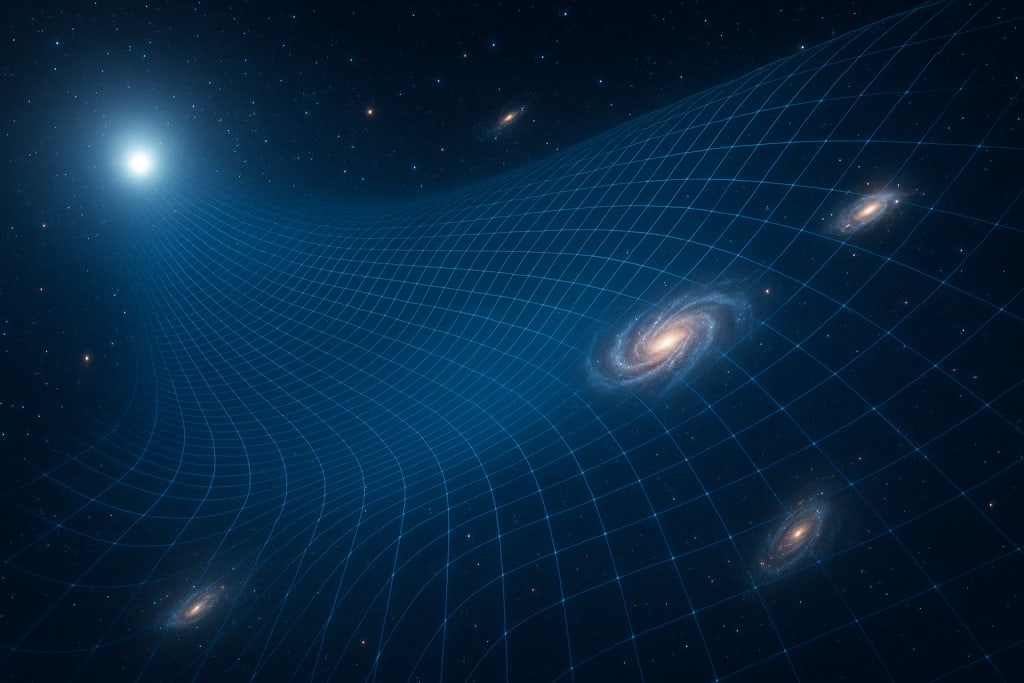
A wormhole, technically called an Einstein–Rosen bridge, is a hypothetical structure that links two separate points in spacetime. Think of spacetime as a two-dimensional sheet. Normally, traveling from one point to another requires moving across the surface. A wormhole is like folding the sheet and creating a tunnel that allows instant passage between the points.
Origins in General Relativity
The concept of wormholes originates from Albert Einstein’s general theory of relativity, which describes gravity not as a force but as the curvature of spacetime caused by mass and energy. In 1935, Einstein and his colleague Nathan Rosen proposed solutions to the equations of general relativity that suggested the existence of "bridges" in spacetime—later called wormholes.
Types of Wormholes
Scientists categorize wormholes into several theoretical types:
1. Schwarzschild Wormholes
o Non-traversable, short-lived, and likely unstable.
o Collapse too quickly for anything to pass through.
2. Traversable Wormholes
o Proposed by Kip Thorne in the 1980s.
o Could allow safe passage for matter and information.
o Require exotic matter with negative energy to remain open.
3. Lorentzian Wormholes
o Based on Lorentzian geometry in relativity.
o Can connect different points in space and potentially time.
4. Quantum Wormholes
o Tiny wormholes at quantum scales.
o Could exist briefly due to quantum fluctuations and might influence fundamental physics.
________________________________________
2. Could Wormholes Form Naturally?
The idea that wormholes could exist naturally is a topic of intense theoretical research. If wormholes are solutions to Einstein’s equations, it is reasonable to ask whether the universe might produce them without human intervention.
A. Primordial Wormholes
Physicists hypothesize that wormholes could have formed shortly after the Big Bang. In the extreme conditions of the early universe:
• High energy densities and rapid expansion could create quantum fluctuations that generate tiny wormholes.
• These primordial wormholes might have been microscopic, possibly growing in size as the universe expanded.
• They could exist today as relics of the early universe, hidden and undetectable at cosmic scales.
B. Wormholes in Exotic Astrophysical Objects
Some scientists suggest that certain extreme astrophysical phenomena could naturally harbor wormholes:
• Neutron stars: These ultra-dense objects warp spacetime intensely and might, in theory, support microscopic wormholes.
• Black holes: Some theories propose that what we perceive as black holes could actually be entrances to wormholes connecting distant regions of spacetime.
• Cosmic strings: Hypothetical high-energy defects in spacetime could create conditions suitable for wormhole formation.
________________________________________
3. The Physics Behind Natural Wormholes
For a wormhole to remain open, it must resist the immense gravitational forces that would normally collapse it. This is where the concept of exotic matter becomes crucial.
Exotic Matter and Negative Energy
Exotic matter has negative energy density and unusual gravitational properties:
• Unlike normal matter, exotic matter creates repulsive gravity, counteracting the natural tendency of a wormhole to collapse.
• In theory, even a tiny amount of negative energy could stabilize a microscopic wormhole.
• Quantum effects, such as the Casimir effect, show that negative energy can exist in small quantities under laboratory conditions.
Challenges in Natural Formation
While exotic matter might theoretically exist in nature:
• We have no evidence of large-scale concentrations sufficient to stabilize macroscopic wormholes.
• Quantum fluctuations could create wormholes, but they might collapse almost instantly.
• Gravitational interactions with surrounding matter could destabilize naturally occurring wormholes over time.
________________________________________
4. Wormholes and Time Travel
One of the most exciting implications of natural wormholes is the possibility of time travel. According to relativity:
• If one mouth of a wormhole moves at near-light speed or is subjected to strong gravity, time dilation occurs.
• A traveler entering the moving mouth could emerge in the past relative to the stationary mouth.
• This opens the door to backward time travel, though it introduces paradoxes such as the grandfather paradox.
While time travel via wormholes remains theoretical, it highlights the profound implications of their potential existence in nature.
________________________________________
5. Observational Signatures of Natural Wormholes
Detecting wormholes is extremely challenging. However, scientists have proposed possible observational indicators:
A. Gravitational Lensing Anomalies
• Wormholes can bend light like a massive object but with unusual patterns.
• A natural wormhole could cause multiple images of a distant star or galaxy in ways inconsistent with normal gravitational lensing.
B. High-Energy Radiation
• Traversable wormholes might produce bursts of high-energy radiation as matter interacts with exotic spacetime regions.
• Unexplained gamma-ray bursts or X-ray anomalies could, in principle, hint at wormhole activity.
C. Supermassive Black Hole Alternatives
• Some researchers speculate that certain supermassive black holes might actually be wormholes connecting distant regions of the universe.
• Observing matter falling into such structures could reveal deviations from typical black hole behavior.
D. Gravitational Waves
• Collisions or oscillations involving wormholes might produce distinctive gravitational wave signatures.
• Advanced detectors like LIGO and VIRGO could, in the future, help identify these signals.
________________________________________
6. Wormholes in Modern Physics
Wormholes are not just science fiction—they are studied in mainstream physics for their deep implications:
A. General Relativity
• Wormholes are exact solutions to Einstein’s field equations.
• They demonstrate the extreme flexibility of spacetime.
B. Quantum Gravity
• Wormholes could link quantum phenomena across vast distances.
• They are essential in some theories exploring the unification of quantum mechanics and general relativity.
C. Multiverse Theories
• Some models suggest wormholes could connect parallel universes.
• This could explain the apparent fine-tuning of the physical constants in our universe.
________________________________________
7. Challenges to Natural Wormholes
Even if wormholes exist naturally, several challenges remain:
1. Stability
o Without exotic matter, wormholes collapse instantly.
2. Size
o Primordial or quantum wormholes might be microscopic, too small for human or even photon-scale traversal.
3. Detection
o No direct observational evidence exists.
o Natural wormholes might be indistinguishable from black holes or other cosmic phenomena.
4. Energy Requirements
o Traversable wormholes would require tremendous energy to stabilize.
________________________________________
8. The Philosophical and Scientific Implications
The natural existence of wormholes could revolutionize our understanding of the universe:
• Spacetime Topology: Wormholes suggest spacetime is not simply connected, with hidden shortcuts.
• Interstellar Travel: If traversable wormholes exist, they could theoretically allow near-instant travel across galaxies.
• Time Travel and Causality: Natural wormholes could permit backward time travel, raising questions about cause and effect.
• Fundamental Physics: Studying wormholes may reveal insights into quantum gravity, dark matter, and dark energy.
________________________________________
9. Wormholes in Popular Culture
While scientific, wormholes have also inspired countless works of fiction:
• Interstellar (2014): Realistically depicts a wormhole near Saturn as a gateway to another galaxy.
• Stargate Series: Shows stable wormholes connecting planets for interstellar travel.
• Doctor Who: Uses wormholes as time-travel portals.
• Contact (1997): Explores wormholes as a means of instantaneous cosmic travel.
These portrayals, while exaggerated, often draw on the underlying physics of Einstein–Rosen bridges and relativity.
________________________________________
10. Future Research and Possibilities
While natural wormholes remain hypothetical, scientists continue exploring them:
1. Theoretical Simulations
o Supercomputers model the formation, stability, and behavior of wormholes under realistic conditions.
2. Quantum Experiments
o Studies of quantum fluctuations and Casimir effects may shed light on exotic matter and tiny wormholes.
3. Astrophysical Observations
o Gravitational lensing, high-energy bursts, and gravitational wave signatures are being investigated for potential wormhole evidence.
4. Cosmology
o Primordial wormholes may have influenced galaxy formation or the distribution of matter in the universe.
________________________________________
Conclusion
Could wormholes exist naturally in the universe? The answer, according to modern physics, is possibly—but unproven. General relativity allows their existence, quantum mechanics hints at tiny primordial wormholes, and theoretical models suggest that exotic astrophysical phenomena could support them.
If natural wormholes do exist, they may provide insights into the fundamental nature of spacetime, connect distant regions of the cosmos, and even enable forms of travel that currently seem impossible. While we have yet to detect one, ongoing research in astrophysics, quantum mechanics, and cosmology continues to push the boundaries of what is conceivable.
Wormholes remain one of the most tantalizing mysteries of the universe, bridging the gap between science fiction and cutting-edge science. As our observational tools and theoretical models improve, we may one day discover whether these cosmic gateways are a reality or remain an elegant, untested solution in Einstein’s equations.
About the Creator
Keep reading
More stories from shahkar jalal and writers in Education and other communities.
Wormholes: Gateways Through Spacetime or Just Science Fiction?
1. What Is a Wormhole? A wormhole, sometimes called an Einstein–Rosen bridge, is a hypothetical tunnel-like structure connecting two separate points in spacetime. Imagine folding a piece of paper and punching a hole through it—the hole allows you to move from one side to the other instantaneously, bypassing the distance across the paper. Wormholes are similar in concept, but instead of paper, they exist in the fabric of spacetime itself.
By shahkar jalalabout a month ago in Education
Creating a Calm and Confident Path Toward Retirement
Retirement planning often feels intimidating, especially when people imagine complex calculations and uncertain outcomes. However, when you approach the process with clarity and patience, it becomes far more manageable. Instead of focusing on stress, thoughtful planning helps you feel confident about the future you are building.
By Michael Petruska3 days ago in Education
The Night of Mi‘rāj: A Journey Beyond Time, Space, and Human Imagination
Mi‘rāj — A Night That Reshaped Human Understanding Among all the extraordinary events recorded in Islamic tradition, Mi‘rāj stands as one of the most profound. It is not merely a journey; it is a moment when the boundaries of time, space, and perception were transcended by the Prophet Muhammad ﷺ through the will of God.
By Muhammad Islam khan swati3 days ago in Education
Miss Persephone's Manual to a Seemingly Ordinary Life
Miss Persephone was found at the dining table, her blue eyes swollen, her tears arriving and retreating like the tides of the ocean. Earlier that day, her family had visited her in the retirement home where she had lived for eight years. It was her eightieth birthday.
By Imola Tótha day ago in Fiction


Comments
There are no comments for this story
Be the first to respond and start the conversation.