
What are Cyber Security Threats? All You Need to Know
Hackers take advantage of failures in fundamentals. When a proper Cyber Security system is not in place in an organization or at home, it becomes an easy target for cyber attackers.
What are Cyber Security Threats?
The term, ‘cyber’, in the 1950s used to refer to cybernetics, which involves the science of understanding the control and movement of machines and animals. Later on, it was used to refer to something computerized. With the start of the 90s, ‘cyberspace’ became a popular term that referred to a physical space that was believed to exist behind the electronic activities of computing devices. It was coined to set the online world as a distinct space. Nowadays, everyone likes to think of it as the global network of interdependent IT infrastructures.
Interested to learn more about Cybersecurity threats?Join HKR Trainings!
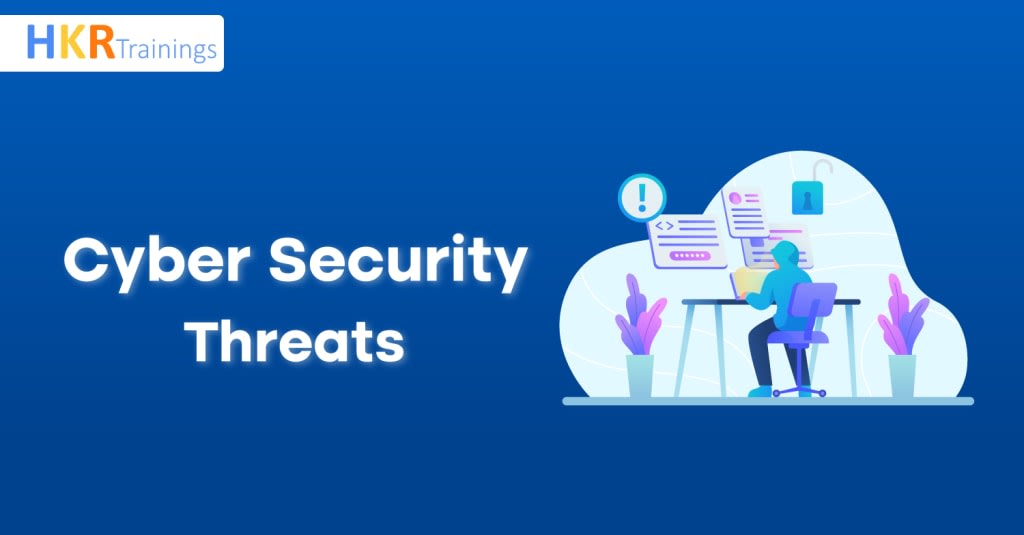
A Cyber Threat or a Cyber Security Threat is a malicious act performed by hackers to intentionally steal data or other assets, misuse them, or simply cause disruption in digital life in general. Cyber Threats can come from remote locations by unknown parties or even within an organization by trusted users. While many cyberattacks are intended to be nuisances, some are actually quite serious, and can even potentially harm human lives.
Types of Cyber Security Threats
Cyber threats can be classified into three broad categories of intent.
Disruption espionage
Corporate espionage (theft of patents)
State espionage
Every Cyber Threat falls into one of the above three categories. Some common cyber security threats are:
Malware
Malware is software that performs malicious actions on a device or network such as data corruption or taking over a system. Malware makes its way into the system through a malicious link or email that a user clicks. Once malware is in the system, it can block access to critical components of your network, gather sensitive data, and damage the system.
Spyware
Spyware is a form of malware that stays concealed on a device and transmits real-time data like bank details and passwords covertly to its host.
Phishing
When a hacker attempts to bait individuals into disclosing critical information such as personally identifiable information (PII), banking details, and passwords, it is known as phishing. An email can trick the email recipient into providing confidential information or downloading malware into the system by clicking on a hyperlink in the email.
Distributed Denial-of-Service (DDoS)
DDoS attacks are aimed to disrupt a computer network by overwhelming the servers and requests. The network gets flooded with superfluous requests from hundreds or thousands of IP addresses that overload the system and keep the legitimate requests from being fulfilled. It causes the target system, like a website, to crash from an overload of demands.
Ransomware
As the name suggests, ransomware is a type of malware that blocks access to a system or data until a ransom is paid. The attack involves data encryption on the target system that renders all the files inaccessible and demands a monetary ransom to give back access to the owner again. These attacks can be low-level nuisances or even have damaging consequences.
Zero-day exploits
A zero-day exploit is a cyber attack that happens the same day a flaw occurs in software, hardware, or firmware. Because the software flaw is recent, it is hard to put up a protection system in place immediately.
Advanced persistent threats (APTs)
An advanced persistent threat refers to an unauthorized user gaining access to a system or network and remaining there without being detected for a long period of time.
Trojans
Named after the Trojan Horse of ancient Greek history, this type of malware or code initially acts as a legitimate standard application or file and tricks one into loading and executing the malware on their device. Once inside the host system, the trojan lets out the malicious code that has the potential to damage, steal data, or inflict some other harmful activity on a network.
Wiper attacks
A wiper attack is a type of malware that intends to wipe out the hard drive of the computer it infects. It involves wiping, overwriting, or removing data from the victim. These kinds of attacks are mainly destructive in nature and often do not involve a ransom. Sometimes, they are used to cover the tracks of separate data theft that is occurring. Wiper attacks aren’t covert for the most part as it is not meant to linger quietly in the background.
Intellectual property theft
Intellectual property theft is stealing or using someone else’s intellectual property without permission.
Man-in-the-middle attack (MITM attack)
A MITM attack is when an attacker inserts himself in the middle of a communication between two parties like a user and an application and attempts to steal information. Attackers can eavesdrop or impersonate one of the parties, making it appear as if a normal exchange of information is underway.
Drive-by downloads
A drive-by download attack is a download that happens without a person’s knowledge, often installing a malicious program like spyware, malware, or virus. The download can happen in two ways:
Downloads that happened after the authorization given by a user but without understanding the consequences, such as downloads that install an unknown or counterfeit executable program
Downloads that happens without the knowledge of the person, like a computer virus, spyware, malware, or crimeware
Malvertising
Malvertising, otherwise referred to as malware advertising, is the online advertisements that spread malware and compromise systems. Generally, this happens through the injection of malicious code into ads.
Rogue Security Software
Rogue security software is a malware and internet fraud that is disguised as real software and tricks users into believing that their computer has a virus. It convinces the users to pay for a fake malware removal tool that instead installs malware on their computer.
Natural Disasters
Sometimes, natural disasters can disrupt the data centre that software is housed in.
Sources of Cyber Threats
Cyber threats can arise from a variety of sources. To effectively protect against cyberattacks, it’s essential to understand threat actors and their intentions. Following are some of the sources of Cyber threats:
Hackers
Hackers use various tactics and techniques to exploit vulnerabilities and attempt security breaches in a computer system or network. They are mainly driven by personal gain, financial gain, political activism, and sometimes, even revenge and stalking. Hackers are capable of developing new threats for the thrill of the challenge or for the bragging rights they can have in the hacker community.
Nation-states
Cyber attacks by nation-states devote a surprising amount of time and resources to gain an upper hand in favor of national interests, gathering intelligence, and espionage, theft, and disruption for military strength. Attacks against software supply chains and attempts to obtain IP data on vaccines just demonstrate the lengths to which they go to achieve their strategic goals. A very recent study sponsored by HP Inc. found that some governments use tactics used by organized criminals in cyberspace.
Criminal Groups
Criminal groups mainly intend to infiltrate systems or networks for the sake of financial gain. They resort to phishing, spyware, spam, and malware to various thefts, frauds, and extortions.
Terrorist Groups
Terrorists seek to threaten national security, disrupt the economy, compromise military equipment, or cause mass casualties by destroying, infiltrating, or exploiting critical infrastructure through cyber attacks.
About the Creator
Keep reading
More stories from srikanthbollu and writers in Education and other communities.
ServiceNow CMDB Tutorial | Concepts of CMDB in ServiceNow
What is CMDB in ServiceNow ? A configuration management database (CMDB) is a database that contains all relevant information about the hardware, IP Components and software components etc. used in an organization's IT services and it also contains the relationships between those components.
By srikanthbollu3 years ago in Education
What Is Polarization of Light?
Understanding Light as a Wave To understand polarization, we must first understand light as a wave. Light is an electromagnetic wave, meaning it consists of oscillating electric and magnetic fields that travel through space. These oscillations occur perpendicular to the direction the light is moving.
By shahkar jalal3 days ago in Education
Parts of my Library Planner
This one is a long one, but I hope it helps some librarians (or anyone). Once you’ve purchased your planner materials, you need something to go inside it. I honestly feel that what goes in your planner is personal and needs to be tailored to what you’ll use. While you can find many teacher planners, when I searched for school librarian planners, I found only four. Although one is only 12.50, you would have to print and assemble it yourself. A second one is almost thirty dollars and also has to be printed and assembled yourself. A third is mass produced through Amazon and doesn’t have everything I would want. Finally there’s the Demco planner. While I agree that it looks like a fantastic purchase, I just cannot justify spending that much money on a planner that I’m only going to use for one year. For all the librarians that do purchase it, I hope you enjoy it. I might invest in it one year just to see what the fuss is about. For now, I’ll continue to use the one I’ve been developing and customizing for the last two years.
By Reb Kreyling3 days ago in Education



Comments
There are no comments for this story
Be the first to respond and start the conversation.