
What Are Cosmic Jets and Why Are They So Powerful?
Space

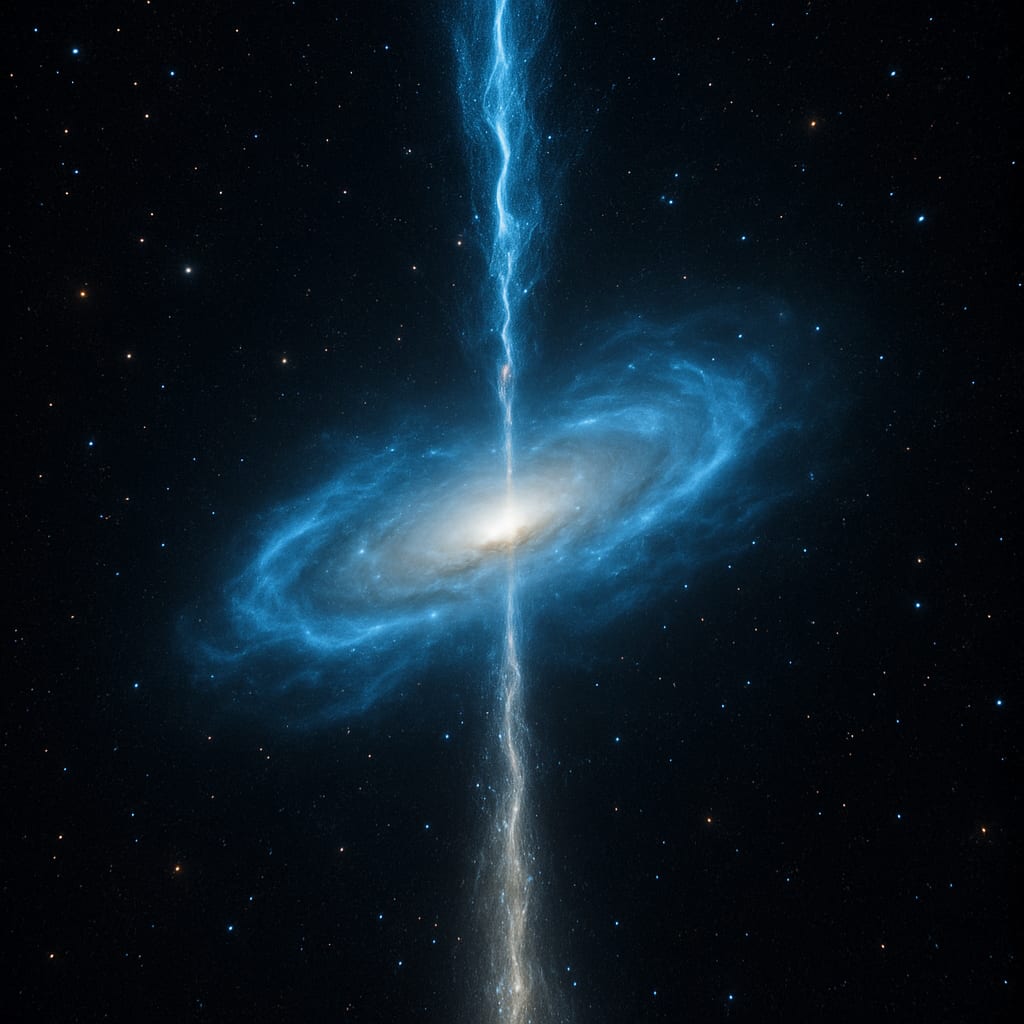
If you ever found yourself near a young star, a neutron star, or a black hole, you might witness one of the most awe-inspiring spectacles in the universe — a cosmic jet. These are enormous streams of matter and energy blasting into space at nearly the speed of light. They appear as brilliant beams shooting from the poles of celestial objects, sometimes stretching for thousands or even millions of light-years. But what exactly are these cosmic “fire hoses,” and why are they so incredibly powerful?
The Universe’s Giant Plasma Streams
The simplest way to picture a cosmic jet is to imagine a gigantic fire hose spraying out superheated plasma instead of water. But unlike an ordinary spray, these jets are narrow, focused, and unimaginably energetic. They carry charged particles, often traveling at relativistic speeds — that is, speeds close to that of light itself.
What’s fascinating is that jets appear in different cosmic environments and at very different scales:
- Around young stars (protostars), jets form as a byproduct of stellar birth.
- From neutron stars and pulsars, where intense gravity and magnetic fields accelerate particles outward.
- Most spectacularly, from black holes, including the supermassive black holes at the centers of galaxies, where jets can extend across intergalactic space for millions of light-years.
The Science Behind Jet Formation
The key to understanding cosmic jets lies in the accretion disk — the swirling ring of matter orbiting a compact object. Whether the central engine is a forming star, a collapsed stellar remnant, or a black hole, the process is surprisingly similar.
Matter falls inward. Gas, dust, and other material spiral toward the central object under the pull of gravity.
Energy is released. As this material compresses and heats up, it releases tremendous amounts of radiation.
Magnetic fields take control. Intense magnetic fields channel part of this material away from the disk and launch it outward along the object’s rotational axis.
The result? Instead of all the matter being swallowed by the central object, some of it escapes in these narrow, focused beams. In the case of black holes, the escaping particles are accelerated so violently that the jets shine across vast cosmic distances.
Why Are They So Powerful?
The power of cosmic jets can be explained by three main factors:
- Gravitational Energy
When matter falls toward a dense object like a neutron star or black hole, it releases an enormous amount of energy. Pound for pound, accretion is far more efficient than nuclear fusion inside stars.
- Magnetic Acceleration
The object’s magnetic fields act like cosmic railguns, flinging particles outward at tremendous speeds.
- Sheer Scale
Jets from black holes can dwarf entire galaxies. Some stretch for millions of light-years, meaning they’re larger than the Milky Way itself.
To put this into perspective: if our Solar System were caught inside such a jet, the stream would extend far, far beyond Pluto — engulfing the Sun and planets like a speck of dust in a cosmic lighthouse beam.
Cosmic Beacons and Their Role in the Universe
Cosmic jets aren’t just visually stunning; they also play an important role in shaping the universe. Scientists use them as natural laboratories to study physics under extreme conditions — conditions impossible to recreate on Earth.
They help us understand how magnetic fields and plasma dynamics work on cosmic scales.
They give clues about star and galaxy formation, since jets from young stars influence the surrounding gas clouds.
On a galactic scale, jets from supermassive black holes can regulate star formation by heating interstellar gas, preventing it from collapsing to form new stars.
In a sense, cosmic jets act like feedback mechanisms. They don’t just release energy; they shape the destiny of galaxies themselves.
A Show of Power and Beauty
Astronomers observing jets often describe them as among the most beautiful structures in the cosmos. Imagine a galaxy tens of millions of light-years away. From its heart, a blazing stream of matter shoots outward, glowing in X-rays and radio waves. These structures are so bright that we can see them across intergalactic distances, turning them into cosmic beacons.
Jets also remind us of the incredible efficiency of nature’s engines. While our most advanced rockets struggle to escape Earth’s gravity, black holes and neutron stars launch matter at speeds that brush against the cosmic speed limit — the speed of light.
Conclusion
Cosmic jets are one of the universe’s most dramatic and powerful phenomena. Born in the turbulent environments of accretion disks and sculpted by magnetic forces, they channel unimaginable energy across distances that dwarf entire galaxies. Beyond their spectacle, they also serve as crucial tools for science, offering insights into the forces that shape stars, galaxies, and the universe itself.
Next time you see an image of a distant galaxy with glowing beams shooting from its center, remember: you’re looking at a natural engine so powerful that it makes our Sun seem small, and so vast that it stitches galaxies together with threads of light.
About the Creator
Keep reading
More stories from Holianyk Ihor and writers in Education and other communities.
The Mystery of “Dark” Galaxies Without Stars
When most of us picture a galaxy, we imagine vast spirals of radiant stars, glowing nebulae, and brilliant cores shining across unimaginable distances. Galaxies are often described as cosmic cities of light, each home to billions or even trillions of suns. But in recent decades, astronomers have stumbled upon a puzzling phenomenon that challenges this idea: so-called dark galaxies.
By Holianyk Ihor5 months ago in Education
Key Qualities to Look for in a Financial Advisor for Your Retirement Goals
Choosing a financial advisor is one of the most important decisions you will make as you prepare for retirement. The right advisor can help you create a strong financial plan, protect your savings, and guide you through complex decisions about investments, taxes, and income distribution. Since retirement planning involves long-term commitments, it is essential to work with someone who understands your goals and values. Knowing what to look for in a financial advisor ensures you choose a professional who can support your financial security for years to come.
By Keith D'Agostino3 days ago in Education



Comments
There are no comments for this story
Be the first to respond and start the conversation.