
The Mystery of “Dark” Galaxies Without Stars
Space

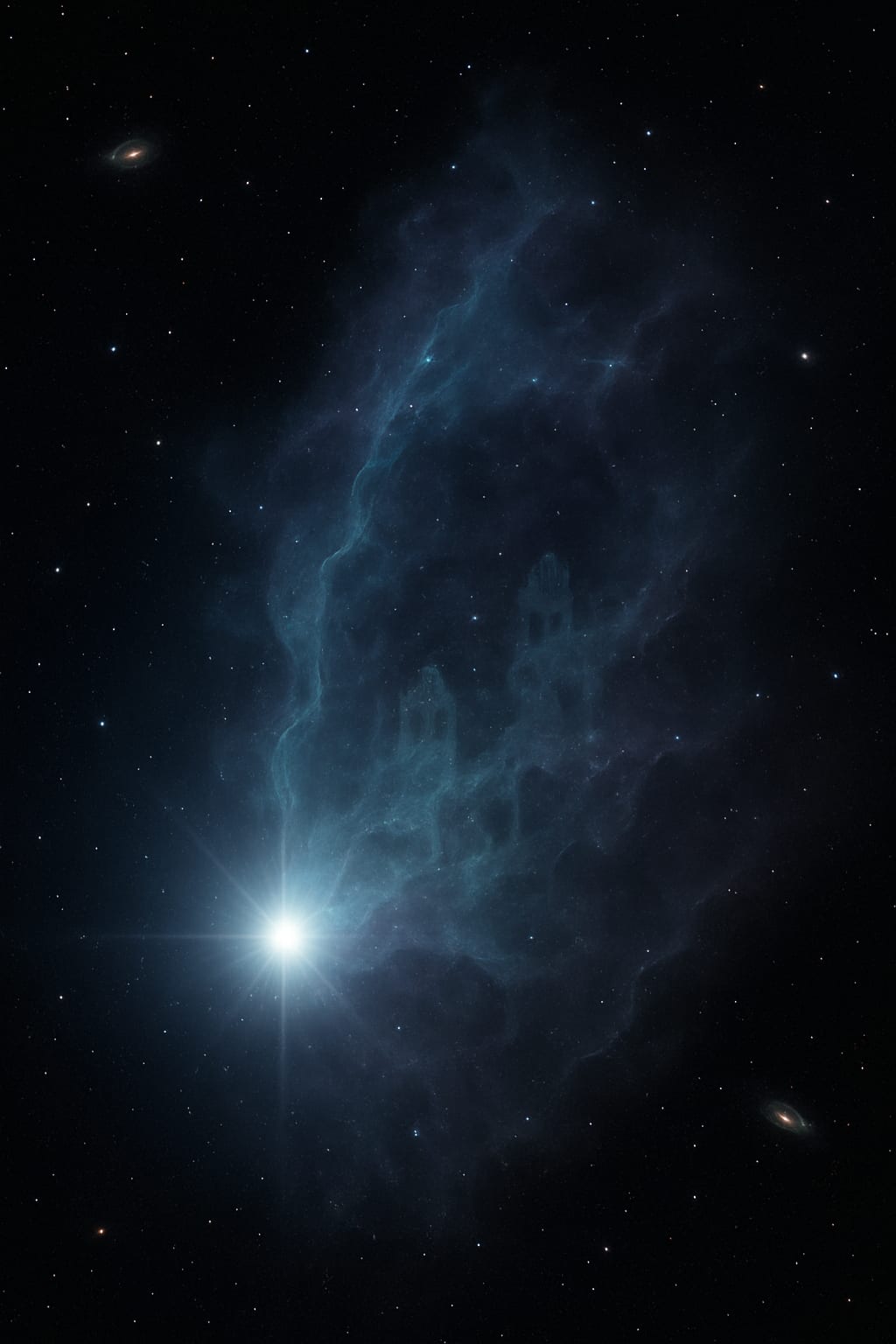
When most of us picture a galaxy, we imagine vast spirals of radiant stars, glowing nebulae, and brilliant cores shining across unimaginable distances. Galaxies are often described as cosmic cities of light, each home to billions or even trillions of suns. But in recent decades, astronomers have stumbled upon a puzzling phenomenon that challenges this idea: so-called dark galaxies.
These elusive structures contain little to no stars at all. They are almost completely invisible in ordinary light, drifting through the universe like ghost towns. And yet, despite their silence and obscurity, they may hold answers to some of the deepest questions about the origin of galaxies and the role of dark matter in shaping the cosmos.
What Are Dark Galaxies?
Ordinary galaxies form within vast halos of dark matter — the invisible substance that makes up most of the universe’s mass. Within these halos, gas cools, condenses, and eventually ignites in the form of stars. But for reasons we still don’t fully understand, this process fails in dark galaxies.
They contain gas and dark matter, but for the most part, they never “sparked” into star-forming regions. As a result, they don’t glow the way normal galaxies do. To telescopes sensitive only to visible light, they are essentially invisible.
Instead, astronomers must rely on indirect methods to detect them. One way is by observing the faint radio signals from cold hydrogen gas. Another is to notice their gravitational pull on nearby galaxies. In a sense, they are discovered not by their presence, but by the shadows they cast on the cosmos.
First Clues of Their Existence
Hints of dark galaxies first appeared in the late 20th century. Radio astronomers scanning the skies noticed mysterious hydrogen clouds with no visible stars associated with them. These “invisible companions” suggested that there might be entire galaxies lurking in the dark.
But real evidence came in the early 2010s thanks to powerful observatories like the Very Large Telescope (VLT) and the Hubble Space Telescope. Astronomers studying a bright quasar more than 11 billion light-years away discovered that its intense light illuminated nearby patches of gas. Much like shining a flashlight into a foggy night, the quasar revealed the faint glow of what appeared to be multiple dark galaxies.
For the first time, scientists weren’t just guessing — they were actually seeing these ghostly structures.
Why Didn’t They Form Stars?
This is one of the greatest unsolved puzzles in astronomy. Why would a galaxy full of gas fail to form stars? Researchers have suggested several possibilities:
- The harsh radiation of the early universe. In the young cosmos, ultraviolet light from the first galaxies and quasars may have heated up the gas, preventing it from cooling enough to collapse into stars.
- Low mass. Smaller galaxies may simply lack the gravitational pull necessary to compress gas clouds to the density needed for star birth.
- Cosmic theft. Nearby, more massive galaxies could strip away gas from their smaller companions, leaving them “starved” before they had a chance to light up.
It’s possible that all three of these processes worked together, creating a population of galaxies that were doomed to remain forever dark.
Why Do Dark Galaxies Matter?
It might be tempting to dismiss these galaxies as cosmic failures — structures that never “switched on.” But they may actually be key to understanding how the universe evolved.
Testing dark matter theories. If a galaxy can hold large amounts of gas without any stars, it must be dark matter’s gravity keeping it together. This gives astronomers a natural laboratory to study how dark matter works.
Clues to the early universe. Dark galaxies may represent “building blocks” of larger galaxies. Understanding them could reveal how the Milky Way and other galaxies like it grew over billions of years.
The missing galaxies problem. Current models predict there should be far more small galaxies in the universe than we actually observe. Dark galaxies may be the missing population — not gone, just hidden from view.
The Ghosts of the Cosmos
Even today, dark galaxies remain incredibly difficult to study. Instruments like ALMA (the Atacama Large Millimeter/submillimeter Array) and the James Webb Space Telescope are beginning to give us better glimpses into these shadowy structures. But we are still at the beginning of solving their mystery.
It’s a strange thought: as we look up at the night sky, filled with dazzling stars, there may be countless invisible galaxies drifting silently among them. They have no suns, no glittering clusters, no brilliant spirals — just gas and darkness, guided by the hidden hand of dark matter.
Yet it may be these very invisible galaxies that hold the secrets of why the cosmos looks the way it does today. Sometimes, the things we cannot see are the ones that matter the most.
About the Creator
Keep reading
More stories from Holianyk Ihor and writers in Education and other communities.
Why Scientists Are Searching for Neutrino Oscillations
One of the most fascinating puzzles in modern science is hidden in particles so small and elusive that billions of them pass through your body every second without you even noticing. These ghostly particles are called neutrinos, and they may hold the key to some of the deepest secrets of the cosmos. At the heart of this mystery is a strange phenomenon known as neutrino oscillations.
By Holianyk Ihor5 months ago in Education
Is Pharmacy Tech a Good Career Choice for 2026?
Given the recent shifts in the market and AI automation, people are now well aware that economic shakeups can drastically hinder their income sources. This is causing a lot of people to switch careers, and a majority of people are targeting healthcare roles. However, not all allied healthcare roles are created equal. Also, you can aim to become a medical assistant, but if you do not want to deal with patients, the ideal role for you is that of a Pharmacy Technician.
By Meaghan Howe3 days ago in Education




Comments
There are no comments for this story
Be the first to respond and start the conversation.