
We Turned a Devastating School Closure Into an Empowering Celebration
"How a grieving school community found strength, joy, and unity through music, activism, and resilience."

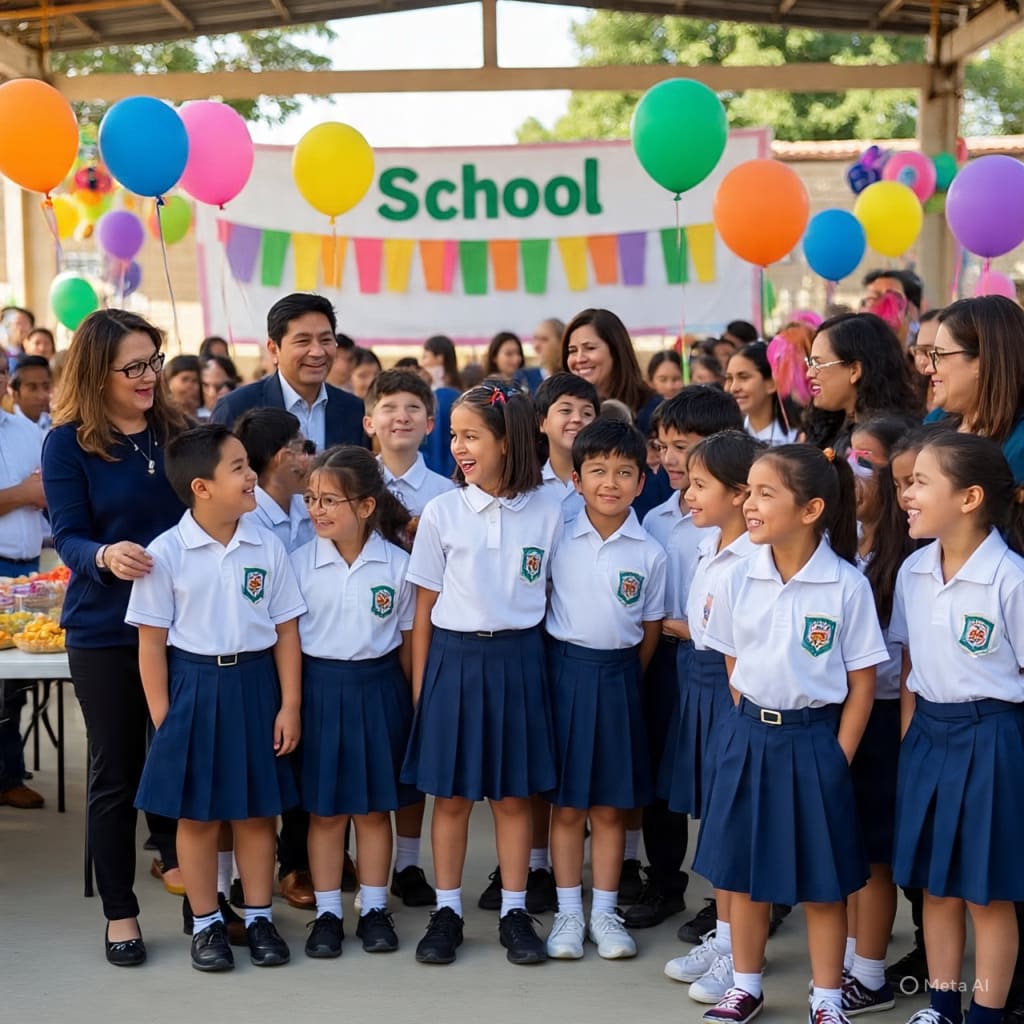
When my oldest child crossed the finish line at her school's 35th annual Wildcat holiday race, she and everyone else running down the track or cheering on the field had no idea she would be the last girl to bring home that First Place Trophy. Next winter, her schoolmates will no longer race each other in this beloved holiday tradition because their school, by then, will cease to exist.
Three days after the race, our school community was blindsided by the superintendent of schools' unilateral decision, with no prior attempt to communicate or engage with us, let alone seek our input, to shut down our children's educational home at the end of the school year.
A group of us parents physically reeled from the sting of a figurative slap to the face.
Every school district has its own version of the Wildcat: the under-served, under-invested, under-performing Title I school that is home to the largest number of disadvantaged scholars. It is often a community anchor that welcomes all, regardless of the complexity of a child's academic or behavioral needs, despite the water damages, HVAC malfunctions, lead pipes, missing tiles, and rodent troubles the building suffers.
After years of parental advocacy, we are outraged that district administrators responded with this "final solution," instead of investing in a more robust manner to equalize learning and teaching conditions. Our children are frustrated that the adults in charge, including elected officials, refused to fix their "home-away-from-home" when they walked in the hallways, but now use deteriorating infrastructure to justify repurposing their school building and uprooting them from support networks.
Families are worried about next year, when we have to join unfamiliar school communities where not all learning needs are viewed as equal. Kids are not trees, even if our school board is partial to such an analogy.
Will our "replanted" English learners and children with disabilities receive adequate services? Will our "repotted" low-income and unhoused scholars feel they belong when most future classmates do not share their plight?
Following his sudden announcement, Mr. Superintendent scheduled a belated evening meeting in our school auditorium to "justify" his unilateral decision, using a slide deck populated with charts and graphs of inequity data that our team of advocates had handed him earlier, gift-wrapped with a ribbon on top.
His misappropriation of our research aside, we were irritated that in a well-resourced district boasting a multilingual support team, notices coming out of his office about the community meeting were issued only via email in English.
Our team of "agitators" worked around the clock to design and print a poster to better publicize the meeting in our school's top 5 languages. I brushed up my Japanese to first translate the poster, then chat up kodomo-tachi and their parents during morning drop-off outside the school.
Our district has a dubious reputation for catering dinner-time meetings. Cheese pizza is often the only option, which families with diverse dietary restrictions are prohibited from consuming. I reached out to the head of the Family Engagement Office to request an "upgrade." On meeting day, the smell of fresh salad, chicken and vegetarian wraps permeated our cafeteria for a change.
Meanwhile, Wildcat students were covering a unit on social change and change-makers in their curriculum. Inspired by such examples as Malala Yousafzai, Greta Thunberg, Rosa Parks, Mary McLeod Bethune, Eleanor Roosevelt, and Audrey Faye Hendricks, my oldest collaborated with her classmates to draft and circulate a petition to fight the closure, collecting over 200 signatures from students and staff.
My children and some friends read their petition at the community meeting, then presented the document, stapled together with pages of signatures, to Mr. Superintendent. An assistant superintendent later told me in private that she teared up watching and listening to the kids' plea.
Since Mr. Superintendent had already lined up his school board votes in behind-closed-doors negotiations, he gave our community exactly two weeks to respond before the board's formal vote. It was an extremely short window, and our team soon concluded that it would be futile to fight the closure per se, but important to rally the community at large to prioritize the children in their imminent displacement.
We mobilized personal networks, the teachers' union, and community partners, many of whom have collaborated with Wildcat for over 30 years, to join us at the upcoming school board meeting. Scores of supporters showed up to make public comments and have our backs, overcrowding the meeting venue. The board chair halved our allotted speaking time, yet it still took well over two hours for every commenter to be heard.
My oldest practiced real-life democracy by signing up to speak at her very first civic meeting in front of a huge audience. Her impassioned, logically woven arguments and her telling the board members they should be ashamed of themselves for having ignored Wildcat for so long were picked up by a major regional newspaper and appeared in one of their articles the next day.
As expected, the school board voted unanimously to approve the closure. Our team regrouped to focus our effort on ensuring every Wildcat student "comes out ahead" as the district promises, in exchange for this massive disruption to their educational career.
In subsequent weeks, as a parent rep on our school council, I attended multiple school council meetings at various prospective receiving schools to discuss the "transition," asked hard questions, toured school campuses, observed classes, and personally interviewed dozens of current and past parents to "dig up dirt."
During one of the school tours, I was even roped in to interpret for one of our Spanish-speaking-only families because that well-funded, national-blue-ribbon-winning school does not have appropriate staff to serve this particular demographic.
Our due diligence convinced us that in addition to their paternalistic "grade cohort transfer" plan devised on the fly, the district must also accommodate families who find the designated receiving schools unfeasible. The central office thus isolated these families, mine included, assigned each of us a number, then ran a "special reassignment lottery."
While a majority of the children got their preferred school, a waitlist had to be created, pitting friends against each other, for seats at a fellow under-performing Title I school. District administration puzzled over the outcome, dismissing the reality that sometimes families value school culture more than test scores or blue-ribbon status.
To model transparency as we navigated this heartbreaking situation, our team co-authored a series of biweekly caregiver newsletters, available through our school's Friends Of website or email subscription. We kept the community apprised of developments by sharing first-hand experiences and organic questions, as we dissected the district's opaque, verbose, top-down communications full of jargon, legalese, and run-on sentences.
We debated and disagreed among ourselves, arguing over the angles and facets of different issues, over the most responsible use of our platform and collective voice. We wrote with clarity, professionalism, and the occasional humor to safeguard our published product from morphing into anyone's personal soapbox.
We were heartened by the outpouring of reader responses, especially following the final issue of our newsletter. Parents from other schools called us "grassroots organizing at its best," "a model for positive activism," claiming that we "opened many eyes in the district to the reality of inequity," "reinvented the standard for caregiver advocacy," and "galvanized many to join the fight in addressing systemic inequity."
We had accidentally set a "precedent" for meaningful community engagement in our school district.
To end things on an even higher note, I connected with the outreach team of a renowned local university orchestra and invited them to perform a special Send-Off Concert for the kids. In response to student requests, these talented young musicians curated a captivating repertoire, spanning from familiar favorites like Disney's "Let It Go," to the classic graduation theme "Pomp and Circumstance March №1 in D."
The biggest hit and absolute crowd favorite, stunning the adults in the audience, was the orchestra's rendition of the viral Russian meme "Sigma Boy." The children clapped and sang along to the music at the top of their lungs, even demanding an encore. Our community appreciated this memorable experience, as well as the joy and uplift it brought to the children in a challenging time.
Afterward, the university newspaper quoted me sharing my belief that music is the greatest equalizer in children's education. Only the fun is not yet over. As the school's "unofficial" pianist, I am accompanying the children's final concert in a few weeks. Our program will feature a Congolese folk song with conga drums, a couple of Caribbean calypsos, a gospel-style medley about joy, and the school anthem "The Wildcat Way," among others.
Lyrics in the gospel medley paraphrase and reaffirm a key message from Ecclesiastes 5:18-20: No adversity can take away the joy found deep in our hearts. Somewhere down the road, when Wildcat kids think back to their final weeks at the school, they will fondly recall these amazing celebrations with music, produced by themselves and by the big brothers and big sisters who came to cheer them on.
Wildcat's story is not unique. It is taking place and will continue to unfold in other school districts, especially in the aftermath of the current administration's overhaul of public education.
Without confronting root causes, expedient school closure to eliminate any civil rights violations that might have occurred only risks exacerbating underlying inequities. Leaving systemic inequities intact guarantees that the system continues to serve only some students and, sooner or later, creates another Wildcat.
All children deserve an education that can prepare them to one day also run for and serve on a school board, to make our public schools more equitable than what they have found. Our students are lucky to carry with them the Wildcat spirit centering empathy, equity, and self-efficacy as they move forward.
For all of us concerned with the future of public education in this country, never doubt the power of a small group of thoughtful, committed individuals to bring about change. According to anthropologist Margaret Mead, it is the only thing that ever has.
About the Creator
Keep reading
More stories from Shayan Ali and writers in Education and other communities.
Beyond the Transcript: What Extracurriculars and Essays Reveal That Grades Cannot
Colleges today look far beyond GPAs and test scores to understand who applicants truly are. While academic metrics indicate preparedness for coursework, they fail to capture personality, resilience, passion, and potential contributions to campus life. This is why essays, extracurricular activities, and other non-academic elements of an application hold significant power. They offer admissions officers a fuller, richer, more human version of the student—one that no number can represent.
By Carmen Reida day ago in Education


Comments
There are no comments for this story
Be the first to respond and start the conversation.