
UPSC Previous Year Question Papers
IAS Previous Year Paper

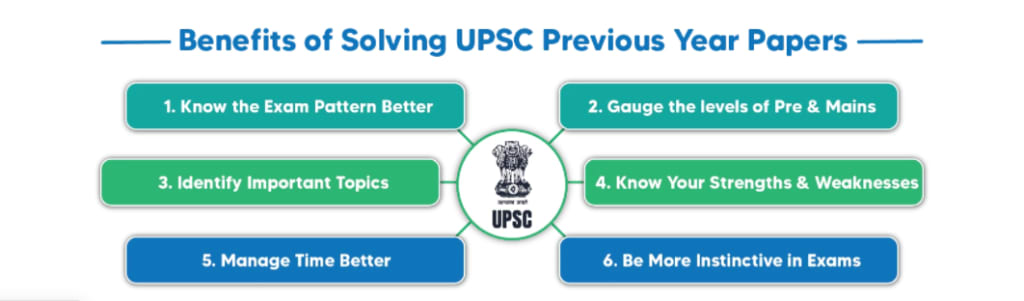
Knowing that you might have already gotten an idea about how important the UPSC (IAS) previous year’s question papers are to a sincere aspirant, I shall not be dwelling on the topic much.
The best way to utilize previous year’s question papers is to use them to access your preparation. It is also important to analyse your performance in those papers by comparing your marks to the cut off of the respective years.
With that done, you’ll be able to gauge your strengths and weaknesses.
Then, according to those, you can focus your efforts to shore up the weak areas while holding on to your strengths.
Benefits of Solving Previous Year Papers
In this section I have talked about the various ways, solving UPSC previous year paper will benefit you.
1. Know the Exam Pattern Better
The act of solving the various UPSC (IAS) prelims and mains previous year question papers will render you a superior understanding of the exam pattern and the kind of questions that are normally asked in it.
This understanding of the exam pattern and the various sections lying in it will, in turn, help you solve questions more quickly in the actual exam.
This is because, with such a photographic understanding of the exam sections and patterns, you won’t have to waste time figuring what goes where, and you’d directly be able to go over to the section of the paper you are most comfortable in.
2. Gauge the Levels of Prelims & Mains
The more you solve previous year papers, the more you’ll be able to familiarise yourself with the massive jump in the difficulty levels from the UPSC Prelims to the Mains papers, and subsequently prepare yourself for the same.
3. Identify Important Topics
Solving more Previous year papers would mean getting to identify the most commonly asked questions in the exams, and from them, the most important UPSC topics.
These are the topics that you’d then have to learn about in much more detail, considering that they are the ones most likely to be asked about in the upcoming IAS exam.
4. Know Your Strengths & Weaknesses
This is something that I have already talked about in the first point of this list i.e., getting to know more about your strengths and weaknesses by solving more and more past year papers.
By knowing your strengths and weaknesses better, you’d be able to subsequently focus on your weak points more, thus erasing them in the process, and also further hone your strong points.
That way you’d be able to achieve an equal level of mastery in all the topics. This is needed even more so, considering that the UPSC (IAS) exam papers have negative marking for every wrong answer, something that you absolutely cannot afford to do.
5. Manage Time Better
One of the reasons why the UPSC exams are so tough per se is because of the limited time and space that are provided to aspirants to fill in their answers.
This should give you all the more reason to try and solve more and more previous year question papers using the actual UPSC exam time limit.
Doing so will improve your time management skills during exams and help you save yourself from all the last-minute anxiety attacks that people normally get on not being able to finish their papers on time.
6. Be More Instinctive in Exams
More and more practice on previous year papers using the actual exam time limit will train you to be more instinctive and accurate while marking the right answers.
With that, I think I have said everything there is to know about the topic of UPSC (IAS) previous year question paper.
Read More: UPSC CSE
About the Creator
Anuj jindal
Anujjindal.in focuses on providing high quality comprehensive course for various Government & Academic Exams like RBI Grade B, SEBI Grade A, NABARD Grade A, UPSC CSE, NTA NET JRF etc.
Keep reading
More stories from writers in Education and other communities.
Elevating Your Financial Future Through Smarter Investment Choices
When you begin your journey toward financial independence, you must first build a strong, organized foundation. Although many people rush into investing without preparation, creating a clear plan ensures that your decisions align with your long-term goals. As you analyze your income, expenses, and savings, you gain a deeper understanding of your financial strengths and weaknesses. With this knowledge, you can design a structured approach that supports your investing habits and encourages consistent growth through wealth management.
By Millicent Prince5 days ago in Education
The Velvet Revolution Inside China’s $351 Billion Luxury Automotive Pivot (2025–2033)
In 2026, the streets of Shanghai's Jing'an District are no longer just a parade of traditional German engineering. While the silver three-pointed star and the blue-and-white roundel still hold prestige, they are now sharing the asphalt with a new breed of "Tech-Luxury" titans.
By Neeraj kumar5 days ago in Education



Comments
There are no comments for this story
Be the first to respond and start the conversation.