
Unlocking the Universe: How Astronomy Transforms Curiosity Into Knowledge
Every night, the universe opens its vast classroom above us. Stars shimmer like ancient lanterns, planets drift silently in their orbits, and galaxies swirl across unimaginable distances. For thousands of years, humans have looked up at this cosmic ocean with questions, dreams, and mysteries. Today, astronomy stands not only as a scientific discipline but also as a powerful educational tool capable of shaping how we learn, think, and imagine. Astronomy education bridges the gap between curiosity and scientific understanding, making it one of the most meaningful subjects for learners of all ages. It teaches us about the origins of the universe, the structure of galaxies, and the nature of space and time—but it also teaches us about ourselves and our place in the cosmos.

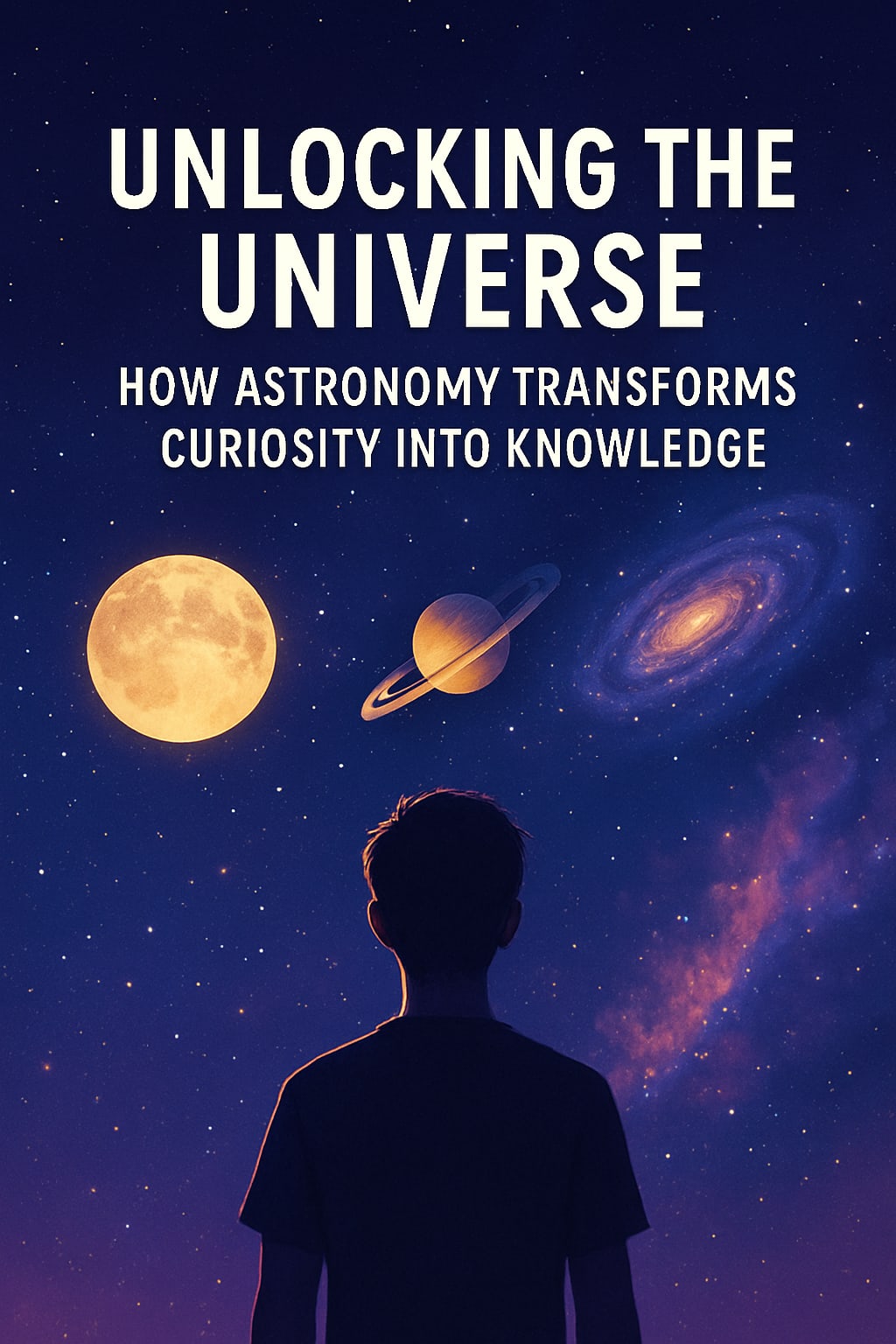
Why Astronomy Is Essential for Today’s Learners
1. A Natural Spark for Curiosity
Astronomy begins with a simple act: looking up.
Even a child seeing the Moon’s craters or Saturn’s rings for the first time feels a sense of wonder rarely matched by other subjects. This natural fascination is a powerful catalyst for learning. Unlike textbooks or equations alone, astronomy makes science feel alive. It transforms questions into adventures and imaginations into possibilities.
2. A Perfect Blend of Art and Science
Astronomy uniquely blends scientific investigation with visual beauty. Colorful nebulae, massive star clusters, and glowing galaxies make learning engaging and memorable. Students who struggle with traditional science often find astronomy more approachable because it relies heavily on storytelling, imagery, and exploration.
The universe itself becomes a canvas—one painted with physics, chemistry, mathematics, and time.
3. Strengthening STEM Foundations
Behind every cosmic image lies a world of science. Astronomy introduces students to:
Physics: gravity, light, motion, energy
Mathematics: orbits, distances, measurements
Chemistry: composition of stars and atmospheres
Engineering: spacecraft, telescopes, robotics
This combination makes astronomy a gateway into STEM fields, supporting future careers in robotics, aerospace, data science, and astrophysics.
The Universe as a Teacher
1. Learning from Stars
Stars are more than distant spheres of burning gas; they are storytellers of the universe. By studying them, students learn:
how elements are formed
how energy travels through space
how time shapes the universe
The lifecycle of a star—from its birth in a nebula to its explosive death as a supernova—teaches students about transformation, change, and the interconnectedness of all matter.
2. Exploring Planets and the Possibility of Life
With the discovery of more than 5,000 exoplanets, astronomy is entering a golden era. Some planets orbit their stars in perfect conditions where liquid water might exist. These worlds—known as “habitable zone planets”—push students to think about biology, chemistry, and the conditions required for life.
Astronomy education doesn’t only ask whether life exists elsewhere; it helps us appreciate the fragility of life here on Earth.
3. Understanding Earth Through the Cosmos
Ironically, to fully understand our own planet, we must look beyond it. Studying the Sun reveals patterns in Earth’s climate. Observing asteroids helps us understand planetary formation. Monitoring space weather protects satellites and power grids.
Astronomy shows that Earth is not separate from the universe—it is a small but precious part of it.
Astronomy Builds Skills for the Future
1. Data Literacy and Analytical Thinking
Modern astronomy relies heavily on interpreting large data sets from telescopes and satellites. Students learn to identify patterns, analyze results, and draw scientific conclusions—skills highly valuable in today’s technology-driven world.
2. Creativity and Imagination
While astronomy is scientific, it is also deeply imaginative. Topics like time travel, black holes, wormholes, and multiverses require creative thinking. Students learn that the universe is full of ideas beyond ordinary experience, encouraging them to think outside the box.
3. Global Perspective
Astronomy teaches one of the most important lessons of all:
We all share the same sky.
This simple truth promotes unity, environmental awareness, and a deeper sense of responsibility toward our planet.
How Anyone Can Begin Their Cosmic Journey
You don’t need a telescope or a degree to start exploring the universe. Here’s how beginners can jump in:
Use astronomy apps to identify stars and planets.
Follow space missions like Artemis, JWST, and Mars rovers.
Watch meteor showers and lunar eclipses.
Join online astronomy groups for discussions and tips.
Start with binoculars to observe craters on the Moon or the moons of Jupiter.
The sky is always open, no matter where you live.
Conclusion: A Universe Full of Lessons
Astronomy is more than science—it is a journey. It teaches us to question, to observe, and to wonder. It doesn’t ask us to memorize answers but encourages us to seek them. In a rapidly changing world, astronomy education helps build thinkers, innovators, and dreamers.
The universe is vast, mysterious, and breathtaking—and every time we look up, we take our first step into its endless classroom.
About the Creator
Keep reading
More stories from shahkar jalal and writers in Education and other communities.
Exoplanets and Habitability: Exploring New Worlds
What Are Exoplanets? Exoplanets, or extrasolar planets, are planets found outside our solar system. Although the first confirmed exoplanets were discovered in 1992, the field has expanded rapidly thanks to advanced telescopes and detection technologies. Today, astronomers have cataloged more than 5,000 confirmed exoplanets, ranging from small rocky worlds to massive gas giants.
By shahkar jalal2 months ago in Education
Best Laptop for Recording Music
If you’re serious about recording music, you already know this truth one slow laptop, one audio drop, and your creative flow is gone. Whether you’re tracking vocals, layering beats, or mixing a full song, your laptop can either power your creativity or completely kill it.
By Projectorsea7 days ago in Education
How Powerful Can AI Be? Understanding the Limits and Possibilities of Machine Intelligence
Shant Khayalian — Balian’s Deep Tech The Question of Power We live in a time of extraordinary change. Machines are writing our emails, designing proteins, driving cars, creating art, and even passing legal and medical exams. In just a few years, artificial intelligence has gone from an obscure branch of computer science to a central force shaping the world around us.
By Chant Khialian5 days ago in Education


Comments
There are no comments for this story
Be the first to respond and start the conversation.