
Unlearning Ableism as a Sign Language Student
Tips for language learners


Hey ASL Learners! I’m glad you’re learning to sign!
Learning a new language is always an exciting journey filled with challenges, victories, and sometimes unexpected lessons. As a sign language student, you’re finding that you’re not only learning a new way to communicate but also needing to unlearn some deeply ingrained societal biases.
Let me share with you what you need to do to unlearn ableism as a sign language student.
Inclusivity & Accessibility
One of the most important lessons to learn is the importance of inclusivity and accessibility.
You need to realize that communication is not one-size-fits-all and that it’s essential to accommodate different communication styles and preferences.
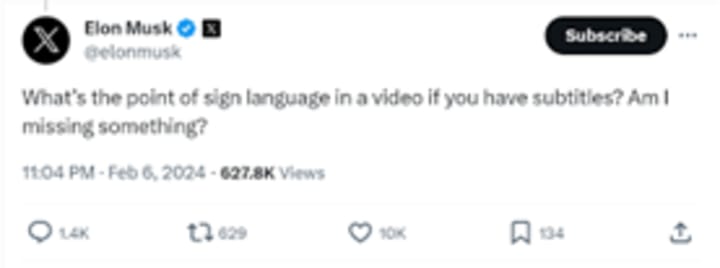
Challenge your thinking and advocate for access to information and spaces to be more Deaf-friendly. You may recall Elon Musk’s tweet going around.
Then there was Charlie Kirk's rant about banning interpreters on emergency news announcements.
As a student, you would know that ASL and English are two different languages, not all Deaf are fluent in English, and not all deaf know sign language.
You should call out ableism when you see it — but also don’t make it about you. Shine the spotlight on Deaf creators and teachers. In the same vein, you need to recognize your hearing privileges.
You as a hearing person are used to an aural-speech perspective of the world whereas the Deaf community is a visual-spatial perspective. Be aware of your comments when responding to Deaf people’s experiences.
Do not compare your life experiences with the Deaf person — you are comparing apples to oranges. Understanding this difference is crucial. It’s not just about spoken words vs. signing; it’s about an entirely different ways of perceiving and interacting with the world.
As an ASL teacher, I frequently ask the question “Why do you want to learn ASL” and the second most frequent response after “I need the grade for school”, is “I want to help the Deaf community”.
I try and discourage this line of thinking — the savior complex does not fly well in the Deaf community. Simply put, a savior complex is someone who has a strong urge to help others, but to an unhealthy degree. They feel a constant need to fix other’s problems, they’re overly empathetic and jump to “rescue” someone — even if it’s unwanted.
I can assure you the Deaf community does not need rescuing. and besides, you’ll make things worse and the spotlight is on you — not the original issue. “Look at me helping the Deaf”.
Unlearn this right now.
You should learn about the concept of Deaf gain — the idea that deafness is not just a deficit but also brings unique perspectives and experiences to the table. Such as heightened visual-spatial awareness and excellent visual communication — this can bring new perspectives to architecture, filmmaking, and education.
The main point is we are fine with being Deaf — we don’t need to be fixed, coddled, patronized, or pitied.
Diversity Not Disability
Along the same vein as the previous point — you need to frame deafness as a natural part of human variation, not a disability or a deficit.
A major part of Deaf Culture is that we are not “disabled” and it’s a language barrier, not a listening barrier. Some Deaf people are now telling hearing folks “The interpreter is here for you, not me as you do not know sign language”.
How’s that for a spin?
Celebrate the unique perspectives and contributions that Deaf individuals bring to the world.
Be Aware Of Your Own Signing Skills
Know your skills and what you are actually capable of. I know you’re excited to use your new ASL skills but I discourage you from jumping in when you see a Deaf person trying to communicate with a hearing person — whether at a fast food joint, on the street, in a store, etc.
Don’t jump in and go “I KNOW SIGN! Let me interpret!” Unless you are a qualified, certified interpreter — hold off on this. I promise you’ll just hinder the conversation and slow it down.
First off signing “I KNOW ASL” implies you are fully fluent, when the truth is you should be signing “I’m learning ASL”. Trust me you may feel like you’re helping but if no one is understanding your signs or interpretations — it’s not interpreting is it?
Trust me, Deaf people have been around a long, long time and we have our ways to communicate with non-signers long before you came along and will continue long after you.
Keep Your Sign Language Practices To Yourself
Please for the love of everything sacred — please fight the urge to post your “lessons” on social media. Even with the claim “I’m not a teacher” does not discourage new learners from copying you and frankly, there are way too many bad signing out there.
We ASL teachers and Deaf citizens have our hands full trying to undo this mess.
If you're unsure if that signer on social media is legit, or the sign language group you joined is valid, my article The Legitimacy of Sign Language Resources will help.
Closing Thoughts
I encourage you to approach your language learning journey with an open mind and a willingness to challenge your own biases.
You never know what unexpected lessons you might learn along the way!
Happy signing! 🤟🏽
About the Creator
Tracy Stine
Freelance Writer. ASL Teacher. Disability Advocate. Deafblind. Snarky.
Keep reading
More stories from Tracy Stine and writers in Education and other communities.
A Planetary Alignment will coincide with Mercury Retrograde
Double phenomena in the heavens Some people say in jest that the planets have aligned in their favor when life works the way they desire. Were you aware that there are seasons when things do line up in the heavens? There will be a planetary alignment AKA a planet parade, on February 28, 2026.
By Cheryl E Preston6 days ago in FYI



Comments
There are no comments for this story
Be the first to respond and start the conversation.