
**Understanding the Three-Body Problem in Physics**
*Unraveling the Complex Dynamics of Interacting Celestial Bodies*

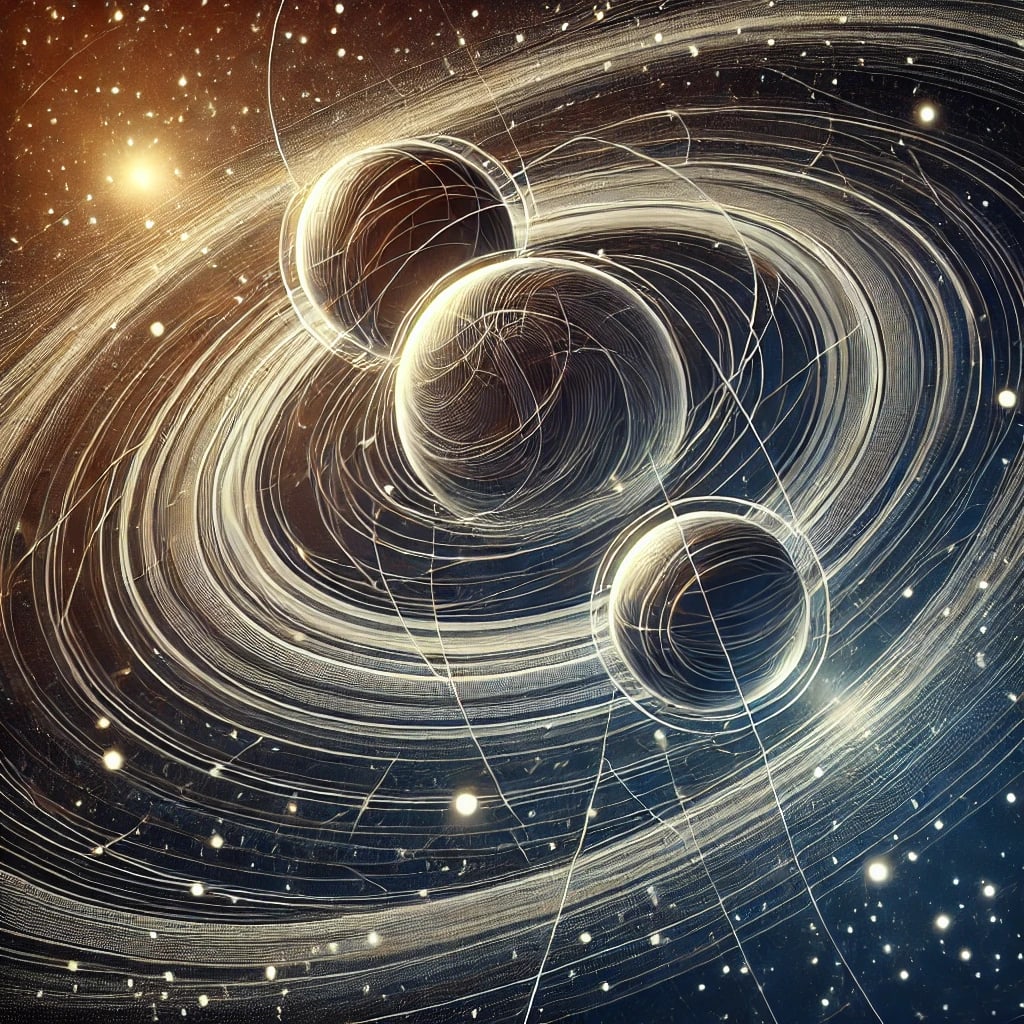
The three-body problem is a classical issue in physics and astronomy that involves predicting the motion of three celestial bodies interacting with each other through gravity. While the motion of two bodies orbiting each other can be calculated precisely using Newton's laws of motion and universal gravitation, adding a third body makes the system significantly more complex and unpredictable. This problem has fascinated scientists for centuries and has led to some of the most important discoveries in both theoretical and applied physics.
**The Two-Body Problem Simplified**
To understand the three-body problem, it's helpful to first understand the simpler two-body problem. When only two objects are involved—such as the Earth and the Moon—their motion is governed by Newton’s law of universal gravitation, which states that every mass attracts every other mass with a force that is proportional to the product of their masses and inversely proportional to the square of the distance between them. In such a system, each object feels the gravitational pull of the other, and they trace out elliptical orbits around their common center of mass.
The two-body problem can be solved exactly using Newton’s laws. Mathematicians can derive precise formulas to predict the positions and velocities of the two bodies at any future time. This solution is known as a deterministic solution, meaning that if you know the initial positions and velocities of the objects, you can predict their future positions with complete accuracy.
**Introducing the Third Body**
The situation becomes far more complicated when a third body is introduced. Now, instead of only two objects exerting gravitational forces on each other, each of the three bodies experiences the gravitational attraction of the other two. As these objects move, the gravitational forces change dynamically, creating a system of interactions that is extremely difficult to solve.
For instance, consider the Sun, Earth, and Moon. The Sun and Earth form a two-body system that would be relatively easy to describe on their own. However, when you add the Moon, it introduces additional gravitational forces that disturb the stable orbits that would otherwise exist. The Sun pulls on the Moon, the Moon pulls on the Earth, and all three bodies are in constant motion, making the system much more complex.
**Why Is the Three-Body Problem So Difficult?**
The core of the difficulty in solving the three-body problem lies in the non-linear nature of the equations that describe the motion. In a two-body system, the equations are linear and can be separated, making them solvable. In the three-body system, the equations become coupled and non-linear, meaning the motion of one body depends intricately on the motions of the others in ways that cannot be disentangled. This interdependence leads to an unpredictable and chaotic system.
Furthermore, the three-body problem exhibits what is called “sensitive dependence on initial conditions.” This is a hallmark of chaotic systems: small changes in the starting positions or velocities of the bodies can lead to dramatically different outcomes. Even the most precise measurements of the initial state of the system will eventually lead to large errors when predicting the motion over time. In essence, small differences in initial conditions snowball, making long-term predictions practically impossible.
**Historical Attempts at Solutions**
The three-body problem has a long history in science, and many brilliant minds have tried to solve it. The problem first became important in the 17th century when Isaac Newton formulated his laws of motion and gravitation. Newton realized that while the two-body problem could be solved exactly, the addition of a third body made the system unpredictable.
In the 18th century, some progress was made by mathematicians such as Leonhard Euler and Joseph-Louis Lagrange, who found special cases where the three-body problem could be solved. These special cases include situations where the three bodies have very particular masses and initial positions. Euler and Lagrange discovered that in certain configurations, the gravitational forces and orbital motions balance out in such a way that the system becomes stable. These points are now called the Euler and Lagrange points, and they are used in modern space missions to place satellites in stable orbits.
**The Role of Chaos Theory**
The three-body problem is one of the earliest examples of chaos in a dynamical system. Chaos theory is a branch of mathematics that studies systems that are highly sensitive to initial conditions, meaning that even tiny differences in the starting state of the system can lead to completely different outcomes. This chaotic behavior makes it impossible to predict the long-term behavior of a system, even if the system is governed by simple physical laws.
In the three-body problem, chaos emerges because the gravitational forces are constantly changing as the bodies move. This unpredictability makes it impossible to find an exact, general solution to the problem. Instead, scientists have developed numerical methods and computer simulations to approximate the motion of the bodies over time.
**Modern Approaches**
Today, with the advent of powerful computers, scientists can simulate the three-body problem using numerical methods. These methods involve breaking down the motion of the bodies into very small time steps and calculating their positions and velocities at each step. While this approach doesn’t provide an exact solution, it allows scientists to make predictions about the behavior of the system over a limited period.
For example, scientists can use these simulations to model the motion of stars in galaxies, the orbits of planets in solar systems, and even the trajectories of spacecraft. Despite the lack of a general solution, these methods have proven to be extremely useful in both astronomy and space exploration.
**Applications and Importance**
The three-body problem has many practical applications in space exploration and astronomy. For instance, understanding the complex gravitational interactions between the Earth, Moon, and Sun helps scientists plan spacecraft trajectories. The gravitational pull of other celestial bodies can be used to "slingshot" a spacecraft, increasing its speed without additional fuel. This technique, called gravity assist, has been used in many space missions, including the Voyager probes and missions to Mars.
Moreover, the three-body problem is important in astrophysics for studying the motion of stars in binary or multiple-star systems, as well as understanding the behavior of planets and other objects in complex gravitational fields.
**Conclusion**
The three-body problem highlights the complexities that can arise from seemingly simple systems governed by basic laws of physics. While the problem remains unsolved in a general sense, the efforts to understand it have led to important developments in mathematics and physics, including chaos theory and numerical simulation techniques. The three-body problem continues to be a rich area of study, offering insights into the intricate dance of celestial bodies and the unpredictable nature of the universe.
About the Creator
Empowering Your Financial Journey: The Role of Wellness and Coaching
Financial success is not only about numbers, budgets, and investment strategies. It is also deeply connected to mindset, habits, and overall well-being. Many people work hard to improve their financial situation, yet they often overlook the emotional and behavioral aspects that influence financial decisions. Empowering your financial journey means recognizing that financial wellness and coaching can play a powerful role in building lasting stability and confidence.
By Mario Payne6 days ago in Education
Genomic Breakthroughs, Life-Changing Impact
Scientific discovery has always played a vital role in advancing human health, but few fields have transformed medicine as dramatically as genomics. By exploring the structure and function of genes, scientists have gained powerful insights into how diseases develop, how individuals respond to treatments, and how health risks can be predicted before symptoms appear. These genomic breakthroughs are not only advancing science but also changing lives around the world. From personalized medicine to improved disease prevention, the impact of genomics is reshaping healthcare, offering hope, understanding, and better outcomes for countless people.
By Mark Bouzykabout 20 hours ago in Education



Comments (1)
This intrigues me. I studied a little physics, but I never understood this particular problem.