
Understanding Proactive vs. Reactive Salesforce Management
Balancing Innovation and Problem-Solving: Mastering Proactive and Reactive Strategies for Effective Salesforce Management and Long-Term Business Success.


When it comes to managing Salesforce effectively, I’ve learned that the approach you take—proactive or reactive—can significantly impact your system’s performance and your business outcomes. Through my experience, I’ve seen how these two management styles shape everything from operational efficiency to user satisfaction. Let me walk you through what I’ve come to understand about proactive and reactive Salesforce management, so you can make the best choice for your organization.
What I’ve Learned About Proactive Salesforce Management
Proactive Salesforce management, in my experience, is all about staying ahead of the curve. Instead of waiting for something to go wrong, I focus on identifying opportunities for improvement, anticipating potential issues, and optimizing the system before problems arise.
Here’s What It Involves:
- Regular System Health Checks: I make it a priority to conduct routine audits. This helps me uncover inefficiencies and ensure the system is running smoothly.
- Continuous Optimization: Whether it’s fine-tuning workflows or integrating new features, I’m always looking for ways to make the system better.
- Planning for Growth: Scaling up is inevitable for most businesses, so I always plan for increased data volumes and more users.
- Staying Updated: Salesforce releases are packed with new features, and I love exploring how these can benefit the organization.
- Training Users: I believe in empowering users with knowledge. Regular training sessions make all the difference.
Why I Choose Proactive Management Whenever Possible:
- It minimizes disruptions.
- Users are happier and more productive.
- It helps me get the most out of Salesforce, maximizing the ROI.
Of course, proactive management does require effort and resources, but I’ve found the benefits far outweigh the initial investment.
When I’ve Relied on Reactive Salesforce Management
Reactive Salesforce management, on the other hand, is about addressing problems as they arise. Sometimes, despite our best efforts, issues happen—and that’s okay. What matters is how you respond.
What Reactive Management Looks Like for Me:
- Fixing Problems: Whether it’s a bug or a user-reported issue, I jump in to resolve it as quickly as possible.
- Implementing Updates on Demand: Sometimes, updates are only rolled out when absolutely necessary.
- Troubleshooting: This is a big part of reactive management—figuring out what went wrong and ensuring it doesn’t happen again.
The Upside and Downside I’ve Experienced:
- Reactive management can be quicker and less resource-intensive initially.
- But, I’ve also noticed that it leads to inefficiencies and higher long-term costs.
- The biggest challenge for me is the frustration it causes users when issues aren’t addressed proactively.
What I Recommend
Here’s how I approach choosing between proactive and reactive management:
Go Proactive When:
- You want to future-proof your Salesforce instance.
- Your organization relies heavily on Salesforce for day-to-day operations.
- You’re looking to maximize ROI and user satisfaction.
Use Reactive Management When:
- Resources are limited, and a lighter-touch approach works for now.
- Your Salesforce instance has fewer users or isn’t central to your operations.
- You have an internal team that can quickly address issues as they arise.
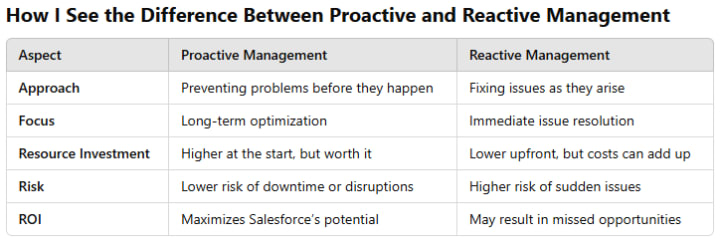
What I’ve Found Works Best
For me, it’s rarely one or the other—it’s a mix. I focus on being proactive wherever it matters most, like ensuring data quality and optimizing workflows. But I also recognize the need for reactive management when unexpected issues pop up.
This is where Salesforce Managed Services come into play. These services blend proactive strategies like monitoring and optimization with reactive support when you need it. They’ve been a game-changer, helping strike the perfect balance without overwhelming team.
About the Creator
Harry Johnson
I am a Salesforce consultant and business analyst at Emorphis Technologies with a proven track record of success. I help businesses understand their requirements and translate them into Salesforce solutions.
Keep reading
More stories from Harry Johnson and writers in Education and other communities.
Best Practices For Implementing Salesforce CPQ
Salesforce CPQ (Configure, Price, Quote) is a powerful tool that can transform your sales processes by streamlining configurations, automating pricing, and generating accurate quotes. However, implementing Salesforce CPQ effectively requires a structured approach to ensure it delivers maximum value to your business.
By Harry Johnsonabout a year ago in Education
The Golden Pulse: Spain’s Luxury Revolution and the New Paradigm of 2026
For decades, the global luxury map was anchored by the historic maisons of Paris and the artisanal workshops of Milan. However, as we move through 2026, the narrative of high-end consumption has shifted significantly toward the Iberian Peninsula. Spain has emerged not just as a destination for sun and culture, but as a premier global hub for the Spain luxury goods industry. Driven by a resilient domestic affluent class, a record-breaking surge in high-net-worth tourism, and a unique blend of heritage craftsmanship and digital innovation, the Spanish luxury market has reached a historic valuation of over $7.4 billion this year. This "Spanish Renaissance" in luxury is defined by a shift from mere status symbols to "Experiential Value," where the soul of the product and the ethics of the brand are as important as the price tag.
By Neeraj kumar4 days ago in Education
One Unchecked Box
"Republished" because it was the only way to add the embed for the newly recorded audio version of this story due to the Top Story badge. Plus it serves as a nice, informal announcement of the podcast's revival for another season (go subscribe!):
By Stephen A. Roddewig6 days ago in Fiction


Comments (1)
Hey, just wanna let you know that this is more suitable to be posted in the FYI community 😊