
Understanding Parts of Speech
Understanding Parts of Speech: The Building Blocks of English
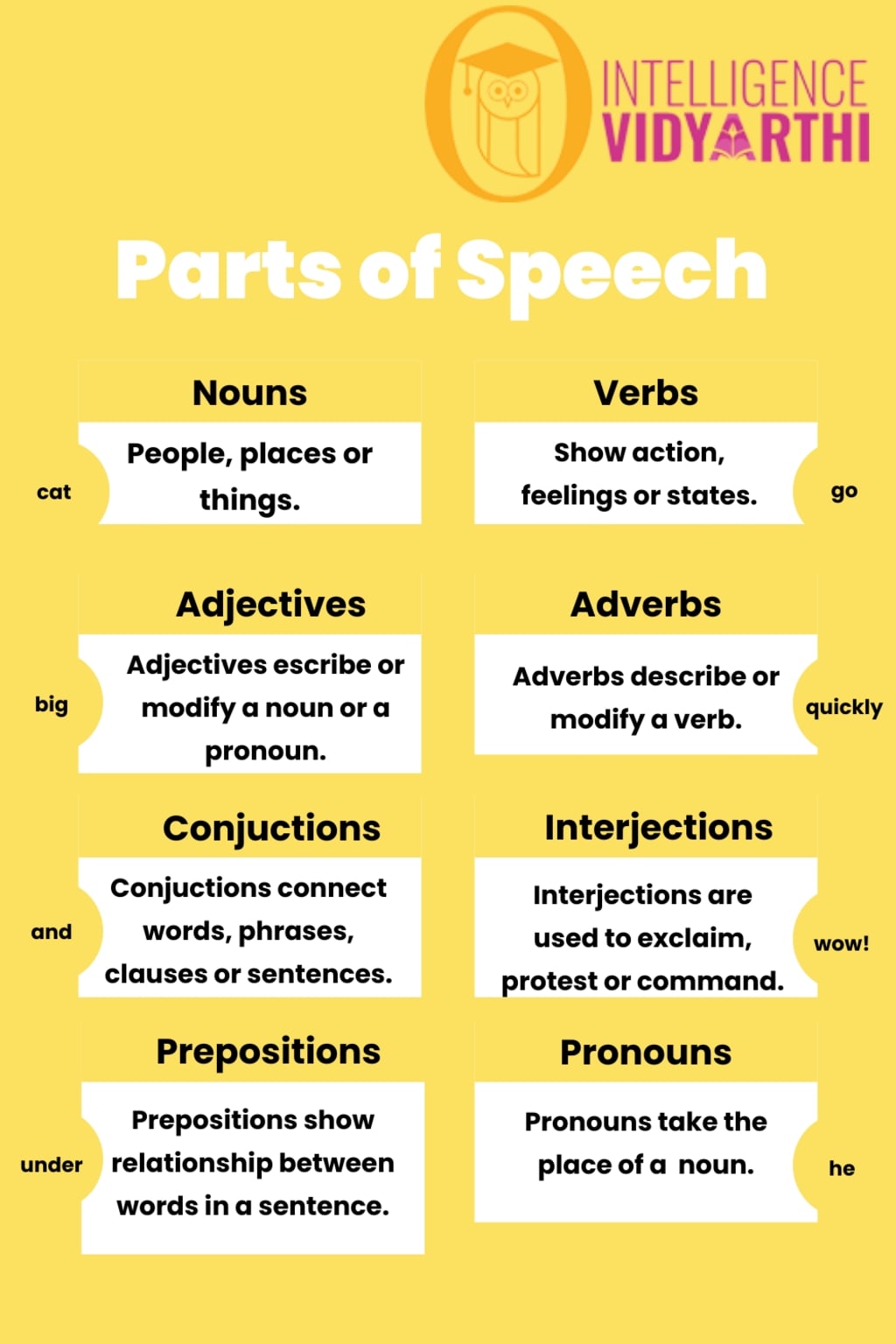
Language is a fascinating and intricate system, and at its core are the parts of speech. These are the categories that words fall into, depending on their function in a sentence. Understanding these categories is crucial for mastering English, as they help us construct sentences that are clear and effective. Let’s explore the main parts of speech and their roles in communication.
Nouns are the names of people, places, things, or ideas. They can be concrete, like "apple" or "dog," which refer to physical objects you can see or touch, or abstract, like "happiness" or "freedom," which refer to concepts or emotions. Nouns can be singular or plural (e.g., "cat" vs. "cats") and can be countable or uncountable. They also serve as subjects or objects in sentences. For instance, in the sentence "The cat sleeps," "cat" is the subject performing the action.
Pronouns are words that take the place of nouns to avoid repetition and make sentences more fluid. Common pronouns include "he," "she," "it," "they," and "we." For example, instead of saying "Maria went to Maria's house," you can say "She went to her house." Pronouns must agree with the nouns they replace in terms of number and gender.
Verbs are action words that describe what the subject is doing. They are essential to forming sentences and can express actions (e.g., "run," "write"), states of being (e.g., "is," "seem"), or occurrences (e.g., "happen"). Verbs also change form based on tense (past, present, future), aspect (perfect, progressive), and mood (indicative, imperative, subjunctive). For instance, in "She runs every morning," "runs" is the verb describing the action.
Adjectives modify nouns and pronouns by providing more detail about them. They can describe qualities, quantities, or states. For example, in "a red apple" or "three books," "red" and "three" are adjectives describing the nouns "apple" and "books," respectively. Adjectives help add specificity and clarity to our descriptions.
Adverbs modify verbs, adjectives, or other adverbs. They often answer questions like "how," "when," "where," or "to what extent." For example, in "She sings beautifully," the adverb "beautifully" modifies the verb "sings," describing the manner in which the action is performed. Adverbs can be single words (e.g., "quickly") or phrases (e.g., "very well").
Prepositions establish relationships between other words in a sentence, often indicating location, direction, time, or method. Common prepositions include "in," "on," "at," "by," and "with." For example, in the sentence "The book is on the table," "on" is a preposition showing the relationship between "book" and "table."
Conjunctions connect words, phrases, or clauses within sentences. They help in forming compound and complex sentences, adding coherence to writing. Coordinating conjunctions like "and," "but," and "or" link similar elements, while subordinating conjunctions like "because," "although," and "if" introduce dependent clauses.
Interjections are words or phrases used to express strong emotions or reactions. They are often standalone and can convey excitement, surprise, or other sentiments. Examples include "Wow!" "Oh no!" and "Yikes!" Although they are not grammatically connected to the rest of the sentence, they add emotion and emphasis.
Mastering the parts of speech is fundamental to understanding and using English effectively. By recognizing the roles of nouns, pronouns, verbs, adjectives, adverbs, prepositions, conjunctions, and interjections, you can enhance both your writing and speaking skills. Each part of speech has a unique function, but together they create the rich tapestry of language that allows us to communicate with precision and creativity.
About the Creator
SAKSHEE SHUKLA
https://intelligencevidyarthi.in/course_details?table_manners_&_etiquettes&cm=MTc=
Keep reading
More stories from SAKSHEE SHUKLA and writers in Education and other communities.
METAPHOR VS SIMILE
In the world of writing, similes and metaphors are powerful tools that help us create vivid imagery and convey complex ideas. Both serve to draw comparisons, but they do so in distinct ways. Understanding when to use a simile versus a metaphor can enhance your writing and make your descriptions more precise and evocative.
By SAKSHEE SHUKLAabout a year ago in Education
Top 10 SEO Experts In Pakistan In 2026
Introduction Search optimization in 2026 no longer revolves around keywords or isolated ranking tactics. Google’s AI Overviews, entity-based indexing, and answer-first systems have changed how visibility is earned. Search engines now evaluate meaning, credibility, and contextual authority rather than mechanical signals.
By Sajid Ali Shar4 days ago in Education
Colors and Such
Before I retired in 2020, I worked as a Nursing instructor in one of the nation's largest community colleges. It was a job I thoroughly enjoyed for fifteen years because I had a heart for the students and genuinely wanted to invest in them and their futures.
By Shirley Belk5 days ago in Education


Comments (2)
Nice article
Thanks for the analysis