
Understanding ELT and ETL Pipelines
If you are new to Data Engineering, or for that matter data in general, you would have come across the words like pipeline, ETL, ELT, Data Warehouse etc. These terms are ubiquitous, and at the same time, super important in the world of data. These are the core of Data Engineering. Today, let's understand what exactly pipeline means, the types of channels widely used, why we need them, and what purpose they serve.


What is a pipeline?
In simple words, a step-by-step process is a pipeline. Processes connected sequentially are referred to as a pipeline. In other words, when the output of Process A becomes the input of Process B is a pipeline.

Now that we have an understanding of what a pipeline is, let’s dive into the two types of pipelines that are widely used: ETL and ELT.
ETL
Let's talk about ETL first, and ELT will automatically fall into place.
ETL is a pipeline. This pipeline contains 3 jobs, as the name suggests. Extract, Transform and Load, short as ETL.
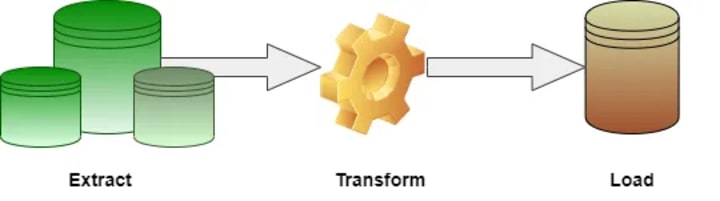
This is an automated data pipeline, whereby data is acquired and prepared for subsequent use in an analytics environment, such as a data warehouse or data mart. Data is extracted from multiple sources, usually in raw format, transformed as per requirements and loaded to the destination for end-users to use. ETL is a rigid process as it is meant to serve a specific function.
Why do we need ETL?
There are various situations where ETL is super helpful. It consists of a variety of use cases:
1. Digitizing of analogue data: There is a lot of information that is still present in the analogue format like paper drawing, analogue audio and videos. All of these data can be transformed into digital using the ETL process. The analogue data is extracted, transformed using some logic to convert into digital format, and then loaded to the desired location.
2. Data from OLTP to OLAP Systems: OLTP (Online Transactional Processing) Systems contain raw transactional data coming from various sources, so they can’t be used for analytical purposes. OLTP data needs to be cleaned and transformed in a way that can be useful for Data Analysts or Data Scientists. This cleaned and transformed data can be used using OLAP (Online Analytical Processing) Systems. Data is extracted from databases consisting of transactional data, processed, cleaned and transformed as per the use case, and loaded into a Data Warehouse or Data Mart to be used for analytical purposes.
3. Dashboarding: Once we have data readily available in OLAP Systems, the data can be further used to create dashboards for business stakeholders.
ELT
The only difference between ETL and ELT is in ETL transformation happens before loading the data to the destination, whereas in ELT, transformation happens after loading the data to the destination.
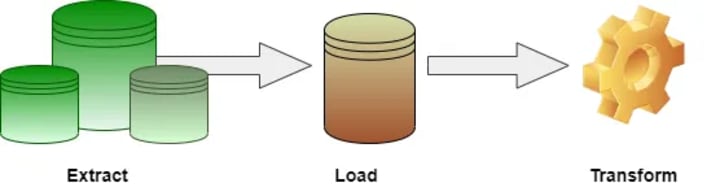
Data is acquired and loaded as-is, into the destination location. Then it is transformed on demand and however is required. ELT is dynamic and flexible as the data is readily available for self-serve analytics uses. ELT handles any kind of structured and unstructured data. Modern analytics tools allow on-demand exploration and visualization of data in the destination environment.
ETL is booming mainly because cloud computing solutions are evolving at tremendous rates due to the demands of Big Data. They can easily handle huge amounts of asynchronous data which can be highly distributed around the world. With ELT, you have a clean separation between moving data and processing data. Because you are working with a replica of the source data, there is no information loss. ELT is an emerging trend mainly because cloud platform technologies are enabling it.
In Summary:
The transformations happen in a different order: Transformations for ETL pipelines take place within the data pipeline, before the data reaches its destination, whereas transformations for ELT are decoupled from the data pipeline, and happen in the destination environment at will.
They also differ in flexibility in how they can be used: ETL is normally a fixed process meant to serve a very specific function, whereas ELT is flexible, making data readily available for self-serve analytics.
They also differ in their ability to handle Big Data. ETL processes traditionally handle structured, relational data, and on-premise computing resources handle the workflow. Thus, scalability can be a problem. ELT, on the other hand, handles any kind of data, structured and unstructured. ELT provides more agility. With some training in modern analytics applications, end users can easily connect to and experiment with the raw data, create their dashboards, and run predictive models themselves. ELT is a natural evolution of ETL.
Hi! Thank you for giving this a read. This is my first article around tech, so please let me know what did you think of it. I would love to hear feedbacks. Write me on [email protected] to share your thoughts/suggestions. :)
Diksha
About the Creator
Keep reading
More stories from writers in Education and other communities.
From Job to Prison: Revenge, Sacrifice, and Ending
The story begins by showing a bald and strong man named Bradley, who is a car mechanic by profession. As usual, Bradley reaches the garage with a broken car, but after arriving there, he sees that the garage owner is anxiously waiting only for him, which makes him a little surprised. Then the garage owner calls him into his office. Hearing this, Bradley understands that he is about to be fired from his job, and exactly that happens. The owner tells him that these days the garage is going through a financial crisis, and that is why he is being forced to fire some workers. But this is only an excuse, because Bradley is a hard-tempered man, and the owner wants to remove him and hire someone who flatters him. Now since Bradley is a tough man, he does not argue with the owner. He goes to the locker room, takes out his belongings, takes his car, and silently leaves for home. And yes, friends, this is where the downfall of Bradley’s life begins, which continues straight until the end of the story and ends there. Anyway, Bradley stops his car in front of his house, and at the same time he sees that his wife Lauren is sitting in her car, talking to someone on the phone. Bradley becomes suspicious of her. To know the truth, he keeps watching her carefully for some time. When he becomes sure, he immediately goes to Lauren and tells her to open the car door. His wife says, “You came back from work very early today.” At the same moment, Bradley notices marks of someone else’s lips on her neck and says to Lauren, “Give me your phone.” But Lauren refuses to give the phone, because of which Bradley forcefully snatches the phone from her, and his suspicion turns out to be correct. She is talking on the phone with another man. In anger, Bradley tells Lauren to go inside the house. Lauren says, “At least listen to me.” Bradley says, “I said go inside the house.” Then Lauren silently goes inside the house. Now, he had already been fired from his job a little while ago, and now his wife’s affair, because of which he had become even more disturbed, so he starts taking out all his anger on Lauren’s car. How? You can see that yourself. Yes, he is so angry that he does not even realize that his hands have been badly injured. After that, he calms himself down and goes inside the house and questions Lauren about how many days she has been with the other man. Lauren tells him everything, that for the past three months she had been having an affair with someone else. Actually, Bradley’s wife had an abortion a few days earlier, because of which she used to remain sad, and Bradley often stayed busy with his work. Because of this, Lauren felt lonely and very depressed at home, and to fill this emptiness, she had to take support from another man. Hearing these things, Bradley realizes that he should have given time to Lauren. He apologizes to Lauren for this and says that from today, from right now, they will both start a new life. Lauren agrees. After that, Bradley tells Lauren that he has been fired from his job and now he will work for a man named Gil, who is a drug lord. As soon as she hears Gil’s name, Lauren clearly refuses and says, “You yourself said that you would never work with Gil.” Bradley says, “Yes, but in such circumstances, we cannot live like a prosperous family. To run a family, money is needed, and at this time I have no other option.” He also assures Lauren that he will do this work very carefully.
By Filmon Ke Raaz | Movie Mysteries Explained7 days ago in Education
Punjab Orders Action Against Private Schools Pressurizing Parents to Buy From Selected Shops
In a bold move to protect parents and uphold fair practices in education, the Punjab government has ordered strict action against private schools that allegedly pressure parents to purchase supplies, uniforms, or books from selected vendors. The directive comes after multiple complaints surfaced regarding unfair practices that forced families to spend extra money or adhere to specific buying instructions, often leaving them with little choice.
By Muhammad Hassana day ago in Education
The Path to Salvation
The late autumn evening air filled the monk's lungs, but it wasn't the season that chilled his bones. The heavy-handed presence of evil he had sensed upon entering the woods surrounding this mountain village had not bothered to conceal itself from him.
By Made in DNA4 days ago in Fiction




Comments
There are no comments for this story
Be the first to respond and start the conversation.