
Tuning into Spring Qi: Feng Shui Insights for the 2025 Year of the Snake (Part 1)
Understanding Seasonal Energy through the I Ching Hexagrams

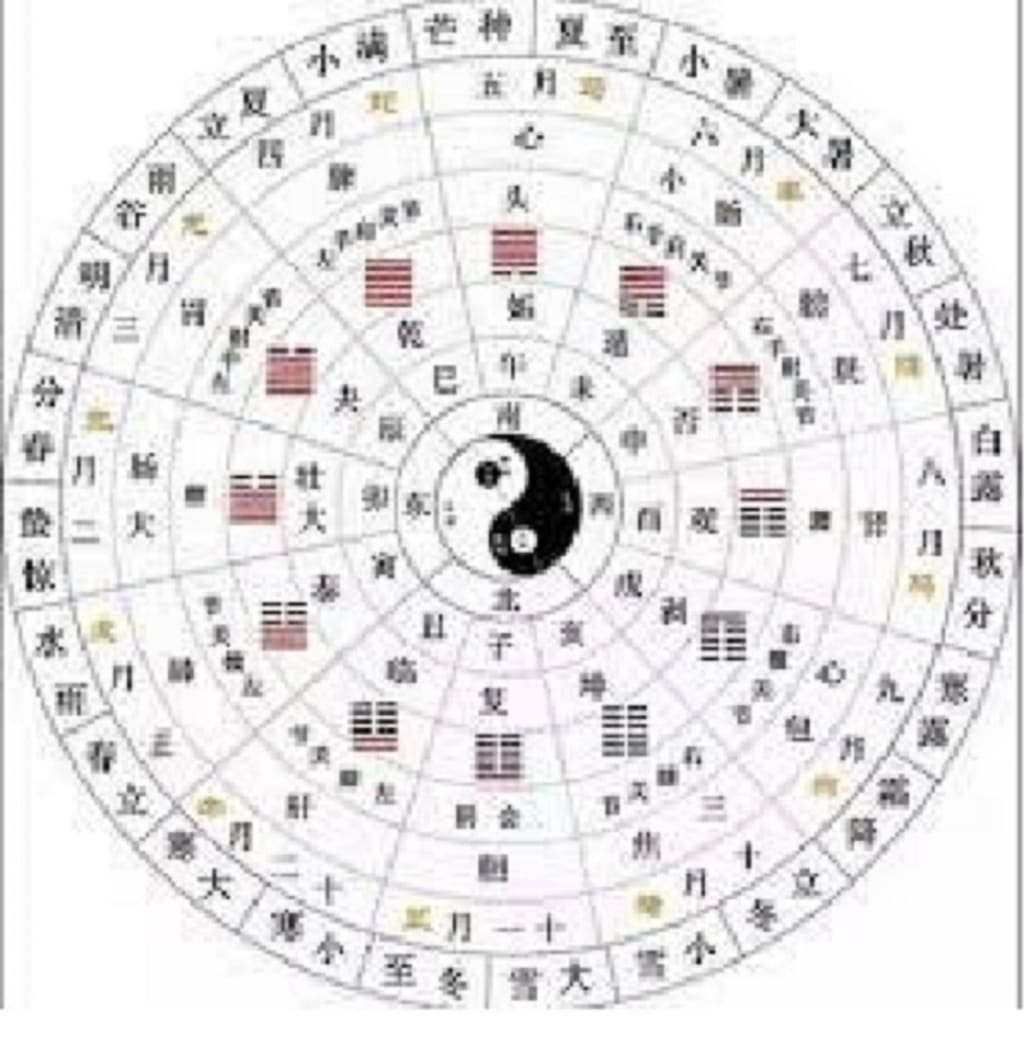
In my previous blogs, I have repeatedly emphasized that Chinese Feng Shui is a body of knowledge focused on adjusting and harmonizing the relationship between time-space Qi (vital life energy) and personal Qi.
Each of us carries a unique personal Qi that not only gives us life energy but also hides the information of our destiny. From the perspective of the Chinese Zodiac, each personal Qi corresponds to a specific type of energy based on the Five Elements. For example, a child born in 2025 will embody a distinctive Fire energy, represented by the Zodiac sign of the Snake.
Likewise, the environments in which we live and work are composed of their own time-space Qi. These environmental Qi fields are shaped by factors such as natural geography, the year a building was constructed, its orientation, location, and other influences—forming a unique energetic field for each space. In turn, these environmental Qi patterns interact with and influence the personal Qi of the individuals who inhabit them.
When a Chinese Feng Shui practitioner is consulted, they typically analyze both the client’s personal Qi and the characteristics of their living or working environment. They then provide a Feng Shui report with recommendations for adjusting the environmental Qi. This usually marks the completion of a standard Feng Shui consultation.
However, this is not the full scope of Feng Shui. Since Feng Shui is fundamentally about adjusting time-space Qi, we can also make intentional adjustments based on the time dimension. As Qi continuously shifts throughout the year, we can respond accordingly by making seasonal adjustments to the Qi in our surroundings—and even our personal Qi. (Adjusting personal Qi is closely related to Traditional Chinese Medicine, which shares the same theoretical foundation as Feng Shui. However, we won’t explore that topic here.)
By tuning into the seasonal Qi, we can enhance the effectiveness of Feng Shui and deepen its positive impact on our lives.
Understanding Spring Qi through Hexagrams
Before making seasonal Feng Shui adjustments, we should first examine how Qi changes throughout the year from a Feng Shui perspective.
The most fundamental nature of Qi is rooted in the interaction between Yin (阴) and Yang (阳). Let’s take the Year of the Snake as an example. In 2025, the Snake Year begins on February 3rd, the day of Lichun (立春), or the Beginning of Spring. This marks the official start of both the spring season and the Snake Year.
To help you better understand the seasonal shift in Qi, I’ll use the Yin-Yang lines of specific hexagrams. This offers an intuitive sense of how Qi evolves throughout the year.
In Zhou Yi (the I Ching,《周易》) culture, we use twelve specific hexagrams to represent the twelve months of the year. Each hexagram reflects the transformation of Qi in terms of Yin and Yang. These hexagrams are formed from two trigrams, and the eight basic trigrams are collectively known as the Ba Gua (八卦, Eight Trigrams).
The three hexagrams that represent the months of spring are:
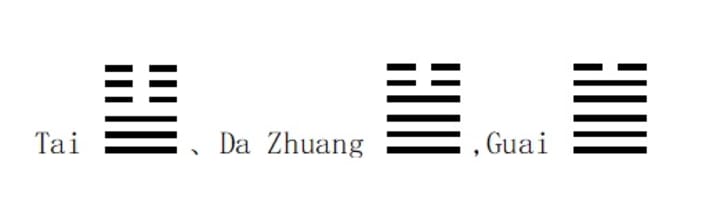
Comparing the Spring Hexagrams
• Tai (泰) has three Yang lines (solid lines) at the bottom and three Yin lines (broken lines) at the top. This balanced structure represents the first month of spring. The Yin Qi (cold) and Yang Qi (warm) are in a state of harmony—there is a hint of warmth, but the air is still chilly.
• In the second month, Da Zhuang (大壮) shows one more Yang line replacing a Yin line, resulting in four Yang lines and two Yin lines. This indicates the growing strength of Yang energy and the gradual warming of the weather.
• By the third month, Guai (夬) contains only one Yin line and five Yang lines. This means that Yang energy is now dominant, and the weather is warm—signifying the height of spring.
These twelve hexagrams, which illustrate the rise and fall of Yin and Yang throughout the year, are unique among the sixty-four hexagrams of the I Ching. They are known as the Xiao Xi Hexagrams (消息卦). While the modern Chinese word “Xiao Xi” (消息) means "information" or "news," in the I Ching, it refers to the increase and decrease—the ebb and flow—of Yin Qi and Yang Qi.
Spring Qi and the Five Elements
From the spring hexagrams above, we observe that Yang Qi is steadily rising during spring. In terms of the Five Elements, this corresponds to the element Wood, which symbolizes the thriving life force of spring—as seen in the growth of plants and the renewed vitality of nature.
In Feng Shui, Wood is also associated with the East and Southeast directions.
Now that we understand the nature of spring’s Qi, we can make targeted Feng Shui adjustments. Specifically, we should focus on balancing the increased Wood energy in our homes. This means not only paying attention to the growing Wood energy itself but also focusing on the East and Southeast areas to help harmonize with the seasonal Qi of spring.
In the next blog, we will discuss how to make these adjustments and offer specific suggestions to align your space’s energy with the vibrant Qi of spring.
About the Creator
Lidong Yu
I am a Chinese Feng Shui consultant and educator, raised and trained in China. My work draws on classical Feng Shui traditions to help people better understand the relationship between themselves, their environments, and time through Qi.
Truth with Responsibility: Navigating Ethics in Documentary Filmmaking
Documentary filmmaking carries a unique power and responsibility. Unlike fictional storytelling, documentaries present real people, real events, and real consequences. Filmmakers step into the lives of individuals and communities, often during vulnerable moments, with the intention of sharing truths that inform and inspire audiences. This power demands a strong ethical foundation. Ethical considerations in documentary production are not optional guidelines but essential principles that protect subjects, preserve credibility, and uphold the integrity of storytelling.
By Nigel Sinclair3 days ago in Education
Why IT Hiring Struggles Despite Plenty of Available Talent
Companies have very well discovered that their open roles are unfilled, not because talent has suddenly vanished. It’s because their expectations have drifted away from what the available workforce can realistically deliver.
By Techreviewer4 days ago in Education



Comments
There are no comments for this story
Be the first to respond and start the conversation.