
Top 10 Unsolved Mysteries of the Universe that will challenge your imagination
Dark Matter: The Hidden Fabric of the Universe Are We Alone? The Quest for Extraterrestrial Life Tracing Time: How Old Is the Universe? The Flat Universe: A Geometry Without Limits Neutron Stars: The Tiny Giants of Space More Stars Than Grains of Sand: A Cosmic Perspective Black Holes: The Universe's Most Puzzling Phenomena The Accelerating Universe: Powered by Dark Energy Time Travel Through Starlight: Looking Into the Past The Multiverse: Beyond Our Known Reality

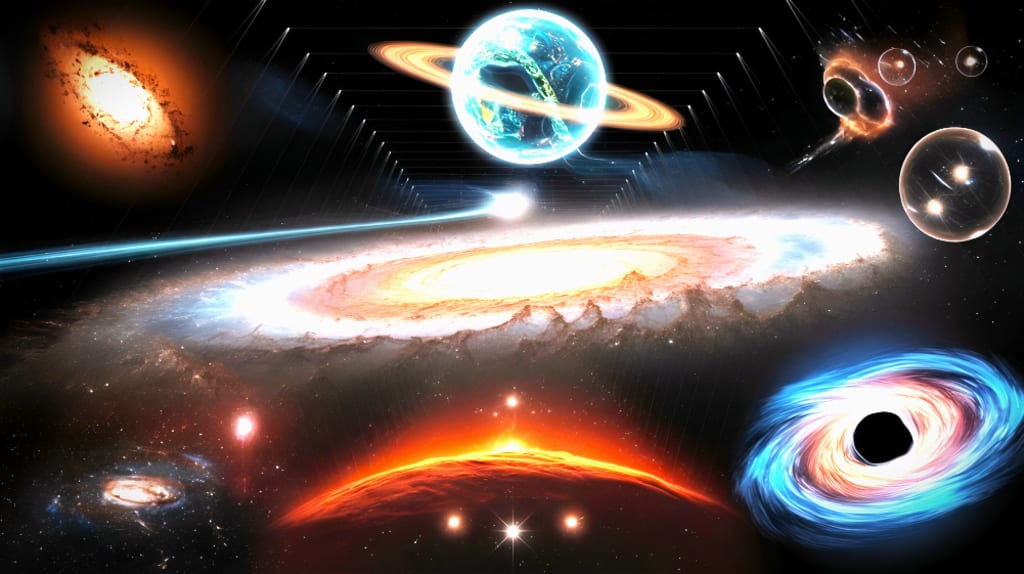
Top 10 Mysteries of the Universe that will challenge your imagination
The universe is a vast and wonderful place. Is "huge" a big enough name? Consider the vastness of space, stars, planets, black holes, and other mysterious objects that are still largely unknown to humanity.
The universe has remained an object of awe and wonder to so many of us ever since life began. We have thus been curious, excited, or even a bit frightened by the concept of how small we are compared to it.
As time went on, the human mind unraveled quite a lot about the universe: the discovery of the planets, understanding how stars are born, and even pictures of black holes. Yet, despite knowledge of all these factors, the universe sounds like it is some big puzzle; there is a heck of a lot more to get out and understand.
It would appear the universe had a curious knack of just continuing to let out how extraordinary and inexplicable life could be journey unto the great unknown, quite literally in every direction with no end. Today, we are going to talk about the top ten mysteries of the cosmos, and everything from invisible stuff to extraterrestrial civilizations will leave you speechless at the enormity of the unknown. Get ready for some astounding facts, a dash of humor, and some mind-boggling concepts. Let the rockets fire!
1. Dark Matter: The Invisible Framework of the Universe
That would be like doing a big jigsaw puzzle, but most of the pieces of the jigsaw are missing and it's just the silhouetted shape you are working out. That would be dark matter. This mysterious substance makes up 27% of the Universe and we have never seen it-no kidding. It doesn't emit or reflect light so to all practical means it's invisible. You might well have a blob of dark matter sitting in your living room right now, and would not have a clue.
So how can we be so certain the stuff exists? Basically, astronomers calculated that galaxies act as if they were a kind of sulky teenagers -they spin faster than they are supposed to. That's because, were an unseen gravitational glue not keeping them together, they'd simply fly apart. Dark matter is like cosmic scaffolding to keep them intact.
Even today, decades later, scientists have no idea what dark matter is. Theories hint at a variety of exotic particles; theories point to WIMPS, axions-but nobody has solved the puzzle until now. It happens to belong to one of the great mysteries in contemporary physics.
Why it matters? Unravel the mystery of dark matter to revolutionize a new understanding of the cosmos and open up an entirely new realm of science.
2. Are We Alone in the Universe?
The search for life in space is not a subject of science fiction, but among the biggest and at the same time most basic questions that human beings have ever been able to pose. There being billions of galaxies, each having billions of stars and planets, uniqueness statistically starts to feel really improbable that Earth is the only host of life.
Astronomers have discovered thousands of exoplanets, some of them existing in the "Goldilocks zone" of their stars-meaning that the temperature on those planets might be just right for liquid water. And where's water, there could be life.
Here’s the kicker: On Earth, we’ve found extremophiles—organisms that thrive in boiling volcanic vents, frozen glaciers, and even the vacuum of space. If life can exist in these extreme conditions, why not on Europa, one of Jupiter’s moons, with its subsurface ocean? Or Titan, Saturn’s moon, with its methane lakes?
But the hunt is well underway, from the James Webb Space Telescope to SETI-Search for Extraterrestrial Intelligence. Whether it is microbes or intelligent life, the discovery will change our understanding of our place in the universe.
Why It's Cool? Imaging a signal received from another civilization. History in the making.
3. How Old Is the Universe?
The age of the Universe is approximately 13.8 billion years old, a little older than most of us had ever thought that time could reach. Astronomers have been able to accomplish this by studying the cosmic microwave background radiation-the faint afterglow of the Big Bang- and the velocity at which galaxies are moving away from us.
But here's the kicker: it may be old, but it certainly is not slowing down. It keeps on expanding at an accelerating rate of speed thanks to something called dark energy.
That opens so many questions, like: What was before the Big Bang? Where will time and space go from here? What is yet to come after-whether it is to continue expanding endlessly, to go into cold and darkness, or it will have collapsed into the fiery "Big Crunch"?
Mind-Blowing Fact: When you look at distant galaxies, you are seeing backward in time. It took their light millions or billions of years to reach us, carrying with it information from the universe's ancient past.
4. The Flat Universe: Geometry Gets Cosmic
Neither did it stand the big sphere-shaped universe since there's a hint this universe is flat - well, not necessarily pancake-like flat, more like geometrically flat; in that type of universe, parallel lines will never join how far they would be set apart in their billions-of-light-year dimensions.
Cosmologists finally inferred through the CMB study: in reality, the young universe indeed suffered an epoch of exponential inflation in which geometry got smoothed.
Flat does not necessarily have to mean boring, however. A flat universe can expand to infinity concepts both fascinating and somewhat terrifying to imagine: a cosmic map with no edges, no bounds- just star after star and galaxy after galaxy forever.
Why It Matters? Shape carries the consequences as far as the ultimate fate of the universe is concerned, to determine whether it would stay in continuous expansion or collapse back on itself in that final, dramatic end.
5. Neutron Stars: Small yet Super-powerful
Neutron stars are the cosmic version of the Hulk: small in size, ridiculously high in power. These stars are the dense remnants created by supernovae explosions of stars much bigger than our Sun. A neutron star jams the mass of the Sun into a sphere only a few miles in width. For a comparison, take this: one teaspoon of neutron star material would weigh billions of tons.
They also rotate like crazy hundreds of times per second. These speed demons, called pulsars, shoot beams of radiation that sweep through space like cosmic lighthouses.
Next come magnetars, a special breed of neutron star whose magnetic fields are trillions of times more powerful than Earth's. If you think your fridge magnets are something, well, think again.
Why It's Awesome? Neutron stars are the ultimate extreme of physics, enabling us to understand how matter can behave under extreme conditions.
6. More Stars Than Sand Grains
Here is one such fact that will just blow your mind: there are more stars in the universe than grains of sand on Earth's beaches. It is not poetic hyperbole but a legitimate scientific estimate.
Every star can be a solar system, and of those systems, a few can have Earth-like planets. It is in the scale at every level that can push and pull you between feelings of immense insignificance and deep connectedness with the universe.
What it means? There are lots of stars and planets out there, and the chance of some hosting alien life or another Earth is much greater than you think.
7. Black Holes: Cosmic Paradoxes
Black holes represent the biggest paradoxes of the universe. These are regions in space that have such a strong gravitation that no shining light outward can ever reach outside their vicinity. They are created when huge stars, due to their weight and while collapsing, form singularities where physical laws break down.
But black holes are not only cosmic vacuum cleaners; they also play a very important role in shaping galaxies. That supermassive black hole-in-residence at the galactic core, Sagittarius A*, acts much like a gravitational anchor, tugging on stars and clouds of gas.
And they're not mute vacuums. The one in the Perseus galaxy emits sound waves equivalent to the lowest note ever produced, 57 octaves below middle C—not exactly a sing-along, but it's cool nonetheless.
Why It's Cool? Black holes go against nearly everything we understand about space, time, and gravity.
8. The Accelerating Universe
This earned a remarkable discovery in the 1990s by scientists that expansion is accelerating. This acceleration may be due to dark energy, a mysterious form of energy comprising about 68 percent of the universe.
Dark energy-the ultimate "What the heck?" of science, anti-gravity that just kinda takes over and starts blowing galaxies farther and farther apart with a constant acceleration. If it keeps up, the Universe could end in what's been called a "Big Rip," where everything- galaxies, stars, even the atoms themselves torn asunder.
Why It's Spooky? Dark energy is the most common thing in the universe. We have no idea what it is.
9. Time Travel Through Starlight
The night sky is somewhat like peering into a time machine. The light of other stars and galaxies, reaching several millions or billions of years to reach us, means we see them in the past.
For example, the Andromeda Galaxy is 2.5 million light-years away, and so when we see it today, we are seeing it as it looked 2.5 million years ago, because of the time it takes its light to reach us. Facts such as these enable astronomers to observe the universe as it was in the distant past and hence reconstruct what happened at earlier times.
Why It's Mind-Blowing? Each time you see stars, you time travel. How cool?
10. The Multiverse: One Universe Just Isn't Enough
But what if our universe were simply one of many? There does indeed exist such a hypothesis-the multiverse-suggesting that there exists an infinite number of universes, each with its separate physical laws and constants.
But where it sounds like the stuff of science fiction, some pretty hard physics-in particular string theory behind it. Other universes can't be proven to exist, but the very idea opens up some wild possibilities: Think of a universe in which dinosaurs never died out or one in which pizza isn't a thing.
Why It's Interesting? The multiverse could explain why our universe seems so finely tuned for life.
Conclusion :
From the invisible scaffolding of dark matter to the tantalizing idea of infinite multiverses, the universe is one treasure after another of mysteries following each other in fascination. These are things that keep us always in our place, just questioning and dreaming and exploring.
Maybe that is the best gift the universe could give us a feeling of wonder. And maybe because most of the answers are not in our pocket, that may be the very reason for us to be curious, push the limits of how much we currently know, and reach for the stars.
The next time you gaze up at the night sky, remember, well, you're a part of something huge, mysterious, and endlessly amazing.
About the Creator
Mahamad Samiullah Kha
I’m Mahamad Samiullah Kha, an 8-year experienced storyteller exploring diverse topics—from scientific wonders to everyday mysteries. I aim to make complex ideas engaging, sparking curiosity and deepening our connection with the world.
Keep reading
More stories from Mahamad Samiullah Kha and writers in Education and other communities.
Success After Failure: The Unforgettable Lessons That Transformed My Life
Success After Failure: The Unforgettable Lessons That Transformed My Life It is quite hard to explain the feeling when one feels it's over, right from the heart to invest in it. That indeed described my mood the first time I ever got into entrepreneurship. For many months, I had been nurturing the idea of starting a digital marketing agency before taking up the plunge.
By Mahamad Samiullah Khaabout a year ago in Education
Guiding While Growing: How Mentorship Shapes Modern Leadership
Leadership today looks very different from what it did a generation ago. Authority alone is no longer enough to inspire trust, loyalty, or growth. The most effective coaches understand that leadership is not about standing above others but about growing alongside them. Mentorship has emerged as one of the most powerful expressions of leadership, especially when coaches are willing to remain learners themselves.
By Thomas Kuriakose, MD6 days ago in Education
Stock Screener vs Manual Stock Analysis: Which Works Better?
Finding the right stocks in a crowded market is a challenge for every investor. With thousands of publicly traded companies and constant price fluctuations, investors rely on different methods to narrow down opportunities. Two of the most common approaches are using a stock screener and performing manual stock analysis. While both aim to identify profitable investments, they differ significantly in speed, depth, and practicality. Understanding how each method works can help investors choose the right approach—or combination—for their trading and investment goals.
By Alven Smithabout 8 hours ago in Education




Comments
There are no comments for this story
Be the first to respond and start the conversation.