

Time travel has been a fascinating topic of discussion for centuries, appearing in works of science fiction, philosophy, and even pop culture. From H.G. Wells’ “The Time Machine” to the “Back to the Future” movies, the idea of traveling through time has captured the imagination of people all over the world. But is time travel really possible? And if so, what would it take for humans to travel through time?
The idea of time travel has been a subject of study for scientists, philosophers, and physicists for decades. Theoretically, time travel is possible according to the laws of physics. Time is a dimension just like length, width, and height. We can move forward and backward in space, so it’s only natural to think that we could do the same in time. However, while the idea of time travel is theoretically possible, the technology required to achieve it is still beyond our current capabilities.
The concept of time travel is often associated with the idea of a time machine, a device that could transport someone through time. In the scientific community, there are various theories about what a time machine could look like and how it could operate. One of the most popular theories is based on Einstein’s theory of relativity, which suggests that time travel could be possible by traveling at the speed of light. According to the theory, time slows down the faster you travel, which means that a person traveling at the speed of light would experience time differently than someone who is stationary. If you could travel at the speed of light, you could technically “travel” through time, experiencing time more slowly than those who are stationary.
Another popular theory about time travel involves the use of a wormhole. A wormhole is a theoretical construct in space-time that would allow someone to travel from one point in space-time to another without traveling the distance in between. The idea is that if a wormhole could be created and stabilized, it could be used as a portal to travel through time. While the concept of a wormhole is still purely theoretical, it has been explored in many works of science fiction and remains an area of interest for scientists and physicists.
Despite the various theories about time travel, the reality is that the technology required to achieve it is still beyond our current capabilities. Even if we were to discover a way to travel at the speed of light or create a stable wormhole, the energy required to power such a device would be astronomical. Furthermore, the physical toll on a human body traveling at such speeds could be catastrophic.
While time travel may be a theoretical possibility, it’s important to remember that the laws of physics still apply. Time travel would require the manipulation of the fabric of space-time, which is a complex and delicate system. It’s possible that even the smallest change in the past could have dramatic effects on the future, creating a “butterfly effect” that could change the course of history.
Of course, time travel isn’t just a topic of scientific discussion. It’s also a popular subject in movies, books, and TV shows. From “Doctor Who” to “The Terminator,” time travel has been used as a plot device in many works of fiction. While these depictions of time travel may not be scientifically accurate, they often serve as a way to explore complex themes such as regret, redemption, and the power of choice.
In popular culture, time travel is often depicted as a way to fix mistakes or right wrongs. The idea is that by going back in time, you could prevent a tragedy or change the course of history for the better. While this may be a comforting thought, it’s important to remember that the past is already written. Changing the past could have unintended consequences, creating a new reality that is
About the Creator
Keep reading
More stories from writers in Education and other communities.
Mastering X-Bar Theory in Grammar in 10 Minutes
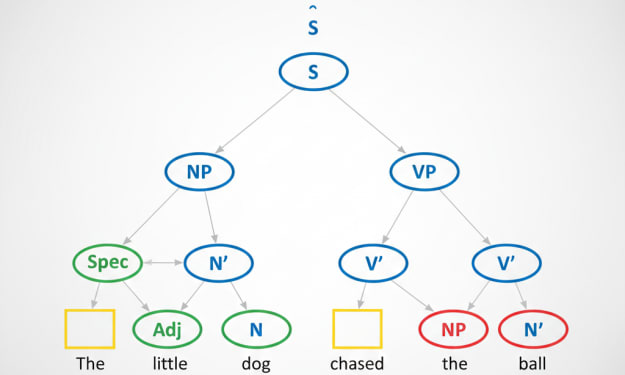
Grammar can often feel like a maze of confusing rules, especially when we dive into syntax — the study of sentence structure. One of the foundational tools in modern linguistics is X-Bar Theory, a framework that helps explain how words and phrases combine to form sentences. While it might sound intimidating, understanding X-Bar Theory can become straightforward if approached step by step.
By Games Mode On2 days ago in Education
How did Hitler rise to power?
How did Adolf Hitler, a tyrant who orchestrated one of the largest genocides in human history, rise to power in a democratic country? The story begins at the end of World War I. With the successful Allied advance in 1918, Germany realized the war was unwinnable and signed an armistice ending the fighting. As its imperial government collapsed, civil unrest and worker strikes spread across the nation. Fearing a Communist revolution, major parties joined to suppress the uprisings, establishing the parliamentary Weimar Republic.
By Munesh Yadava day ago in Education



Comments
There are no comments for this story
Be the first to respond and start the conversation.