
Threads of Frost: How Climate Change Wove a New World
The Strange Beauty That Emerged When the Seasons Broke

The Strange Beauty That Emerged When the Seasons Broke:
We were used to odd weather patterns, of course—spring rains in winter, summer droughts, even the occasional out-of-season hailstorm—but nothing quite like that day. The sun had risen over our small farming town just like it always did, stretching lazy fingers of golden light across the fields of soy and wheat. But by noon, the sky had darkened, and the first snowflakes began to fall.
At first, we thought it was ash.
I was standing outside my family’s farmhouse, coffee in hand, watching the sky blur with a strange, low-hanging fog. The flakes drifted down slowly, as if reluctant to land, and melted the moment they touched the ground. But then the temperature dropped, fast—unnaturally fast—and the flakes began to stick.
By nightfall, the fields were blanketed in white.
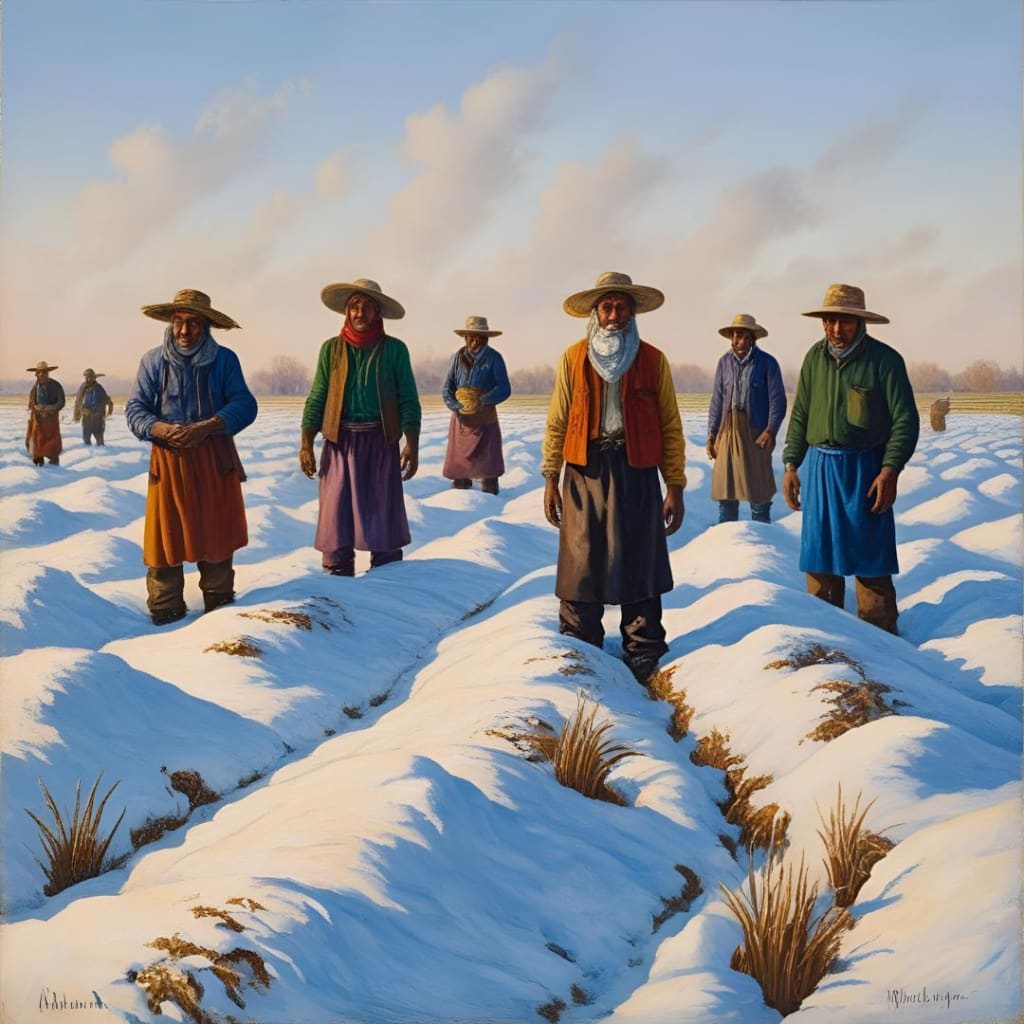
Not the powdery kind of snow we used to get back when winters were predictable and seasons had rules. This was different—fibrous, almost thread-like. It clung to the crops in thin, gauzy layers, like spider silk. We tried to brush it off, but it knotted around the leaves, burrowed into the soil. The wheat bent under its weight.
Someone called it "snow mold." Another said it was microplastic fallout. We didn’t know it yet, but we’d just witnessed the arrival of the Snow Weavers.
They didn’t come from the sky, not exactly.
Scientists later explained that the phenomenon was the result of a complex chain reaction—triggered by atmospheric shifts, ocean currents, and something about spore dispersion mixed with nanofibers. All of it a side effect of geoengineering gone wrong. What was meant to cool the planet had accidentally given birth to something else: synthetic fungal hybrids capable of creating artificial snow-like threads, weaving them together in patterns only nature could understand.
They were alive. And they were learning.
The Snow Weavers spread across the continent within days. From Iowa to Ontario, fields turned white. The temperature dropped in patches, as if the climate was being stitched and re-stitched by unseen hands. Crops failed. Bees vanished. Birds migrated in chaotic loops. It wasn’t a season anymore—it was an invasion.
My town changed quickly.
Farmers are practical people. We tried to fight it at first. We torched the fields, dug trenches, sprayed chemicals that hadn’t been approved for a decade. Nothing worked. The Weavers weren’t just resistant—they adapted. They learned the rhythms of the land, the timing of the tractors, the composition of the soil. Every day, they came back more refined, their fibers tighter, their patterns more intricate.
Soon, they weren’t just weaving over the land—they were weaving through it.
By July, tree roots were braided into lattices. Barns were covered in soft white mesh that sparkled in the moonlight. You could brush it off, but it came back thicker the next day. We started calling it “snowlace.” Some folks found it beautiful, in a haunting sort of way. Others packed up and left.
I stayed.
I wasn’t ready to give up on the land. It had been in my family for generations. But more than that, I was curious. I’d studied biology before I took over the farm. I knew enough to recognize this wasn’t just a disaster—it was a transformation. Something new had emerged from the wreckage of our warming world, something with intent.
One night, I set up a microscope in the barn and examined a few threads. What I found changed everything.
Each strand was made of a complex matrix of organic and synthetic materials—fungal cells bonded with microscopic polymers, capable of storing data. Information, patterns, even rudimentary responses to stimuli. The Snow Weavers weren’t just alive—they were communicating. We just didn’t know the language.
By late summer, we saw the first signs of cohabitation.
It started with the weeds. Where crops had failed, wild plants flourished. Dandelions, thistles, even clover—all wound with the snowlace, growing thicker and faster than ever before. Then came the mushrooms: tall, thin, glowing faintly under moonlight. They sprouted along the edges of the fields, then closer, then right in the center where our corn should’ve been.
I noticed they followed the Weavers' patterns. Wherever the white filaments pooled, mushrooms grew. I started to map the growth, taking photos, marking changes. The Weavers weren’t killing everything—they were selecting.
They were farming.
The world outside was unraveling.
Cities were dealing with their own version of the phenomenon. Skyscrapers webbed in white. Subway tunnels filled with cottony mist. In coastal regions, the Snow Weavers came with fog banks and strange tides, turning boardwalks into slippery, glistening paths. There were mass evacuations. Panic. Governments scrambled to respond. Scientists debated whether this was a mutation or a form of synthetic evolution.
But out here, in the quiet of the country, we were starting to understand.
The Weavers didn’t want destruction. They wanted stability. Balance. They were an answer—however imperfect—to the chaos we’d unleashed on the climate. A kind of biological failsafe. A new steward for a wounded world.
In October, the first harvest came.
Not of wheat or soy, but of something else entirely. The mushrooms. They were unlike anything we’d seen—nutrient-rich, fast-growing, and oddly delicious. Some glowed faintly. Others changed color based on the weather. Lab tests showed they were safe, even beneficial. And they only grew in snowlace zones.
I began cultivating them intentionally. Not just mushrooms, but other snowlace crops too—thick, root-bound vegetables that thrived in the colder microclimates the Weavers created. Carrots the size of forearms. Lettuce that shimmered like frost. It wasn’t farming as I knew it. It was… collaboration.
We began calling ourselves “threadkeepers.”
There was resistance, of course.
Plenty of people still saw the Snow Weavers as a threat. Militias formed to “reclaim the land.” Cities passed laws banning the cultivation of snowlace crops. Conspiracy theories flew like crows—talk of alien lifeforms, secret nanotech programs, divine punishment. But the Weavers kept growing, kept weaving, undeterred.
And some of us kept listening.
We began to decipher the patterns. At first, it was simple—temperature signals, moisture maps, seed distribution. But over time, the Weavers began to respond to us. We’d till the land in a certain way, and they’d form new paths. We’d hum near the fields, and the threads would ripple. Not in fear, but in recognition.
We started leaving messages in compost piles, arranging stones in spirals, marking the ground with natural dyes. The Weavers answered in thread.
We were speaking, now—in a quiet, shared rhythm.
Now it’s been five years since the white fell.
The seasons are still strange, but they’re not senseless anymore. The Snow Weavers remain, drifting through the air like dandelion fluff, weaving fields into new patterns. We farm together now—not with machines, but with presence, with patience, with ritual.
The earth is healing, though not in the way we expected. Not through restoration, but through reinvention. Nature has always been resilient, but now it’s also creative. Collaborative.
People come from all over to learn from us. To walk the white paths. To see the crops that bloom only under snowlace. We tell them the same thing: this isn’t the end. It’s a new beginning.
The day climate change turned our fields white was the day everything changed.
Not just the weather. Not just the crops. Us.
We stopped seeing ourselves as masters of the land and started seeing ourselves as part of its story. The Weavers showed us that survival isn't about control. It’s about connection. Interdependence. Symbiosis.
I don’t miss the old seasons anymore.
I watch the snowlace settle every morning now, like a soft exhale across the earth. And I whisper thanks.
Because in their silent, silver way, the Weavers taught us how to grow again.
About the Creator
Kazi Mirajul Islam
I am expert in digital Marketing .I am also E- book writer & story writer. I am committed to delivering high-quality content.Also create social media account like Facebook,twitter account ,Instagram ,you tube account create and mained.
Keep reading
More stories from Kazi Mirajul Islam and writers in Education and other communities.
Why Great Customer Service Is Non-Negotiable for Modern Businesses
Excellent customer service is no longer something businesses can choose to offer later. It is a basic requirement in today’s fast-moving market. Customers expect respect, clear communication, and fast solutions. When they do not get these things, they leave. This is why excellent customer service is non-negotiable for businesses that want to survive and grow.
By Apex Service Partners5 days ago in Education


Comments
There are no comments for this story
Be the first to respond and start the conversation.