
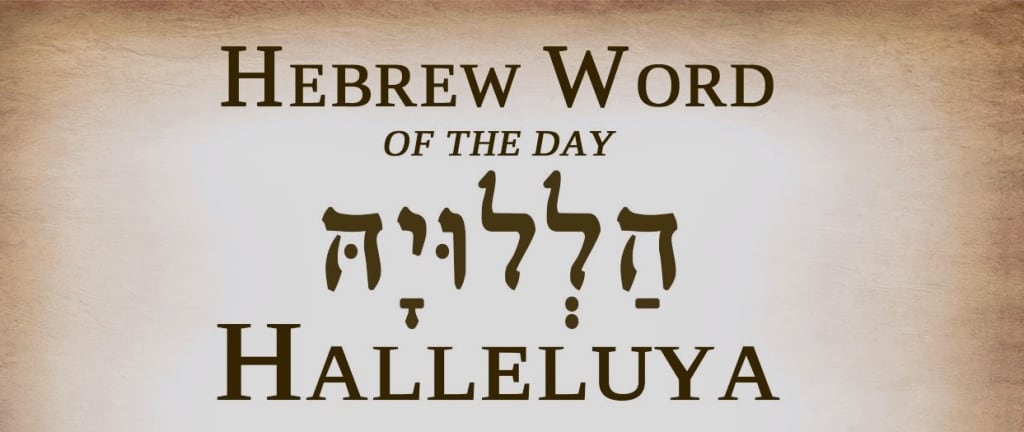
HalleluYah is a term that is often used in religious settings to express gratitude, praise, and worship. It is a powerful word that has been used in various forms of worship, including music, prayer, and Scripture. The word HalleluYah has been used for centuries, and its meaning has evolved over time. In this blog post, we will explore the meaning and history of HalleluYah.
The word HalleluYah is a transliteration of the Hebrew phrase הַלְלוּ יָהּ (hallelu yah), which means "praise the Lord." The word HalleluYah is often used in the Book of Psalms, a collection of religious poems and songs that were used in Jewish worship. In the Hebrew Bible, the word HalleluYah appears 24 times, all in the Book of Psalms.
The word HalleluYah has been used in Christian worship since the early days of the church. The early Christians inherited the Book of Psalms from the Jews and used it as a basis for their own hymns and prayers. The word HalleluYah became a common feature of Christian worship, particularly in the celebration of the Eucharist, or Communion.
In Christian worship, the word HalleluYah is often associated with the idea of salvation. It is used as a way of expressing gratitude and joy for God's saving grace. It is also used as a way of acknowledging God's power and sovereignty over all things.
The word HalleluYah has also been used in secular contexts, particularly in music. It has been used in popular songs, such as Leonard Cohen's "HalleluYah," which has become an iconic song that has been covered by many artists. In these contexts, the word HalleluYah is often used to express feelings of joy and triumph.
In addition to its use in religious and secular contexts, the word HalleluYah has also been used in literature. It has been used in poetry, fiction, and drama as a way of expressing a range of emotions, from joy and celebration to sadness and despair. It has become a powerful and versatile word that can be used to convey a wide range of meanings and emotions.
Etymology
The word HalleluYah is derived from the Hebrew language, with “Hallelu” meaning “praise” or “commend,” and “Yah” being an abbreviation of the name of God, Yahweh. Therefore, the word HalleluYah literally means “praise Yahweh.”
The first part of the word, Hallelu, is an imperative verb that is used to encourage someone to praise or exalt something. It is often used in Psalms and other parts of the Hebrew Bible as a call to worship and praise God. The second part of the word, Yah, is a shortened form of Yahweh, one of the names of God in the Old Testament.
History
The word HalleluYah has been used in religious settings for centuries. It has been used in various forms of worship, including music, prayer, and Scripture. In the Hebrew Bible, HalleluYah is found in the book of Psalms. Psalms are a collection of 150 religious poems and hymns that are used in Jewish and Christian worship. Many of the Psalms contain the word HalleluYah, which is used to express praise and thanksgiving to God.
In the New Testament, HalleluYah is also found in the book of Revelation. In Revelation, the word is used as a call to worship and praise God. It is often used in conjunction with other terms that describe the glory and power of God. For example, in Revelation 19:1-6, the word HalleluYah is used four times to describe the praise and worship that is given to God.
In Christianity, HalleluYah has been used as an exclamation of praise and thanksgiving to God. It has been used in various forms of worship, including music, prayer, and Scripture. In fact, some of the most famous Christian hymns contain the word HalleluYah. For example, the hymn “HalleluYah, What a Savior!” was written in the late 1800s and is still sung in churches today.
In Jewish tradition, HalleluYah is a word that is used to express praise and thanksgiving to God. It is often used in conjunction with other terms that describe the glory and power of God. For example, in Jewish liturgy, the word HalleluYah is used during the Passover Seder to express praise and thanksgiving to God for delivering the Israelites from slavery in Egypt.
Meaning
The word HalleluYah is a powerful word that is used to express praise and worship to God. It is a word that is used to celebrate the goodness, greatness, and glory of God. When we say HalleluYah, we are expressing our gratitude and thanksgiving to God for all that he has done for us.
HalleluYah is a word that is often used in conjunction with other terms that describe the glory and power of God. For example, in the book of Revelation, HalleluYah is used in conjunction with terms like “salvation,” “glory,” and “power.” These terms help to paint a picture of God’s greatness and majesty.
HalleluYah is also a word that is often used in music. Many songs and hymns contain the word HalleluYah.
In addition to its use in religious and secular contexts, the word HalleluYah has also been used in literature. It has been used in poetry, fiction, and drama as a way of expressing a range of emotions, from joy and celebration to sadness and despair. It has become a powerful and versatile word that can be used to convey a wide range of meanings and emotions.
The word HalleluYah has also been the subject of much debate and discussion among scholars and theologians. Some have argued that the word should only be used in religious contexts, as it has a specific meaning and significance within those contexts. Others have argued that the word has transcended its religious origins and can be used in a variety of contexts to express a range of emotions and meanings.
Despite these debates, the word HalleluYah remains a powerful and meaningful word that continues to be used in a variety of contexts. Its rich history and diverse meanings make it a fascinating subject of study and exploration.
In conclusion, the word HalleluYah is a term that has a rich history and a range of meanings. It originated in the Hebrew Bible as a way of praising God and has been used in Christian worship for centuries. It has also been used in secular contexts, particularly in music, as a way of expressing joy and triumph. The word HalleluYah has become a powerful and versatile word that can be used to convey a wide range of meanings and emotions. Its continued use in a variety of contexts is a testament to its enduring significance and power.
About the Creator
Keep reading
More stories from Ehsan Masih and writers in Education and other communities.
The Discipline Line That Protects Every Serious Trader
A lack of opportunity rarely destroys long-term trading success. A single uncontrolled loss far more often destroys it. Markets move quickly, emotions react faster, and hesitation at the wrong moment can erase months or years of progress. Pre-defined stop losses are in place to prevent that outcome.
By Agast Mishra7 days ago in Education
The Road That Taught Him Silence
In the small village where the mountains met the fields, mornings arrived quietly. The sun did not rise in a hurry there; it climbed slowly, as if respecting the stillness of the land. Birds were the first to greet the light, their soft calls weaving through the narrow lanes and mud-brick houses. Aamir had learned to wake before the village did. At first, this habit was forced. Sleepless nights, heavy thoughts, and restless dreams had pushed him out of bed before dawn. He did not know where to go, only that staying inside the house made his chest feel tighter, his breath shorter, his mind louder. One morning, without purpose, he stepped outside and began walking toward the path that lay between the barley fields and the low, blue mountains. That path soon became his silent companion. Every day, he walked there — sometimes quickly, sometimes slowly, sometimes stopping for long minutes to watch the wind bend the crops like a green ocean. The path was narrow and uneven, yet it carried him faithfully, never asking where he was going or why. In its quiet presence, he found a strange comfort. Aamir was not unhappy in the usual sense. He had food, family, and education. He taught children in the village school and was respected by many. Yet inside him lived a deep confusion — a soft but constant question: Am I becoming what I was meant to become? He had dreams once — of writing, of speaking beautifully, of guiding others not only through lessons but through life itself. But responsibilities had grown faster than courage. Slowly, without noticing, he had begun to doubt himself. And doubt, unlike pain, does not shout. It whispers. On one such morning, when the mist still clung to the fields like a thin veil, Aamir noticed footprints beside his own. They were not fresh, but they were regular — the marks of someone who walked the same road every day. A few minutes later, he found their owner. An old man sat on a flat stone near the edge of the path, a wooden staff resting beside him, a small flock of sheep grazing quietly nearby. His beard was silver, his clothes simple, and his eyes clear in a way that surprised Aamir. Those eyes did not seem tired by age; they seemed polished by time. “Peace be upon you,” Aamir greeted. “And upon you, peace,” the old man replied warmly. “You walk early.” “So do you,” Aamir smiled. The old man nodded. “The morning is honest. It shows you who you are before the world begins to tell you who you should be.” The words struck Aamir gently, like a leaf touching water. From that day onward, they met often. Sometimes they spoke, sometimes they shared long silences. The old man never asked many questions, yet somehow Aamir found himself speaking — about his students, his ambitions, his fear of wasting his abilities, his constant comparison with others who seemed more confident, more successful, more certain. One morning, Aamir confessed, “I feel as if I am standing still while the world moves ahead.” The old man watched the sheep for a moment, then said, “Have you seen a tree grow?” “Yes.” “Does it run to become tall?” “No.” “Yet it becomes tall.” Aamir smiled faintly. “But people judge trees by their height.” “They do,” the old man agreed. “But trees are not planted to impress people. They are planted to become themselves.” The sentence stayed with Aamir long after the walk ended. Days turned into weeks, and weeks into months. With each walk, something inside him shifted — slowly, almost invisibly. He began to notice small beauties he had ignored before: the way dew rested on grass like tiny mirrors, the rhythm of his own breathing, the calm dignity of the mountains that never hurried yet never failed to stand firm. One morning, Aamir arrived to find the stone empty. No sheep. No staff. No silver-bearded teacher. For several days, he returned at the same hour, hoping to meet the old man again. But the path remained silent, as if it had never known such a presence. Disappointment crept into his heart. On the seventh morning, as he walked farther than usual, he noticed a small bundle placed carefully beside the path. Inside it lay a worn notebook and a folded piece of paper. The note read: “To the one who walks with questions, Do not search for me again. I was only a mirror, not a guide. The road has taught you silence. Silence has taught you clarity. Now let clarity teach you courage. Remember: You are not late. You are not lost. You are simply growing underground.” Aamir sat there for a long time, holding the paper with trembling hands. That day, when he returned home, he opened his old notebooks, the ones where unfinished writings slept like forgotten seeds. For the first time in years, he wrote not to impress, not to compete, but to understand himself. He began to speak more gently to his students, not only teaching lessons, but listening to fears. He encouraged them to walk, to observe, to think, to trust their own pace. And every morning, he still walked the same path. The road never answered his questions directly. But slowly, quietly, it returned something far more precious: The belief that becoming oneself is not a race — It is a journey best taken in silence, With steady steps, And an honest heart.
By Muhammad yaseen6 days ago in Education




Comments
There are no comments for this story
Be the first to respond and start the conversation.