

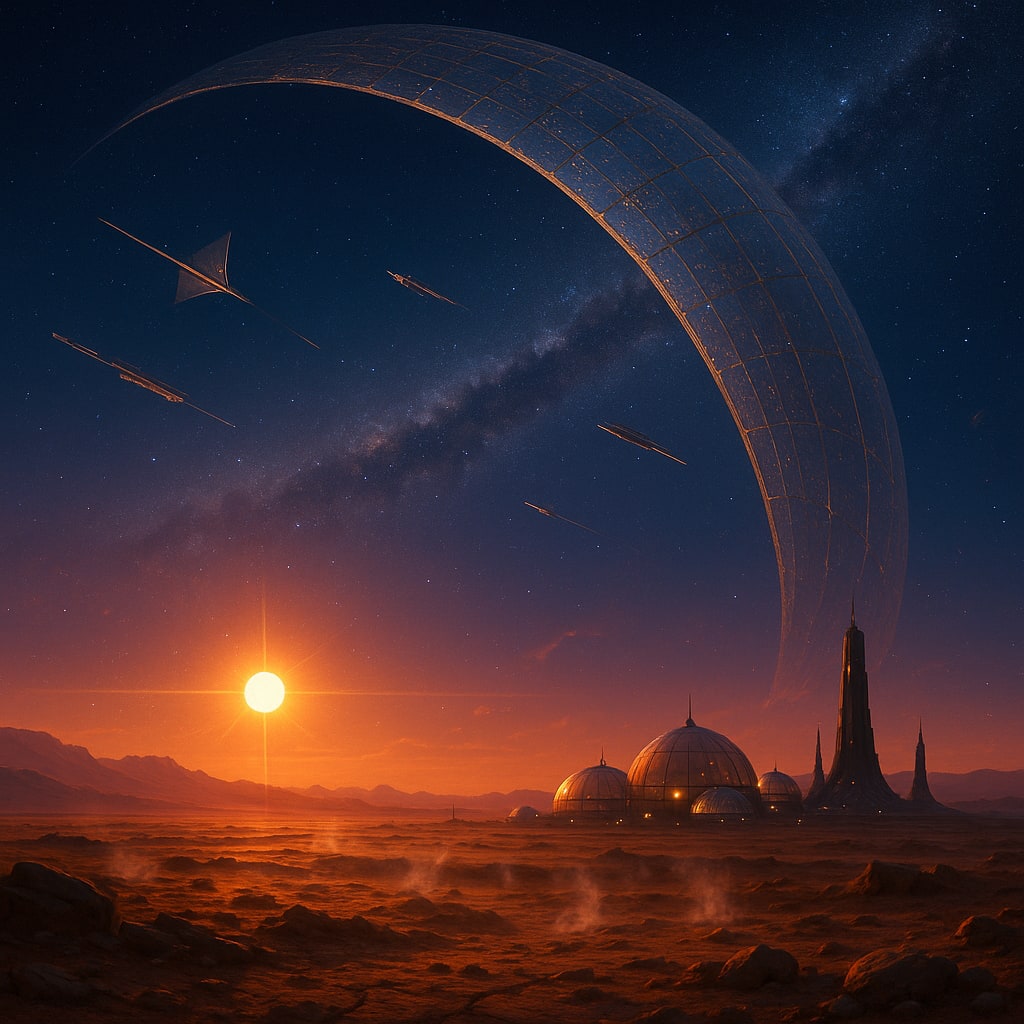
The idea of humanity becoming a galactic civilization sounds like something out of a science fiction novel. Yet if we take a step back and look at the history of our species, it feels less like fantasy and more like the natural continuation of a pattern. Humans have always been explorers. From the moment our ancestors ventured out of caves to sail oceans, climb mountains, and eventually reach the skies, we have expanded the boundaries of the known world. Our next frontier isn’t just another continent or even another planet — it’s the stars themselves.
Humanity’s First Cosmic Steps
At this point in history, we remain bound to Earth. Our resources, culture, and very survival are tied to this fragile planet. And yet, we’ve already taken our first cautious steps toward becoming a spacefaring species. The International Space Station is more than just a science lab floating above the Earth — it is proof that humans can live beyond our home world for extended periods. Future plans for permanent lunar bases and Martian colonies represent the next milestones. But compared to what it would take to become a galactic civilization, these efforts are only the beginning.
The Energy Challenge
In the 1960s, Russian astronomer Nikolai Kardashev proposed a famous scale to measure the advancement of civilizations by the amount of energy they can harness. Humanity currently sits at about 0.7 on this scale. To expand beyond our solar system, we would need to at least reach Type II — the level where a civilization can capture and use the full energy output of its star.
This would require engineering projects on an unimaginable scale. Concepts such as Dyson spheres or Dyson swarms — massive structures that could enclose a star and harvest its energy — are theoretical examples of what might be possible. Another path could be mastering nuclear fusion, which would provide humanity with nearly limitless power. Without such breakthroughs, the dream of traveling between the stars will remain out of reach.
Colonizing New Worlds
If we truly aim to populate the galaxy, humanity will need to adapt to a wide range of environments. Not every planet will be Earth-like, and terraforming — reshaping planets to resemble Earth — may prove extremely difficult. That means future humans might not look like us at all. Through genetic engineering, cybernetics, or other enhancements, we may evolve into beings capable of thriving under extreme radiation, different atmospheres, or alien gravity.
Robotics and artificial intelligence will also play a key role. Before humans ever set foot on distant planets, fleets of autonomous machines could prepare the terrain, build infrastructure, and even mine resources. In many cases, our robotic explorers might be the true pioneers, with humans arriving later.
Culture and Identity in the Stars
Technology alone won’t define a galactic civilization. To survive and flourish among the stars, humanity will need to answer deeper questions about who we are and what values we carry with us. Will our interstellar colonies be united by cooperation, or fractured by competition and conflict?
It’s likely that over thousands of years, different human colonies will develop their own cultures, languages, and even physical traits. A society living under the dim red glow of a dwarf star might evolve in ways unimaginable to us. And yet, they will remain part of the same vast family tree — different branches of humanity spread across the Milky Way.
The Great Obstacles Ahead
Of course, there is no guarantee that humanity will achieve this future. The concept of the “Great Filter” warns us that most civilizations may never reach the stars because something destroys them first — whether it’s self-inflicted war, environmental collapse, or technological disasters. If we want to avoid becoming another silent species lost to history, we must learn to manage our planet’s resources, solve global challenges, and act with long-term vision.
A Million Years Into the Future
Imagine humanity a million years from now. Instead of being confined to a single planet, our descendants might live in thousands of colonies spread across different star systems. Interstellar travel could be as common to them as air travel is to us today. They might send ambassadors to other intelligent species, if any exist, or even form interstellar alliances.
And perhaps, looking back at Earth, they will see it not just as the cradle of humanity but as a sacred homeworld — the place where it all began.
Conclusion
Right now, the dream of becoming a galactic civilization is still just that: a dream. But it is also a powerful source of inspiration. It pushes scientists to develop new technologies, fuels philosophers to question our role in the cosmos, and encourages dreamers to imagine futures beyond imagination.
We may be far from building Dyson spheres or colonizing alien worlds, but we have already taken our first small steps. The stars we see at night are no longer unreachable mysteries — they are destinations. And one day, humanity’s story may not just be written on Earth, but across the galaxy itself.
About the Creator
Keep reading
More stories from Holianyk Ihor and writers in Education and other communities.
Why Are Some Stars Blue?
When we look up at the night sky, it often feels timeless and familiar. The stars twinkle like scattered jewels, and most appear white or slightly yellowish to the naked eye. Yet, if you observe carefully—or even better, through a telescope—you’ll notice that not all stars share the same shade. Some gleam in a striking blue light, brighter and sharper than their neighbors. But why are certain stars blue? What cosmic secrets are hidden behind this intense color?
By Holianyk Ihor5 months ago in Education
From Despair to Hope: How Animal Rescue Efforts Rebuild Broken Lives
Animal rescue efforts stand as a powerful response to suffering that often goes unseen. Across towns, cities, and rural areas, animals face neglect, abandonment, injury, and fear every day. Many are left without food, shelter, or medical care. Others are harmed by abuse or natural disasters. Without help, their future is uncertain. Through patience, care, and action, animal rescue efforts transform despair into hope and give animals the chance to heal and live safely.
By Brenda McGrane3 days ago in Education



Comments
There are no comments for this story
Be the first to respond and start the conversation.