
The Ultimate Showdown: What Happens When Jupiter Meets a Black Hole?
Exploring the Fate of the Galaxy: The Epic Encounter Between Jupiter and a Black Hole
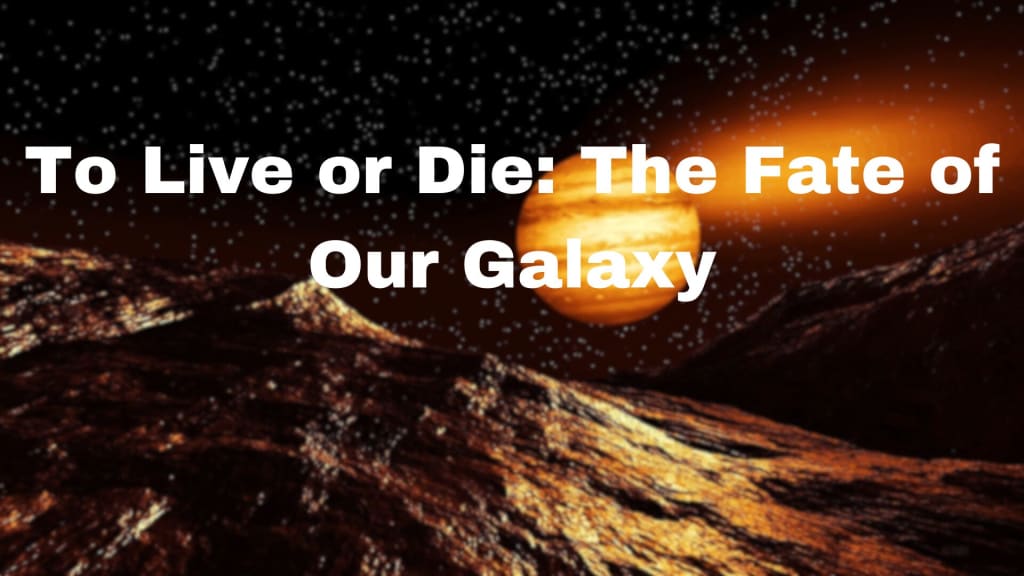
Ladies and gentlemen, get ready for the ultimate cosmic battle. In one corner, we have Jupiter, the largest planet in our solar system, and in the other corner, we have a small but mighty opponent, a black hole. These two forces of nature are hurtling towards each other, and the question on everyone's mind is, "What will happen if they collide?"
Jupiter, the gas giant, is a heavyweight in our solar system, with a mass two and a half times greater than all other planets combined. Its opponent, the black hole, may be small, but it is incredibly dense and has a gravitational pull that is unlike anything we have ever encountered.
Black holes are formed when massive stars collapse under the weight of their own gravity. The resulting object is so dense that nothing can escape its gravitational pull, not even light. Stellar black holes range from three to ten times the mass of our sun, while supermassive black holes can be millions or even billions of times the mass of the sun.
If Jupiter were to collide with a black hole, it would be game over for the gas giant. Despite its enormous size, Jupiter's gravity is no match for the black hole's intense gravitational pull. The black hole would swallow Jupiter whole, pulling in its gas and dust, and eventually consuming the entire planet.
However, it's highly unlikely that a black hole would come close enough to our solar system to cause such destruction. But, let's say a rogue black hole or star did enter our solar system. What would happen then?
The first thing the black hole would encounter is the Oort cloud, a shell of icy objects that surrounds our solar system. The black hole's gravity would disrupt the cloud, causing comets and asteroids to be ejected from their orbits. As the black hole moves closer to our inner planets, it would continue to cause chaos, ejecting icy objects from the Kuiper belt, including the dwarf planet Pluto.
As the black hole passed Uranus, Neptune, and Saturn, their gases would be stripped away, forming an accretion disk of superheated gas and dust around the intruder. If the black hole came too close to any of these planets, they could also be ejected from their orbits.
Finally, the black hole would approach Jupiter, and the gas giant would experience a similar attack on its atmosphere. The black hole would pull away Jupiter's hydrogen and helium gases, eventually pulling the entire planet towards it. Jupiter would be no match for the black hole's intense gravitational pull, and it would be swallowed whole.
As the black hole consumes Jupiter, it would release an explosive wave of UV and x-rays in all directions. This wave of radiation would be incredibly dangerous to any living organisms in its path, including humans. Lethal amounts of radioactive material would rain down on Earth in less than an hour, causing widespread destruction.
Without Jupiter, our solar system would be thrown off balance. Jupiter's gravity plays a vital role in keeping asteroids and comets from hitting Earth and other inner planets. It also helps to maintain Earth's nearly circular orbit around the sun.
In the long term, the loss of Jupiter could have devastating effects on our solar system. Without its protective shield, Earth and other inner planets would be bombarded by asteroids and comets, causing widespread destruction and potentially ending life as we know it.
In conclusion, the collision between Jupiter and a black hole would be the ultimate cosmic showdown. While the chances of such an event happening are incredibly slim, it's a reminder of the destructive power of the universe. Jupiter's fate in such a collision is sealed, but the impact on our solar system would be felt for years to come. We can only hope that we never witness such a catastrophic event in our lifetime.
About the Creator
Keep reading
More stories from writers in Education and other communities.



Comments
There are no comments for this story
Be the first to respond and start the conversation.