
The Tunnel Rats Risked Their Lives Searching For Bombs Underground.
The tunnel rats performed underground search and destroyed enemy missions during the Vietnam War.

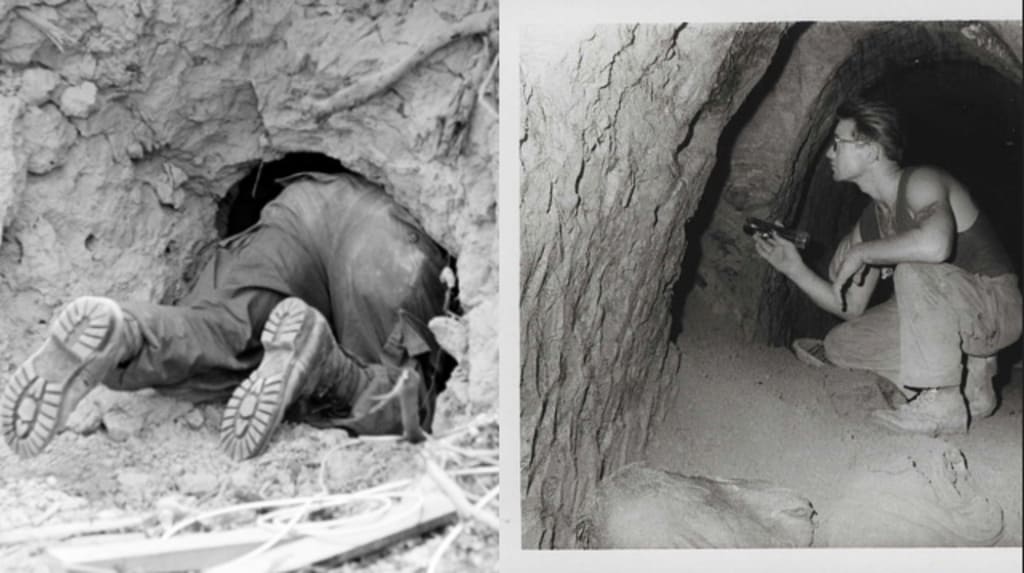
During the Vietnam War, soldiers from South Vietnam, Australia, New Zealand, and the United States carried out missions to search and destroy tunnel systems.
These fearless combat engineers frequently risked their lives as they plunged into the intricate Viet Cong tunnel systems to obtain information and defuse bombs.
The Ingenious Enemy Tunnels
In order to prevent the French colonial invasion of Vietnam, the Viet Minh forces initially constructed a sophisticated network of underground tunnels known as the Cu Chi tunnels.
But when the Viet Cong later used it to fight against American and coalition forces, what had initially been a pretty primitive network of tunnels quickly developed into a sophisticated labyrinth beneath Vietnam.
The tunnels already contained a number of hospitals, storage facilities, training camps, and barracks by the time the Vietnam War broke out in the 1960s. Later, efficient ventilation shafts were put in place, enabling Viet Cong forces to stay underground for extended periods of time.
The tunnels could be demolished above ground, but frequently this was insufficient to completely remove the maze because of how intricate and snake-like the tunnels were. For intelligence to properly guide their attack, someone would need to descend into the tunnels. The tunnel rats were created as a result.
But it turned out that the tunnels were a much more dangerous, undiscovered place, full of mystery. Along with hostilities, the Viet Cong had set booby traps throughout the tunnels since they were fully aware that American forces would try to use the underground against them.
U-bends had been installed along the tunnels, allowing sections of them to flood and trap soldiers. Similar access sites were made so that gas that might kill or knock a soldier out could be introduced.
There were also less advanced traps employed. The tunnels were filled with a variety of venomous snake species that the Vietnamese are familiar with but that foreigners are not.
There were natural risks in addition to planned ones. Being underground exposed troops to insects, some of which were dangerous, like scorpions. The tunnels served as roosts for bats and other species, offering another diversion from the current job.
The tunnel rats were forced to be creative and often even managed to maneuver around these attacks.
Tunnel Rat's
The Australian Army initially referred to them as "Tunnel Runners," then "Ferrets," before changing the name to the more familiar "Tunnel Rat." The rats were made up of engineering personnel, some of whom had received their training at the School of Military Engineering of the Australian Army. Since most of the men were volunteers, it was easier for them to fit through the narrow confines because they tended to be smaller in stature.
The Australian Army initially referred to them as "Tunnel Runners," then "Ferrets," before changing the name to the more familiar "Tunnel Rat." The rats were made up of engineering personnel, some of whom had received their training at the School of Military Engineering of the Australian Army. Since most of the men were volunteers, it was easier for them to fit through the narrow confines because they tended to be smaller in stature.
However, despite occasionally being successful in obtaining intelligence, access to an enemy hospital, or weaponry, many tunnel rats lacked any official training. However, a significant chunk of the weaponry successfully recovered from the Viet Cong was the work of tunnel rats.
Armed simply with an army-issued handgun or revolver, troops frequently entered the tunnels, inspiring them to become inventive with making their own weapons. They typically used sawed-off shotguns and homemade bayonets as their own weapons. Gas masks were another piece of equipment the soldiers had.
In order to protect their hearing and the stability of the area around them, tunnel rats frequently had to use hand-to-hand fighting when confronted by Viet Cong soldiers underground.
About the Creator
Rare Stories
Our goal is to give you stories that will have you hooked.
This is an extension of the Quora space: Rare Stories
X(formerly Twitter): Scarce Stories
Writers:
....xoxo
Keep reading
More stories from Rare Stories and writers in Education and other communities.
Why Environmental Compliance Is Becoming a Business Priority for Companies in Dubai
Dubai continues to grow at a remarkable pace. Industrial zones expand, construction projects reshape the skyline, and logistics networks move goods through ports and airports every day. This growth creates strong economic opportunities, but it also increases environmental pressure across the city.
By Umar Quality Jounal6 days ago in Education
Can Social Media Shape a Better Society?
In today’s world, social media has become one of the most influential parts of everyday life. It connects people across countries, cultures, and languages within seconds. News travels quickly, ideas spread widely, and people share their thoughts with audiences they may never meet in person.
By zohaib ahmad2 days ago in Education


Comments (1)
My brother who just turned 80 was a Marine grunt serving in Nam from 1963 - 1967 He volunteered as a tunnel rat and worked those tunnels It was the scariest thing he’s ever had to do among many crazy things Of course it still affects him to this day.