
The truth about life on other planets - and what it means for humans
Exploring the Possibility of Aliens and the Future of Humanity
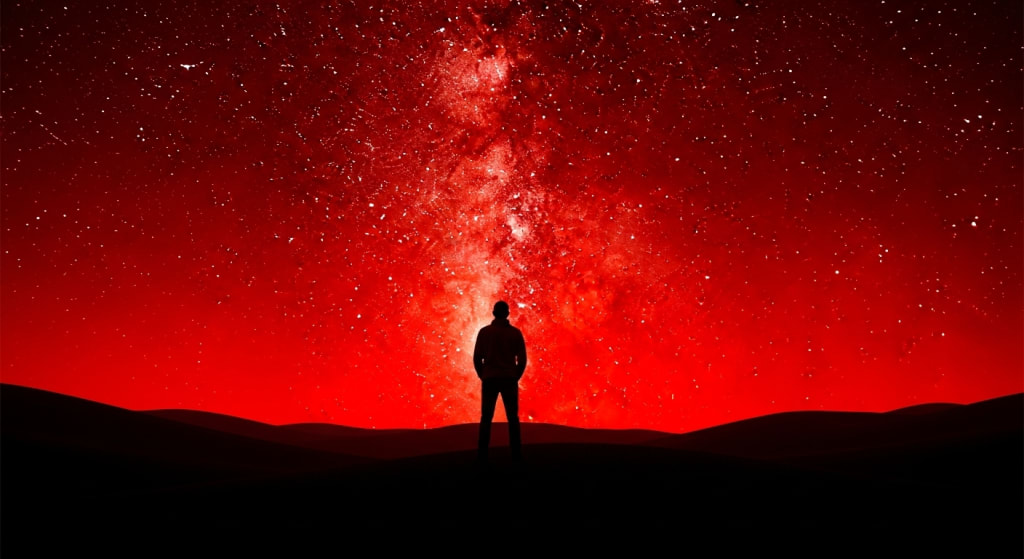
There are some scientific discoveries that do much more than advance our knowledge: they create a shift in our psyche as they show us the scale of the Universe and our place in it.
One such moment was when space craft sent back images of the Earth for the first time. Another is the discovery of life on another world, a moment that has inched a little closer today with the news that signs of a gas, which on Earth is produced by simple marine organisms, has been found on a planet called K2-18b.
Now, the prospect of really finding alien life - meaning we are not alone in the Universe - is not far away, according to the scientist leading the team that made the detection.
"This is basically as big as it gets in terms of fundamental questions, and we may be on the verge of answering that question," says Prof Nikku Madhusudhan of the Institute of Astronomy at Cambridge University.
But all of this prompts even more questions, including, if they do find life on another world, how will this change us as a species?
Flying saucers and sci-fi aliens
For a long time, people have made up stories about creatures living in the sky. In the early 1900s, some scientists thought they saw straight lines on Mars, which made them wonder if smart beings lived there. This idea led to many fun science fiction stories with flying saucers and little green aliens.
At that time, Western countries were very worried about communism, so aliens in stories were often shown as dangerous and scary instead of friendly.
But now, many years later, the best clue of life beyond Earth hasn’t come from nearby planets like Mars or Venus. Instead, it comes from a faraway planet that orbits a distant star, trillions of miles away.
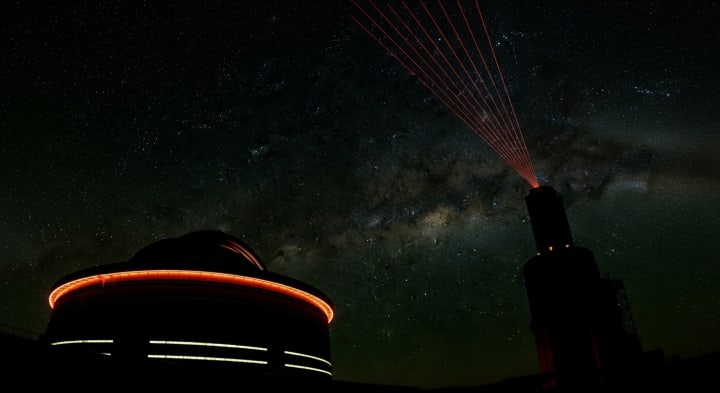
Nasa estimates that there are at least 100 billion planets in galaxy
Part of the challenge when it comes to researching the existence of alien life is knowing where to look.
Until relatively recently, the focus for Nasa's search for life was Mars, but that began to change in 1992 with the discovery of the first planet orbiting another star outside of our solar system.
Although astronomers had suspected that there were other worlds around distant stars there had been no proof until that point. Since then, nearly 6,000 planets outside our solar system have been discovered.
Many are so-called gas giants, like Jupiter and Saturn in our solar system. Others are either too hot or too cold to support liquid water, thought to be essential for life.
But many are in what astronomers call "The Goldilocks Zone" where the distance is "just right" to support life. Prof Madhusudhan believes there could be thousands in our galaxy.
Breathtakingly ambitious tech
As scientists found more of these faraway planets (called exoplanets), they started making tools to study the gases in their atmospheres. Their goal was bold and exciting.
They wanted to catch a small amount of starlight that passes through a planet’s atmosphere and look for signs of certain chemicals. These chemicals, called biosignatures, are only made by living things on Earth.
Scientists were able to build these tools for both ground and space telescopes.
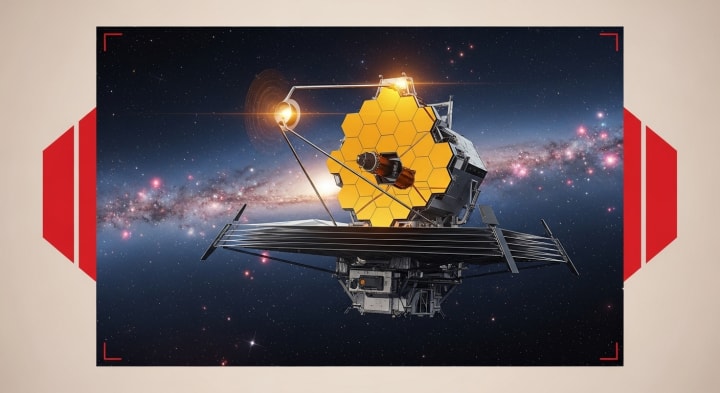
NASA’s James Webb Space Telescope (JWST), which found a special gas on the planet K2-18b, is the most powerful space telescope ever made. When it launched in 2021, many people were excited because it brought us closer than ever to finding life beyond Earth.
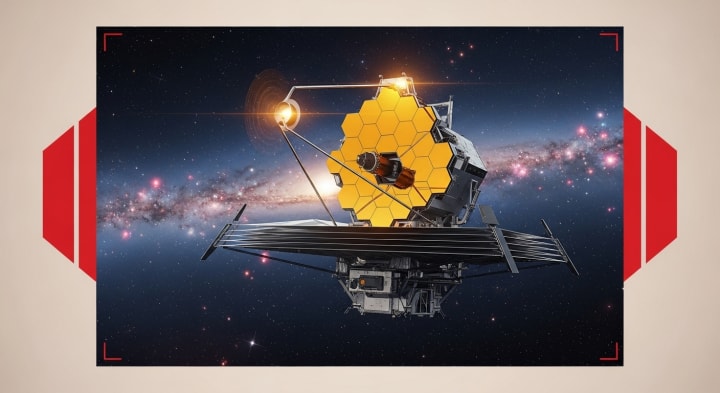
But JWST has its limits - it can't detect faraway planets as small as ours or as close to their parent stars, because of the glare. So, Nasa is planning the Habitable Worlds Observatory (HWO), scheduled for the 2030s, which will be able to spot and sample the atmospheres of planets similar to our own. (This is possible using what is effectively a high-tech sunshield that minimises light from the star which a planet orbits.)
Also coming online later this decade is the European Southern Observatory (ESO)'s Extremely Large Telescope (ELT), which will be on the ground, looking up at the crystal-clear skies of the Chilean desert.
It has the largest mirror of any instrument built, 39-metres in diameter, and so can see vastly more detail at planetary atmospheres than its predecessors.
More discoveries, more questions
Prof Madhusudan, however, hopes to have enough data within two years to demonstrate categorically that he really has discovered the biosignatures around K2-18b. But even if he does achieve his aim, this won't lead to mass celebrations about the discovery of life on another world.
Instead, it will be the start of another robust scientific debate about whether the biosignature could be produced by non-living means.
Eventually though, as more data is gathered from more atmospheres and as chemists fail in finding alternative explanations for biosignatures, the scientific consensus will slowly and gradually shift towards the probability that life does exist on other worlds, according to Prof Catherine Heymans, from Edinburgh University, who is Scotland's Astronomer Royal.
"With more time on telescopes, astronomers will get a clearer vision of the chemical compositions of these atmospheres. You won't know that it's definitely life. But I think the more data that's built up, and that if you see this in multiple different systems, not just this one particular planet, it gives us more confidence".
The world wide web emerged in a series of incremental technological breakthroughs that didn't necessarily feel of enormous consequence at the time.
In similar fashion, it may dawn on people that possibly the most enormous scientific, cultural and social transformation in the whole of human history has happened, but that the moment the balance was tipped in terms of there being other life out there was not fully recognised at the time.
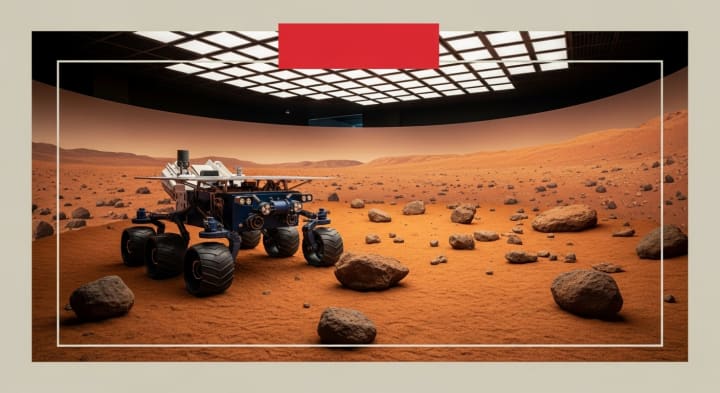
A clearer way to find life beyond Earth would be to use robots with lab tools to search nearby planets and moons. These robots could even bring samples back to Earth as strong proof.
Recent space missions have found signs that life may have existed in our solar system, so more missions are now being planned.
Europe’s ExoMars rover (2028) will drill into Mars to look for signs of life, likely ancient fossils. China’s Tianwen-3 (also 2028) aims to collect Martian samples and return them by 2031. NASA and ESA are also sending missions to Jupiter’s icy moons to search for hidden oceans that might support life.
JWST has its limits - it can't detect faraway planets as small as ours
These space missions aren’t built to find life directly. Instead, they help prepare for future missions that might. Professor Michele Dougherty says it’s a slow process. The next step is to send a lander, but we need to choose the right moon and a spot where the ice isn’t too thick to reach below the surface.
NASA also plans to send the Dragonfly spacecraft to Saturn’s moon Titan in 2034. Titan has lakes and clouds made of carbon-rich chemicals, which, along with water, could help support life.
Prof. Dougherty believes there's a good chance life exists on one of Jupiter or Saturn's icy moons. She says that with heat, water, and organic chemicals — the key ingredients for life — the chances are high.
Reducing human 'specialness'
Finding simple life doesn’t mean complex or intelligent life exists too.
Prof. Madhusudhan says simple life might be common in the galaxy. But how it evolves into complex or intelligent life is still a big mystery, and we don’t yet understand how that happens.
Dr. Robert Massey from the Royal Astronomical Society says simple life is much more likely to exist elsewhere than intelligent life. Life on Earth took a very long time to become complex with many different forms. He wonders if Earth’s unique conditions were needed for this to happen or if it could happen anywhere. Finding even simple alien life would show that humans are less special in the universe.
Many working in the field believe that it is a matter, rather than if, they discover life on other worlds
He says long ago, people thought Earth was the center of the Universe, but now we know we’re not. Finding life elsewhere would make us feel less special.
But Prof Dougherty thinks finding life in our solar system would be great for science and for how we feel inside. It would help us understand how life began and show us we’re part of something bigger, which is comforting.
As exoplanets have discovered, scientists began to develop instruments to analyse the chemical composition of their atmospheres
Never before have scientists searched so hard for life on other worlds and never before have they had such incredible tools to do this with. And many working in the field believe that it is a matter of when, rather than if, they discover life on other worlds. And rather than bringing fear, the discovery of alien life will bring hope, according to Prof Madhusudhan.
"When we would look at the sky, we would see not just physical objects, stars and planets, we would see a living sky. The societal ramifications of that are immense. It will be a huge transformational change in the way we look at ourselves in the cosmic scene.
"It will fundamentally change the human psyche in how we view ourselves and each other, and any barriers, linguistic, political, geographical, will dissolve, as we realise we are all one. And that will bring us closer," he continues.
"It will be another step in our evolution".
About the Creator
Kamran Khan
Proffessor Dr Kamran Khan Phd General science.
M . A English, M . A International Relation ( IR ). I am serving in an international media channel as a writer, Reporter, Article Writing, Story Writing on global news, scientific discoveries.
Keep reading
More stories from Kamran Khan and writers in Education and other communities.
First celestial image unveiled from revolutionary telescope
A Powerful New Telescope Unveils First Images, Promising Astronomical Breakthroughs A revolutionary new telescope in Chile has released its first images, showing off its incredible power to peer deep into the universe. One of the first photos captured vast, colorful clouds of gas and dust swirling in a star-forming region 9,000 light-years from Earth.
By Kamran Khan9 months ago in Education
How Gamified Learning Platforms Are Transforming Modern Education
Education has entered a new digital era where traditional classroom methods are being supported by innovative technologies. Instead of relying solely on textbooks, lectures, and written exams, educators are now exploring interactive tools that make learning more engaging and effective. One of the most important innovations in modern education is the concept of gamified learning, which blends academic content with elements commonly found in digital games.
By Backlinks Cart7 days ago in Education
The Spiritual Science of Krishna Consciousness in ISKCON Books
ISKCON Books and the Science of Krishna Consciousness The teachings of Krishna consciousness have inspired spiritual seekers for centuries, but in the modern world, these teachings have become widely accessible through the literature published by the International Society for Krishna Consciousness (ISKCON). These books present ancient Vedic wisdom in a structured and understandable way, allowing readers to explore profound spiritual knowledge while applying it to daily life.
By sudeshna rarhia day ago in Education
Top tipple tricks
Been thinking a lot about drinking, lately. Not least because of a recent episode of over-indulgence and the inevitable after effects. Some readers may recall the earlier articles I wrote about beating the booze. Here I set out an experiment in techniques for cutting down on my alcohol intake. The experiment was successful, the techniques worked, and I have armed myself with an arsenal of weapons in the war against the demon drink. I have yet to fire the first round however. It's all a question of timing (perhaps procrastination).
By Raymond G. Taylor7 days ago in Psyche




Comments
There are no comments for this story
Be the first to respond and start the conversation.