
First celestial image unveiled from revolutionary telescope
A new era of space exploration begins with groundbreaking clarity
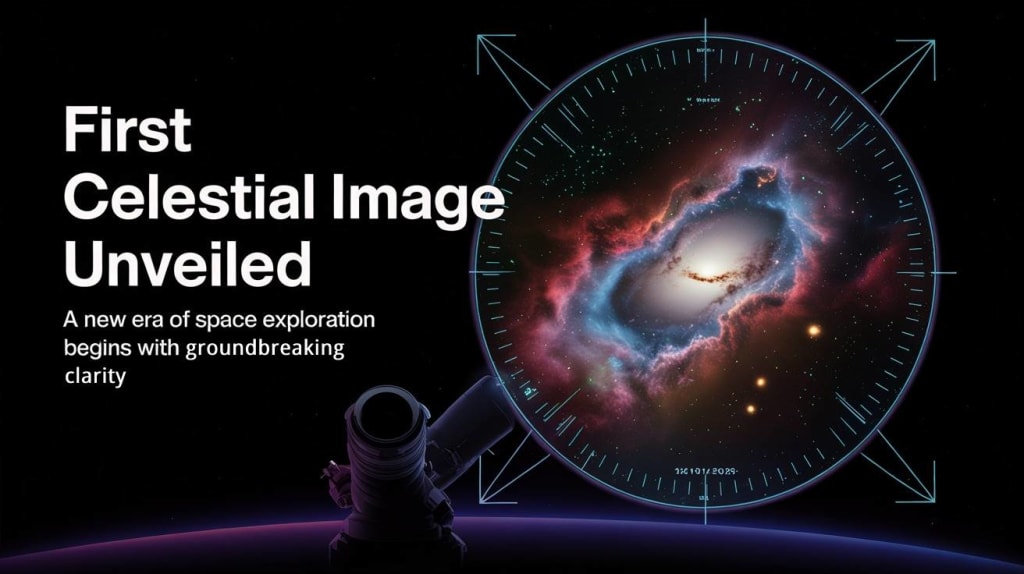
A Powerful New Telescope Unveils First Images, Promising Astronomical Breakthroughs
A revolutionary new telescope in Chile has released its first images, showing off its incredible power to peer deep into the universe. One of the first photos captured vast, colorful clouds of gas and dust swirling in a star-forming region 9,000 light-years from Earth.
The Vera C. Rubin Observatory, located in the Chilean Andes, is home to the world’s most powerful digital camera. With this technology, scientists hope to completely transform our understanding of space — from spotting dangerous asteroids to searching for dark matter and potentially even discovering a ninth planet in our solar system.
In just 10 hours, the telescope discovered 2,104 new asteroids, including seven near-Earth objects. That’s a stunning achievement considering that all other telescopes together usually discover around 20,000 asteroids in a year.
This marks the beginning of a 10-year mission to continuously photograph the southern night sky. “I’ve spent about 25 years working toward this,” said Professor Catherine Heymans, Astronomer Royal for Scotland. “It’s a historic moment.”
Why the Telescope’s Location Matters
The observatory sits atop Cerro Pachón, a dry, dark mountain ideal for space research. The area is kept extremely dark to protect the telescope’s view. Buses avoid using full headlights, and even tiny LED lights are turned off within the dome.
Commissioning scientist Elana Urbach says the telescope’s goal is to "understand the history of the universe." That means detecting faint galaxies and supernovae from billions of years ago — and for that, ultra-clear images are essential.
How the Telescope Works
The telescope uses a three-mirror system to gather and focus light:
- Light enters the telescope and reflects off a main mirror (8.4 meters wide),
- Then to a second mirror (3.4 meters),
- Finally onto a third mirror (4.8 meters) before hitting the camera.
Even a small speck of dust can ruin the image, so cleanliness is key.Its design allows it to collect enormous amounts of light, enabling it to see objects billions of light-years away — essentially looking back in time. “Thanks to the speed and clarity of the mirrors, we can capture the faintest objects,” said optics expert Guillem Megias.
A Record-Breaking Camera
The telescope's camera is a technological marvel:
- Size: 1.65 by 3 meters
- Weight: 2,800 kg
- Resolution: 3,200 megapixels (67x better than an iPhone 16 Pro)
- Speed: Takes a new image every 40 seconds during nightly 8–12 hour sessions
- Viewing Power: One full-resolution image would need 400 ultra-HD TV screens
The camera will photograph the entire night sky every three days as part of the Legacy Survey of Space and Time (LSST). “It was a special moment when we got the first image,” said Megias. “This is the work of a generation — people who started this before I was born.”
A Scientific Treasure Trove
The project is designed around four major goals:
- Tracking changes in the sky
- Studying how the Milky Way was formed
- Mapping objects in the solar system
- Exploring dark matter and the early universe
One of its most exciting features is that it will repeatedly scan the same parts of the sky. If anything changes — like a star exploding or an asteroid passing by — scientists will be alerted immediately.
“This ‘transient sky’ capability is completely new,” said Prof. Heymans. “We may discover things we’ve never even imagined.”
The telescope also has real-world applications — like spotting asteroids that could pose a threat to Earth. One such asteroid, YR4, once sparked fears of a potential collision. The Vera Rubin Observatory’s mirrors can detect the faintest of movements, helping us track such objects with unprecedented accuracy.
Expanding the Boundaries of Our Universe
According to Professor Alis Deason from Durham University, this telescope will completely change how we study the galaxy. Current data only stretches about 163,000 light-years from Earth, but with this telescope, we could see out to 1.2 million light-years.
She plans to use the data to study the Milky Way’s outer halo, a vast area of dead stars and faint satellite galaxies that are hard to detect. “It’s going to be the biggest dataset we’ve ever had,” she said. “It will guide our research for many years.”
Will It Find Planet Nine?
For years, scientists have debated whether a ninth planet — Planet Nine — exists in the far reaches of our solar system. If it does, the Vera Rubin telescope could be the tool to find it. Planet Nine is believed to be 700 times farther from the Sun than Earth, far beyond the reach of existing telescopes.
A Global Effort
The UK is playing a key role in this international project. It will run major data centers to handle the massive amount of imagery coming from the observatory.
Each night, the telescope may send out up to 10 million alerts about changes in the sky — a volume of data so large that teams around the world will be needed to analyze it.
“This is just the beginning,” said Prof. Heymans. “It’ll take time to fully understand how the observatory works. But I can’t wait to begin.”
About the Creator
Kamran Khan
Proffessor Dr Kamran Khan Phd General science.
M . A English, M . A International Relation ( IR ). I am serving in an international media channel as a writer, Reporter, Article Writing, Story Writing on global news, scientific discoveries.
Keep reading
More stories from Kamran Khan and writers in Education and other communities.
New hope for Britain's ash trees
Ash trees, one of Britain’s most iconic and beloved trees, are showing signs of recovery after more than a decade of devastation caused by ash dieback — a disease that has spread rapidly and harmed forests across the UK. New scientific research offers a glimmer of hope that these trees may not be lost forever.
By Kamran Khan8 months ago in Education
7 Online Skills That Can Change Your Financial Future in 2026
7 Online Skills That Can Change Your Financial Future In today’s digital world, one skill can completely transform your life. Just a decade ago, making money online sounded unrealistic to many people. Today, thousands of people are building careers, businesses, and even financial freedom using only their laptops and internet connections. The truth is simple: the internet has created opportunities that never existed before. But the biggest mistake most people make is waiting for the “perfect moment” to start learning. The reality is that learning just one valuable online skill can open doors to income streams you never imagined. Here are seven powerful online skills that can truly change your financial future. 1. Content Writing Content writing is one of the easiest online skills to start with. Every website, blog, and online business needs high-quality content to attract readers and customers. If you can write helpful, interesting, or informative articles, you already have the foundation for this skill. Content writers earn money by writing: Blog posts Website content Product descriptions News articles Platforms like freelance marketplaces, blogging websites, and digital publications are always looking for good writers. With practice, many writers turn this skill into a full-time career. 2. Graphic Design In the online world, visuals matter. Businesses need logos, social media graphics, advertisements, and brand designs to attract attention. Graphic design allows creative people to turn their imagination into income. Even beginners can start by learning simple tools and gradually improving their skills. Graphic designers can work with: Small businesses Online brands Content creators Marketing agencies A single well-designed logo or brand package can sometimes earn more than weeks of traditional work. 3. Video Editing Video is the most powerful form of content on the internet today. From social media platforms to online courses, videos dominate the digital world. But most creators don’t have the time or skill to edit their own videos. This is where video editors come in. If you learn how to cut clips, add music, create smooth transitions, and improve video quality, you can become extremely valuable. Video editors are needed by: YouTubers Businesses Online educators Social media influencers The demand for video editing continues to grow every year. 4. Social Media Management Millions of businesses rely on social media to reach customers. But many business owners don’t know how to grow their pages, create content, or engage with their audience. Social media managers help brands: Plan content Post regularly Respond to followers Grow their audience With the right strategy, social media managers can manage multiple accounts and earn steady monthly income. This skill combines creativity with marketing knowledge, making it highly valuable. 5. Digital Marketing Digital marketing is one of the most powerful online skills you can learn. It involves promoting products, services, or brands through online channels such as search engines, social media, and email. Digital marketers help businesses get: More website visitors More customers More sales Companies are willing to pay well for people who can increase their revenue. Learning digital marketing can open doors to freelance work, remote jobs, or even your own online business. 6. Web Development Every business needs a website. But building a professional website requires technical skills. Web developers create and maintain websites using coding languages and development tools. Although this skill takes more time to learn than others on this list, it is also one of the highest-paying online skills. Many web developers work remotely and build websites for clients all around the world. Once you gain experience, the opportunities become endless. 7. AI Content Creation Artificial intelligence is rapidly changing the online world. Many creators and businesses now use AI tools to produce content faster and more efficiently. AI content creators use technology to generate: Articles Images Videos Marketing content People who understand how to use AI tools effectively have a huge advantage in the modern digital economy. Instead of replacing creativity, AI often amplifies it. Those who learn how to combine creativity with technology will be ahead of the curve. Final Thoughts The internet has made it possible for anyone, anywhere in the world, to build valuable skills and create new income opportunities. But knowledge alone is not enough. The real difference comes from taking action. Pick one skill from this list and start learning today. Practice consistently. Improve a little every day. Over time, that single skill could become the foundation of a completely different financial future. Because sometimes, all it takes is one skill to change everything.
By Baseer Shaheen 4 days ago in Education
I <3 Irasutoya
If you live in Japan, you've seen Irasutoya images everywhere. It's on posters, it's on flyers, it's on internet adverts, it's truly everywhere. You've probably seen it once or twice if you don't live in Japan. It's cute, it's simplistic and it somehow manages to get succinct points across really clearly and concisely.
By Max Brooks5 days ago in Education


Comments
There are no comments for this story
Be the first to respond and start the conversation.