
The Story Of James Webb Space Telescope JWST
JWST

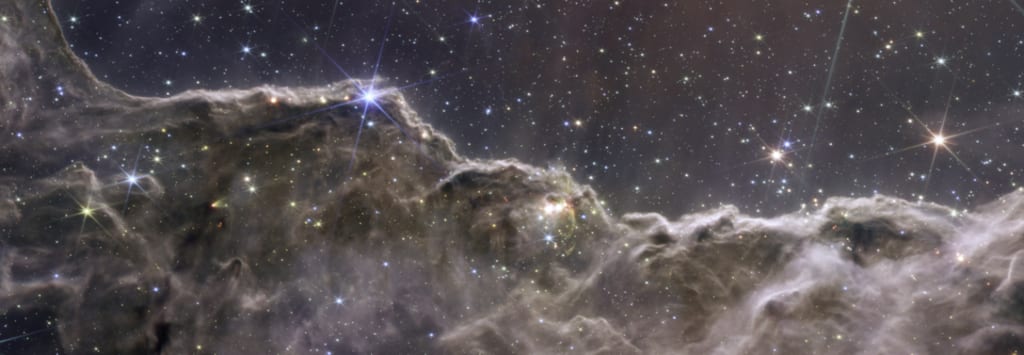
The James Webb Space Telescope JWST is a powerful infrared telescope that allows scientists to observe the universe in unprecedented detail. It has a large, segmented primary mirror that is coated with gold, which helps it collect infrared light from distant objects. JWST primary mirror is composed of 18 hexagonal segments, creating a total mirror diameter of 6.5 meters.
The mission The James Webb Space Telescope Webb is the next great space science observatory following Hubble, designed to answer outstanding questions about the Universe and to make breakthrough discoveries in all fields of astronomy. Webb will see farther into our origins: from the formation of stars and planets, to the birth of the first galaxies in the early Universe. Webb is an international partnership between NASA, ESA and CSA. The telescope launched on an Ariane 5 from Europe Spaceport in French Guiana.
One of the most important things about the James Webb Space Telescope JWST is that it's designed to look farther back in time than any telescope before it seeing galaxies as they were over 13 billion years ago, just a few hundred million years after the Big Bang.
This is possible because JWST observes in infrared light, which allows it to detect the faint glow of the earliest galaxies whose light has been stretched due to the expansion of the universe a phenomenon called redshift.
The launch
Launch date 25 December 2021
Launch location Europe Spaceport in French Guiana
Launch vehicle Ariane 5
Orbit Lagrange point 2, 1.5 million km from Earth
JWST is designed to study the early universe, including the first galaxies and the formation of stars and planetary systems. JWST uses infrared instruments to see through dust and gas clouds, revealing hidden details of the universe. The primary mirror is 6.5 meters 21 feet in diameter and the sunshield is the size of a tennis court. All JWST images are in the public domain and can be used freely.
JWST can analyze the atmospheres of planets outside our solar system exoplanets by measuring how starlight changes as it passes through them. It’s already detected water vapor, carbon dioxide, and even methane which could be signs of habitability or life. It orbits around the second Lagrange point L2, 1.5 million kilometers from Earth, where it stays super cold about -233°C. It needs that chill to observe faint infrared signals without interference. Within just a few months of operation, JWST found galaxies that seem too massive and mature to fit our current models of how the universe evolved. It's challenging what we thought we knew.
One of JWST main goals is to find the first generation of stars, called Population III stars the very first stars ever formed, made almost entirely of hydrogen and helium. No telescope has seen them yet, but JWST might be the first. JWST captured mind-blowing images like the Cosmic Cliffs in the Carina Nebula. These show turbulent regions where new stars are being born, with never before-seen structure and detail. JWST uses gravitational lensing where massive galaxies bend and magnify light from objects behind them to peek even farther into deep space. This helps it study invisible stuff like dark matter and ultra-faint galaxies.
JWST is helping with time domain studies watching how things change over time. That includes tracking supernova explosions, variable stars, and maybe even catching collisions between celestial bodies.
JWST was designed with a minimum mission lifetime of 10 years, but thanks to an extremely precise launch and efficient fuel usage, it could potentially operate for 20 years or more.
The main limiting factor is fuel specifically, the propellant it uses to maintain its position at the L2 point and to keep its instruments aligned properly. Once that fuel runs out, it won’t be able to stay stable or point accurately.
Right now, JWST is healthy and has plenty of fuel left, possibly enough to last into the 2040s if nothing goes wrong.
About the Creator
Keep reading
More stories from Rakibur Rahman Tonmay and writers in Education and other communities.
Time Management Hacks Every Entrepreneur Should Know
Running a startup demands more than hustle—it requires precision in how you use your time. As a founder, your daily choices directly impact your company’s growth, culture, and long-term sustainability. Without the right strategies, it's easy to get overwhelmed by tasks and lose sight of what truly matters. Mastering a few smart productivity habits can dramatically improve how you work.
By Per Jacob Solli4 days ago in Education
The "Free" Lead Trap: Why New Real Estate Agents Are Paying a Hidden Price
In the early stages of a real estate career, an agent’s most precious asset isn't their luxury car, their high-end camera gear, or a downtown office lease. It is their time. Yet, for many new professionals, time is the one resource they are most willing to squander in exchange for the "dopamine hit" of a smartphone notification.
By SiftlyLeads3 days ago in Education



Comments
There are no comments for this story
Be the first to respond and start the conversation.