
The Story of George Peake
The Man Who Turned Corn Into Progress
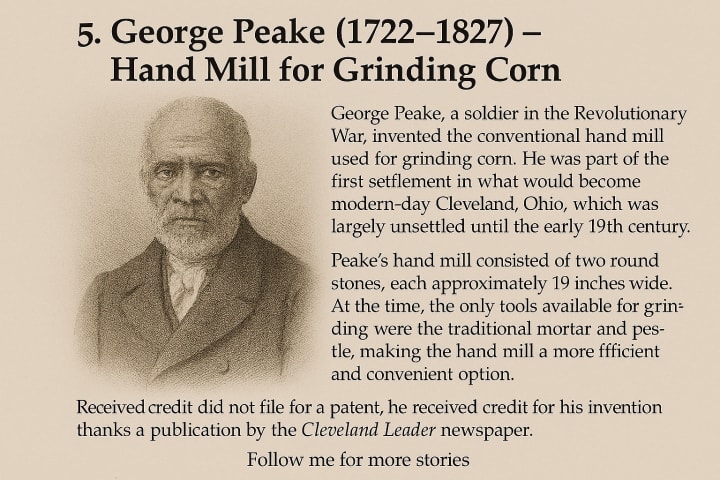
In the early winds of American history, long before cities rose and skylines filled the horizon, a quiet but determined innovator walked across the unsettled fields of what would one day become Cleveland, Ohio. His name was George Peake, a man born in 1722, who lived a remarkable 105 years — a lifetime that stretched across centuries of change.
Peake was no stranger to challenge. As a soldier in the Revolutionary War, he had already served a new and uncertain nation fighting for its independence. But when the war was done, his story was far from over. Where many saw wilderness and hardship in the northern Ohio frontier, Peake saw possibility.
A Settlement Waiting for Innovation
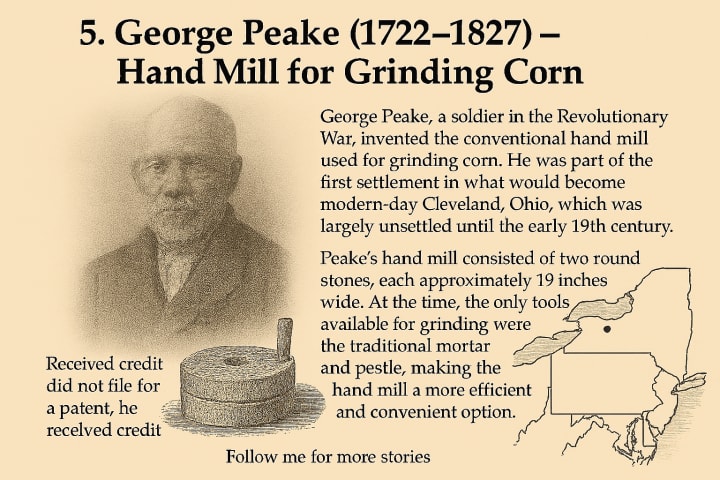
When he and his family arrived as part of Cleveland’s earliest settlement, the land was raw and untamed. Food was precious, labor was exhausting, and survival often depended on how efficiently one could process and prepare natural resources.
At that time, the only common way to crush corn — the backbone of many meals — was by using a mortar and pestle. It was slow. It was tiring. It was inefficient.
But Peake believed there had to be a better way.
The Birth of the Hand Mill
Using his hands, his experience, and the instincts only a lifelong problem solver could possess, George Peake crafted something extraordinary for the era:
a conventional hand mill made from two round stones, each nearly 19 inches wide.
It was simple, elegant, and ingenious.
Where the mortar and pestle required repetitive pounding, the hand mill allowed continuous grinding — smoother, faster, and far more efficient. With this invention, families could process corn more quickly and with far less effort, freeing up precious time and energy for the countless other demands of frontier life.
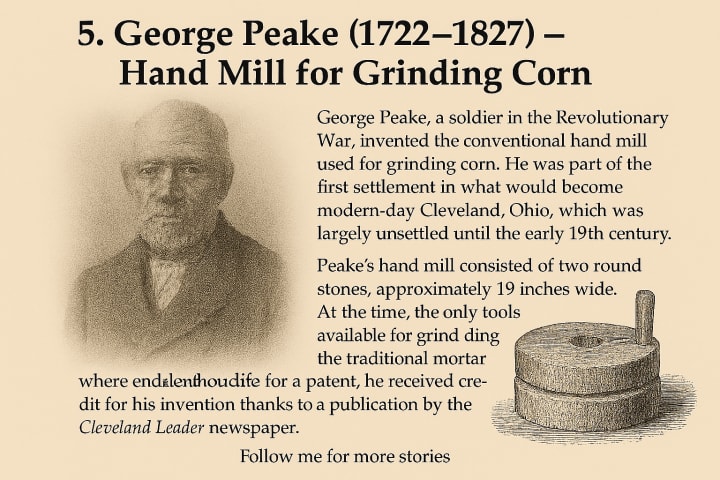
Peake didn’t patent his creation. Maybe he didn’t think about it. Maybe it wasn't important to him. But his community knew the truth.
The Cleveland Leader newspaper would later give him full credit, ensuring that his contribution to early American innovation would not be lost in the passing of time.
A Legacy Ground Into History
George Peake’s invention may not have been flashy, but it transformed daily life in foundational ways. His mill helped families eat better, live easier, and survive harsh days in a developing land. For a man who lived through the birth of a nation, perhaps it was fitting that he would also help shape the birth of a city.
He was a builder. A problem solver. A quiet hero of progress.
His story reminds us that innovation doesn’t always come from laboratories or textbooks — sometimes it comes from a pair of weathered hands turning two stones into a revolution.
If you enjoyed this story…
🔥 Follow me for more stories — inspiring, historical, creative, and powerful.
Your support helps me keep bringing these forgotten figures and untold moments back to life.
About the Creator
TREYTON SCOTT
Top 101 Black Inventors & African American’s Best Invention Ideas that Changed The World. This post lists the top 101 black inventors and African Americans’ best invention ideas that changed the world. Despite racial prejudice.
Keep reading
More stories from TREYTON SCOTT and writers in Education and other communities.
The Story of Andrew J. Beard
The Story of Andrew J. Beard: The Man Who Made Railroads Safer Andrew Jackson Beard entered the world in 1849 under the brutal weight of slavery, born into a system designed to crush ambition and erase potential. Yet from the beginning, Beard possessed something stronger than circumstance: a mind that could see solutions where others only saw problems.
By TREYTON SCOTTa day ago in Education
Parts of my Library Planner
This one is a long one, but I hope it helps some librarians (or anyone). Once you’ve purchased your planner materials, you need something to go inside it. I honestly feel that what goes in your planner is personal and needs to be tailored to what you’ll use. While you can find many teacher planners, when I searched for school librarian planners, I found only four. Although one is only 12.50, you would have to print and assemble it yourself. A second one is almost thirty dollars and also has to be printed and assembled yourself. A third is mass produced through Amazon and doesn’t have everything I would want. Finally there’s the Demco planner. While I agree that it looks like a fantastic purchase, I just cannot justify spending that much money on a planner that I’m only going to use for one year. For all the librarians that do purchase it, I hope you enjoy it. I might invest in it one year just to see what the fuss is about. For now, I’ll continue to use the one I’ve been developing and customizing for the last two years.
By Reb Kreyling6 days ago in Education
Effective App Site Design: Tips & Best Practices
In today's digital age, an engaging and effective app site design is crucial for capturing and retaining user interest. The right design not only showcases your app but also enhances user experience, making it crucial for converting casual visitors into loyal users. This article explores various aspects of app site design, from UI design ideas to responsive layouts, and provides actionable tips to help your app stand out.
By nandbox support2 days ago in Education
Writing About Writing: The Rainbow Trap
The good thing about living in modern times is that LGBTQ representation in media is increasing. Not just in niche and Independant media, either, but also in mainstream media. Books, movies, TV shows, comics... they're finally catching on that LGBTQ+ people form a significant part of their audience, and deserve to see themselves on screen and in fiction, not just as victims in documentaries and true crime shows.
By Natasja Rose4 days ago in Writers


Comments
There are no comments for this story
Be the first to respond and start the conversation.