
The Statue of Zeus at Olympia: A Lost Wonder of the Ancient World
A lost wonder of the world

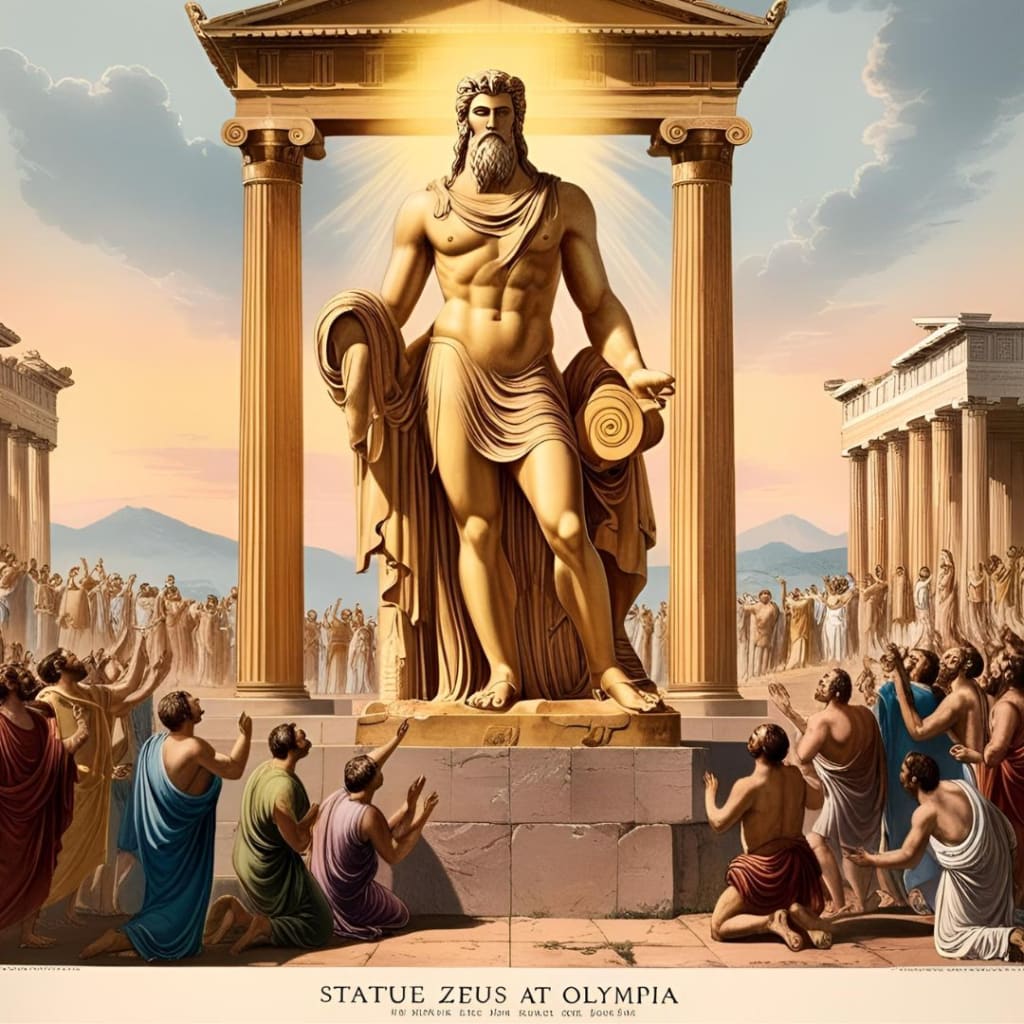
The Statue of Zeus at Olympia: A Lost Wonder of the Ancient World
Introduction
The Statue of Zeus at Olympia was one of the most magnificent and awe-inspiring creations of the ancient world. Listed among the Seven Wonders of the Ancient World, this colossal statue represented Zeus, the king of the Greek gods, in all his divine majesty. Crafted by the celebrated sculptor Phidias around 435 BCE, the statue stood within the Temple of Zeus in Olympia, Greece, a site of great religious and cultural significance. This temple was the focal point of worship and the location of the ancient Olympic Games, a festival held every four years in Zeus’s honor.
The Statue of Zeus was a masterpiece of Greek artistry and engineering, standing nearly 12 meters (39 feet) tall. It was a combination of gold, ivory, and precious materials, a testament to the wealth and artistic brilliance of the ancient Greeks. Though it was lost to history, its impact on art, culture, and religion endured for centuries. This article explores the history, construction, cultural importance, and eventual fate of this legendary statue.
The Origins and Purpose of the Statue
The Olympic Games had been held at Olympia since at least 776 BCE, but it was not until the mid-5th century BCE that the sanctuary saw a significant architectural transformation. The Temple of Zeus, built between 470 and 456 BCE, became the centerpiece of the sacred complex. To honor Zeus and solidify Olympia’s status as a religious hub, the Eleans, who controlled the sanctuary, commissioned the famous sculptor Phidias to create a grand statue of Zeus.
Phidias had already gained fame for his work on the Athena Parthenos, a massive gold and ivory statue of Athena inside the Parthenon in Athens. His reputation made him the perfect choice for the Olympian project. The statue aimed to convey the power, authority, and benevolence of Zeus, reinforcing the god’s role as the ruler of gods and men.
Construction and Materials
The Statue of Zeus was built using a technique called chryselephantine sculpture, which combined gold and ivory. A wooden framework formed the core of the statue, while sheets of ivory were used for the god’s flesh and gold panels adorned his robe and accessories. The throne on which Zeus sat was constructed of cedarwood, inlaid with gold, ebony, ivory, and precious stones. The statue was seated, yet it still nearly touched the temple's ceiling, creating the illusion that Zeus barely fit within his grand sanctuary.
Phidias and his workshop built the statue in a separate workshop near the temple, and archaeological excavations have uncovered tools, molds, and other remnants of the sculptor’s work. These findings provide valuable insights into ancient Greek sculpting techniques. To maintain the statue’s materials, particularly the ivory, workers applied olive oil to prevent cracking and warping in Olympia’s humid climate.
Iconography and Symbolism
Zeus was depicted as a majestic, bearded figure, seated on an elaborately decorated throne. His expression was one of calm authority, embodying the divine wisdom and omnipotence that the Greeks attributed to him. In his right hand, Zeus held a statue of Nike, the winged goddess of victory, symbolizing his role as the ultimate grantor of triumph. His left hand grasped a scepter topped with an eagle, reinforcing his dominion over both gods and men. The throne was adorned with depictions of mythological scenes, including images of gods, heroes, and legendary battles.
The presence of Nike in Zeus’s hand was particularly significant to the ancient Greeks. The Olympic Games were not merely athletic competitions but deeply religious events dedicated to Zeus. Victory in the Games was considered a sign of divine favor, and the statue’s imagery emphasized Zeus’s role in bestowing that favor.
The Temple of Zeus: A Fitting Home
The Temple of Zeus at Olympia was an architectural marvel in its own right. Designed in the Doric order, it was one of the largest temples in Greece at the time, measuring 64 meters in length and 27 meters in width. The temple featured massive columns, a richly decorated pediment, and sculptures depicting the Twelve Labors of Heracles. Inside, the temple was designed to amplify the grandeur of the statue, with the placement of the colonnades and lighting enhancing the visual impact of Zeus’s imposing presence.
The temple and statue together formed the religious heart of Olympia. Pilgrims from across the Greek world traveled to Olympia to pay homage to Zeus, and the Games served as both a religious ritual and a means of uniting the Greek city-states through competition.
The Legacy of the Statue
For centuries, the Statue of Zeus remained one of the most famous and revered sculptures in the ancient world. Numerous ancient writers, including Strabo and Pausanias, described it in detail, marveling at its beauty and divine presence. The Roman general and statesman Dionysius of Halicarnassus even claimed that the statue’s sight alone could uplift the human soul.
Beyond its immediate religious significance, the statue influenced subsequent depictions of Zeus and other deities. Many later Roman representations of Jupiter (Zeus’s Roman counterpart) drew inspiration from Phidias’s masterpiece. Even in modern times, artistic reconstructions of the statue continue to shape our imagination of ancient Greek artistry.
The Mysterious Disappearance
Despite its fame and religious importance, the Statue of Zeus was eventually lost. There are several theories about its fate:
1. Destruction by Fire in Olympia: One possibility is that the statue perished when the Temple of Zeus was damaged by fire in the 5th century CE. As Christianity spread throughout the Roman Empire, many pagan temples were abandoned or destroyed, and the temple may have fallen into disrepair.
2. Relocation to Constantinople: Some sources suggest that the statue was moved to Constantinople (modern-day Istanbul) around the 4th century CE, possibly by Emperor Theodosius I, who sought to preserve significant artworks. If this was the case, the statue may have been destroyed in the great fire of 475 CE, which ravaged much of the city’s treasures.
3. Gradual Decay: Another theory suggests that the statue simply deteriorated over time due to neglect, looting, or natural decay. The materials used—gold, ivory, and wood—would have made it particularly vulnerable to theft and environmental damage.
Regardless of how the statue met its end, no physical remnants have been recovered. Only descriptions, artistic depictions, and the ruins of Phidias’s workshop remain as evidence of this once-glorious wonder.
Conclusion
The Statue of Zeus at Olympia was a masterpiece of ancient Greek artistry, embodying both religious devotion and artistic excellence. Its sheer size, grandeur, and craftsmanship made it one of the most celebrated sculptures of antiquity. Though lost to history, its legacy endures through literary descriptions, archaeological findings, and artistic reconstructions.
The statue served as a powerful reminder of the reverence the ancient Greeks had for Zeus, the king of the gods, and their dedication to both religion and the Olympic tradition. Even today, it stands as a symbol of classical Greek art and the enduring wonder of human creativity. The mystery of its disappearance only adds to its legend, ensuring that the Statue of Zeus at Olympia remains one of the most fascinating lost treasures of the ancient world.
About the Creator
Kazi Mirajul Islam
I am expert in digital Marketing .I am also E- book writer & story writer. I am committed to delivering high-quality content.Also create social media account like Facebook,twitter account ,Instagram ,you tube account create and mained.
Keep reading
More stories from Kazi Mirajul Islam and writers in Education and other communities.
The Mausoleum at Halicarnassus: A Grand Tomb for Mausolus
The Mausoleum at Halicarnassus: A Grand Tomb for Mausolus Introduction The Mausoleum at Halicarnassus, one of the Seven Wonders of the Ancient World, stood as an extraordinary symbol of architectural brilliance and artistic grandeur. Located in present-day Bodrum, Turkey, this monumental tomb was constructed for Mausolus, a satrap (governor) of the Persian Empire, and his wife (and sister) Artemisia II. It became so famous that the word "mausoleum" has since been used to describe grand tombs worldwide. This article explores the historical context, architectural magnificence, artistic influence, and the enduring legacy of the Mausoleum at Halicarnassus.
By Kazi Mirajul Islam10 months ago in Education
Golf Handicap Reduction Without a Swing Overhaul: Smarter Ways to Play Better Golf
Lowering your handicap does not always require technical changes or hours on the range; it requires rebuilding your swing. Many golfers overlook the fact that scoring improvement often comes from strategic thinking, mental discipline, and better preparation. By focusing on how you play rather than how you swing, you can unlock consistent progress and enjoy the game more. This article explores practical, on-course methods that help you shoot lower scores while keeping your swing exactly as it is.
By Ian Schenkel Haliburtonabout 13 hours ago in Education
The Editorial Stack: Building Content Teams for the Multi-Platform Era
In an age where content travels across screens, feeds, formats, and audiences in real time, the old newsroom model no longer fits the demands of digital publishing. Today's media landscape requires more than great writers and sharp editors—it demands a multi-disciplinary, agile, and strategically aligned editorial stack. From video producers to data analysts, newsletter editors to TikTok creators, modern content teams must be designed with versatility and collaboration at their core.
By James Kaminskyabout 18 hours ago in Education


Comments
There are no comments for this story
Be the first to respond and start the conversation.