
The Secret Library of Dust and Hope
When They Banned the Books, We Learned to Read the World.
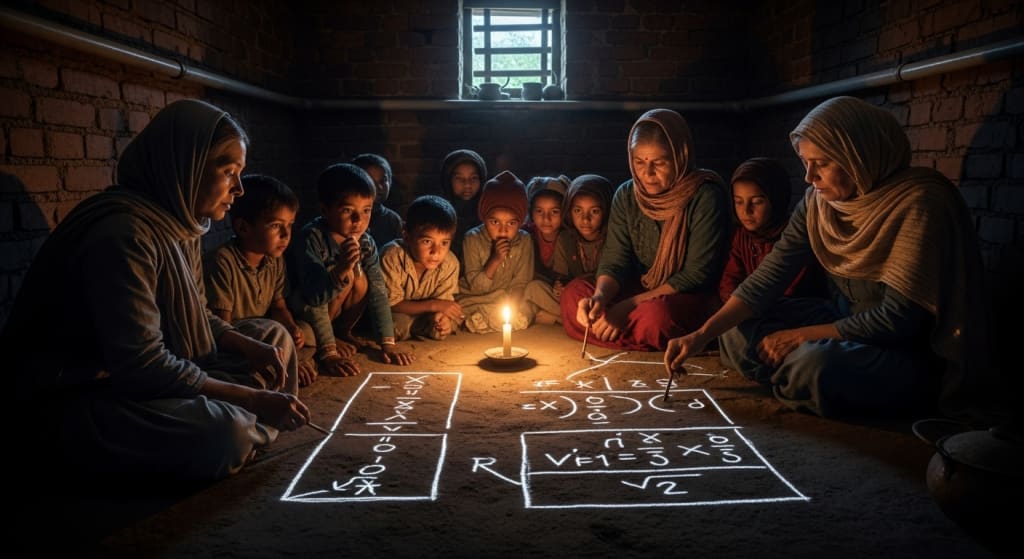
The decree came on a Tuesday, announced by grim-faced men in crisp uniforms on every screen. "To purify the national spirit and strengthen practical minds," they said, "the teaching of history, literature, and theoretical sciences is hereby suspended." Schools would now only teach manual trades and state-approved doctrine. Books were to be surrendered. Libraries were sealed.
Overnight, the world went quiet. The vibrant hum of ideas was replaced by the dull drone of indoctrination. For children like Anya, it was like a color had been bleached from the universe. Her mother, a former literature professor, now worked in a textile factory, her hands growing rough, her eyes growing distant.
But the human spirit is a stubbornly fertile thing. It cannot be caged for long.
The resistance began in whispers. It was called "The Dust School."
Anya’s mother, Professor Elara, was one of its founders. The library was the basement of a ruined bakery, its entrance hidden behind a false wall of bricks. There were no books; those were too dangerous. Instead, they had their minds.
On the first day, a dozen children sat on the cold, earthen floor. Professor Elara knelt before them. She had no chalkboard. She had only the dusty ground.
"Today," she whispered, her voice a soft rebellion in the dark, "we will learn about gravity." She let a pebble fall. "Isaac Newton saw an apple fall and asked 'why?' That question was more important than the answer. Your first lesson is to never stop asking 'why?'"
The Dust School curriculum was written in ephemeral things. Mathematics was traced with a finger on the floor, the numbers wiped away with a sweep of a hand after the problem was solved. History was told through spoken stories, a secret oral tradition passed from teacher to student, each child a living book. Literature was recited from memory—sonnets by Shakespeare, verses of Rumi, the powerful prose of banned novelists—their words living on in the breath of the children.
They learned chemistry by helping an old apothecary mix remedies, physics by studying the pulleys and levers used by the city's builders. The world itself became their textbook.
Anya thrived. She learned that poetry wasn't just words on a page; it was the rhythm of the rain on the roof and the meter of a heartbeat. She learned that history wasn't just dates; it was the story of the cracked foundation of the bakery, of who built it and why it fell. She learned that an idea, once planted in a mind, cannot be burned.
The danger was constant. Patrols roamed the streets, listening for the wrong kind of talk. Once, they came dangerously close to the bakery. The children froze, their hearts pounding in the silence. Professor Elara didn't flinch. She simply changed the lesson.
"...and that is why the stitch must be even, to ensure the strength of the seam," she said loudly, her voice now that of a simple sewing instructor. The patrol moved on, unaware they had just passed a university.
Years passed. The children of the Dust School grew into young adults, their minds sharpened by hunger for knowledge. They were mechanics who understood the philosophy of cause and effect, weavers who could deconstruct political rhetoric, and builders who saw the geometry of justice in their blueprints.
The regime, in its arrogance, believed it had killed education. But it had only forced it to evolve. By banning the formal vessel of learning, they had unleashed its true essence. Education was no longer a place you went or a book you read; it became a secret you carried, a fire you tended, a language you spoke with your eyes.
The day the regime finally faltered, it was not brought down by an army, but by a generation weaned on forbidden knowledge. It was the engineers who sabotaged the state's propaganda machines, the writers who secretly documented the truth, and the critical thinkers who could no longer be fooled.
Anya, now a teacher herself, stood before a new generation in a real, sunlit classroom. On her desk was a single, worn brick from the old bakery wall.
"We will read from many books now," she told her students. "But never forget that the most important library is not made of paper and ink. It is built of dust and hope, and it exists right here." She tapped her temple. "And no one can ever, ever, close its doors."
About the Creator
HAADI
Dark Side Of Our Society
Generosity Without Boundaries: Advancing Equity Through Philanthropy
Philanthropy has always played a meaningful role in shaping societies and improving the lives of individuals in need. From supporting educational programs to funding healthcare initiatives, acts of giving have helped communities overcome many challenges. In today’s diverse world, however, philanthropy is taking on a deeper purpose. It is increasingly focused on equity—ensuring that resources and opportunities are distributed fairly among people from different backgrounds and circumstances.
By John Olin Killgorea day ago in Education


Comments (1)
Brought tears to my eyes 🥹 When books are burned, people become the books. “The Dust School” will live forever. Masterpiece.