
The Architect of Silence
In a World Drowning in Noise, He Built Rooms Where You Could Hear Your Own Soul.
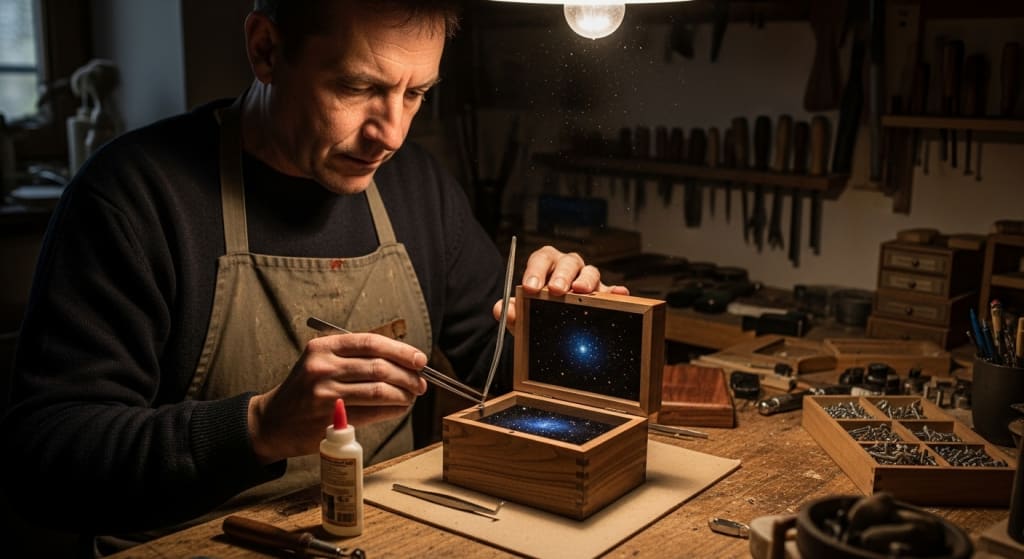
In a city that never slept, a city of roaring engines, blaring horns, and the constant, low-grade hum of a million digital lives, there was a man who sold silence. His name was Arthur, and he was the Architect of Silence.
His workshop was a sanctuary, a pocket of profound quiet in the urban cacophony. People didn't come to him for furniture or art. They came for his "Hush-Boxes"—small, intricately crafted containers that didn't just block sound, but absorbed it, creating a perfect, pristine void of quiet.
A CEO bought one to place on her desk, a refuge from the endless meetings and decisions. Inside the box, she said, she could finally hear her own intuition. A writer, plagued by writer's block, placed one in his study. The absence of external noise, he claimed, allowed the voices of his characters to finally speak. A new mother, frazzled and overstimulated, kept one on her nightstand. Opening it for just a minute was a reset for her soul, a moment of pure, unadulterated peace.
Arthur’s craft was a secret passed down through generations. The boxes weren't made of rare woods or precious metals, but of intention. He would work in complete silence, his own focus and calm becoming the primary material. He carved symbols of stillness into the hidden joints and lined the interiors with a velvet woven from the memory of a windless night.
He didn't just build boxes. On special commission, he built rooms.
His masterpiece was for an elderly violinist, Maestro Valdez, who was losing his hearing. The maestro wasn't afraid of the silence itself, but of the loss of the music that would soon be trapped inside his head, unheard by anyone, even himself.
"I do not need to hear the world," the maestro told Arthur, his voice trembling. "I need to hear the last symphony. The one I have not yet written. It is in here," he said, tapping his temple, "but the noise of my own fear is drowning it out."
Arthur accepted the commission. He worked for a month in the maestro's soundproofed music room. He didn't install acoustic panels or thicker walls. Instead, he re-tuned the room. He adjusted the space not for sound, but for its absence. He calibrated the angles of the walls to catch and dissolve vibrations. He laid a floor that drank the sound of footsteps. He created a space that was less a room and more a sensory deprivation tank for the soul.
When it was finished, he led the nearly deaf Maestro Valdez inside and closed the door.
The silence was absolute. It was not the dead silence of a vacuum, but a living, fertile silence. It was a blank canvas.
At first, the maestro wept, the sound of his own sobs swallowed by the room. He was confronting the void. But then, he picked up his violin. He could not hear it, but he could feel the vibrations through the wood, through his jaw, into his bones.
In that profound quiet, freed from the distraction of external sound and even the feedback of his own instrument, he could finally hear the music inside him with perfect clarity. His hands moved. The composition, once trapped and tangled, flowed out. He played the entire symphony, his body the only audience.
When he emerged hours later, his face was radiant. "I heard it," he whispered. "For the first time, I truly heard it."
He spent his final years composing in that room, writing some of the most celebrated music of his career—music born not from sound, but from the pure essence of it, filtered through silence.
Arthur, the Architect, knew his work was done. He returned to his workshop. The city's roar was a distant thing. He picked up his tools and a block of sandalwood, ready to build another small, precious fortress of quiet in a world that had forgotten how to listen to the most important thing of all: the sound of its own heart.
About the Creator
HAADI
Dark Side Of Our Society
Physical Grit at Work: How Strength and Endurance Shape Lasting Career Success
Professional success often connects to skills, education, and experience. These qualities are important for career development and long-term achievement. However, another factor also supports strong professional growth over time. That factor is physical grit, which many successful professionals develop through discipline and consistent effort.
By Richard Ceffalio Jr.3 days ago in Education
RenWeb Login – FACTS Family Portal Guide 2026
Parents, students, and teachers often struggle to access grades, attendance records, assignments, and school announcements in one centralized place. Forgotten passwords, confusion about the district code, and uncertainty about platform updates create frustration. The solution lies in understanding how RenWeb works—now integrated into the FACTS system—and learning the correct RenWeb login process through the FACTS Family Portal. This complete 2026 guide explains everything clearly, including RenWeb SIS access, district code usage, teacher and student login steps, and troubleshooting tips.
By Zain Prince5 days ago in Education


Comments
There are no comments for this story
Be the first to respond and start the conversation.