
The Role of NLP and LLM in Building Conversational AI
From Traditional Bots to AI-Powered Assistants: The Role of NLP and LLMs

Conversational AI experiences an evolutionary change through the combination of Natural Language Processing (NLP) with Large Language (LLMs). According to estimated data 67% of organizations will deploy generative AI solutions which utilize LLMs to boost human language interaction by the upcoming years. The global LLM market value is projected to raise from $1.59 billion in 2023 to $259.8 billion in 2030 at an annual compound growth rate (CAGR) of 79.8%.
Chatbots and virtual assistants receive contextual understanding and emotional sensitivity from these technologies to create more human-like and natural communications with users. The combination creates opportunities for businesses to deliver advanced customer service and task automation and generate customized user interfaces.
Traditional Chatbots VS LLM and NLP-Powered AI Chatbot Platforms
Before we start with understanding the importance of LLM for chatbots and conversational AI, here is a table that describes why LLM and NLP-powered bots are better than traditional ways of user interaction. Let us look at it.
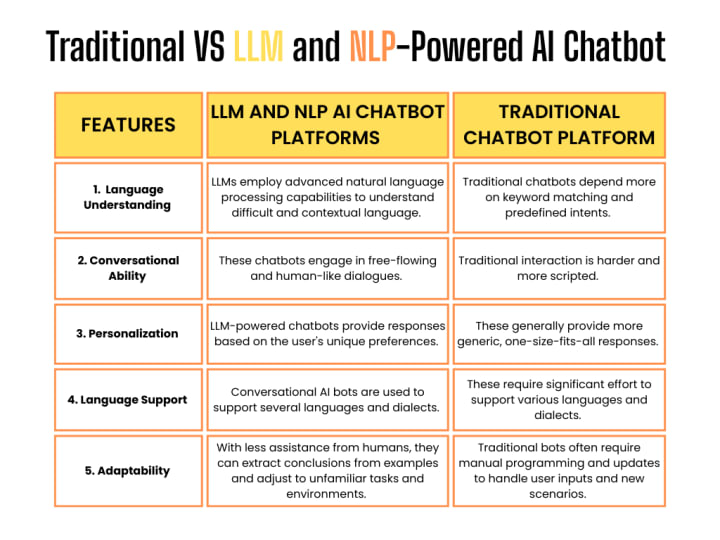
Features
1. Language understanding:
LLM and NLP Powered AI Chatbot Platforms: LLMs employ advanced natural language processing capabilities to understand difficult and contextual language.
Traditional chatbot platform: Traditional chatbots depend more on keyword matching and predefined intents.
2. Conversational Ability:
LLM and NLP Powered AI Chatbot Platforms: These chatbots engage in free-flowing and human-like dialogues.
Traditional chatbot platform: Traditional interaction is harder and more scripted.
3. Personalization:
LLM and NLP Powered AI Chatbot Platforms: LLM-powered chatbots provide responses based on the user's unique preferences.
Traditional chatbot platform: These generally provide more generic, one-size-fits-all responses.
4.Language Support:
LLM and NLP Powered AI Chatbot Platforms: Conversational AI bots are used to support several languages and dialects.
Traditional Chatbot Platforms: These require significant effort to support various languages and dialects.
5. Adaptability:
LLM and NLP Powered AI Chatbot Platforms: With less assistance from humans, they can extract conclusions from examples and adjust to unfamiliar tasks and environments.
Traditional Chatbot Platforms: Traditional bots often require manual programming and updates to handle user inputs and new scenarios.
Understanding Natural Language Processing (NLP)
Natural Language Processing is a branch of AI that is used to help bots understand human intentions and meanings based on grammar, sentence structure and keywords. It breaks human language down into its basic components and then employ algorithms to analyze and extract the key information that is necessary to understand a customer’s intent.
NLP models are better equipped for handling well-defined tasks that includes text classification and data extraction. A business employs NLP-based bots to enable smooth agent routing. When a customer submits a help ticket, your NLP model easily analyzes the language used to divert the customer to the best agent for the task. It helps accelerate issue resolution and deliver better service.
The Power of Large Language Models (LLMs)
LLMs are a type of AI model that are trained to understand, create and manipulate human language. LLMs, such as GPT, employ large amounts of data to learn how to predict and create language, which can later be used to power applications such as chatbots.
Throughout the training process, LLMs learn to recognize patterns in text, which allows a bot to generate engaging responses that simulate human activity.
Combining LLMs and NLP: Building A Better Chatbot
LLMs and traditional NLP models have unique strengths and weaknesses. With the combination of LLMs and NLP architecture, you can begin to design more functional bots. It enhances business value across a more varied selection of use cases.
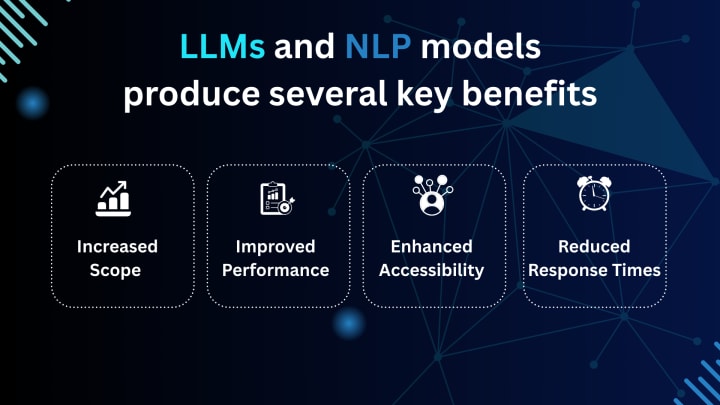
For businesses that are seeking to design a more sophisticated bot, the combination of LLMs and NLP models produce several key benefits, including the following:
Increased Scope
Your bot can be used for a wider range of applications that need a more advanced skill set by combing LLM and NLP. This includes virtual assistants, language translations, content generation and much more.
Improved Performance
You can combine LLM and NLP models to train your bot to understand language rules and context. These bots can be perfectly tuned for specific applications with improved accuracy and quality, without any requirement for extensive manual feature engineering.
Enhanced Accessibility
Together, LLM and NLP infrastructures include capabilities that can be used by a wider range of developers and organizations. This inspires further innovation and the development of more sophisticated bots.
Reduced Response Times
Business responses to customer questions are made faster through LLMs and NLPs. Their state-of-the-art natural language processing methods allows them to evaluate customer inquiries through contextual understanding to provide suitable responses immediately.
This is a major improvement over traditional chatbots, which often struggle with slow response times. These chatbots boost operation effectiveness by fast customer need resolution which results in better customer satisfaction.
Consistent Brand Voice
Maintaining a consistent brand voice is crucial for companies aiming to create a memorable customer experience. LLMs and NLPs play a significant role in ensuring that chatbots communicate in a manner that aligns with the brand's identity.
By adapting the language, phrasing, and emotional expression to mirror the brand voice, LLM-powered chatbots contribute to a positive and cohesive customer experience, reinforcing the brand's image.
While there are various technologies that you can use to design a bot, it is essential to understand your business’s objectives and customer needs.
Building Smarter AI Solutions
The development of smarter AI solutions requires using NLP and LLM features. The process starts with following these steps:
Define Your Goals: Establish your performance targets that your AI solution should accomplish. For example, your business needs improvement in customer service, user engagement, and process automation.
Choose the Right Tools: Before starting select the optimal combination of NLP and LLM tools that match your targets. The toolset for NLP and LLM includes open-source software and commercial applications which include GPT models from OpenAI.
Train Your Models: Apply training to your NLP and LLM models with suitable data sets to help them understand application-specific needs.
Integrate with Existing Systems: Your AI solution should smoothly connect with your present infrastructure through platform integration.
Monitor and Improve: Your AI solution needs ongoing performance monitoring to improve it via user feedback insights and data analysis results.
Conclusion
NLP and LLM combine to transform the development of conversational AI systems. One excels at the analysis of linguistic structures, syntax, and meaningful patterns within language, the other brings creative expressions, fluency, and contextual understanding.
Together, they enable the delivery of real-time, personalized, and human-like interactions in developing AI solutions that transform customer engagements in terms of satisfaction and efficiency across industries.
The combination of analytical strength of NLP with the contextual depth of LLM allows an LLM development company to help businesses build advanced systems that bridge the gap between human communication and artificial intelligence. Furthermore, it drives innovation and delivers exceptional user experiences.
About the Creator
MoogleLabs
MoogleLabs leverage AI/ML, Blockchain, DevOps, and Data Science to come up with the best solutions for diverse businesses.
Keep reading
More stories from MoogleLabs and writers in Education and other communities.
AI Services Company: The Future of Digital Creativity
The world of creativity has been made more accessible thanks to the introduction of artificial intelligence. Today, every AI services company is working on projects that are pushing the boundaries of digital creativity. This is especially true in the world of web design industry, where they are building solutions that can automate website building and provide intelligent design assistants.
By MoogleLabsabout a year ago in Education
From Stove to Strategy: Steve Wolfe’s Take on Scaling Your Food Business from Kitchen to Boardroom
Every food business begins with passion—late nights in the kitchen, handwritten recipes, and the joy of seeing someone love what you’ve made. But when demand grows, passion alone isn’t enough. Scaling your food business from kitchen to boardroom requires a shift in thinking, planning, and leadership.
By Steven Joseph Wolfe6 days ago in Education



Comments
There are no comments for this story
Be the first to respond and start the conversation.