
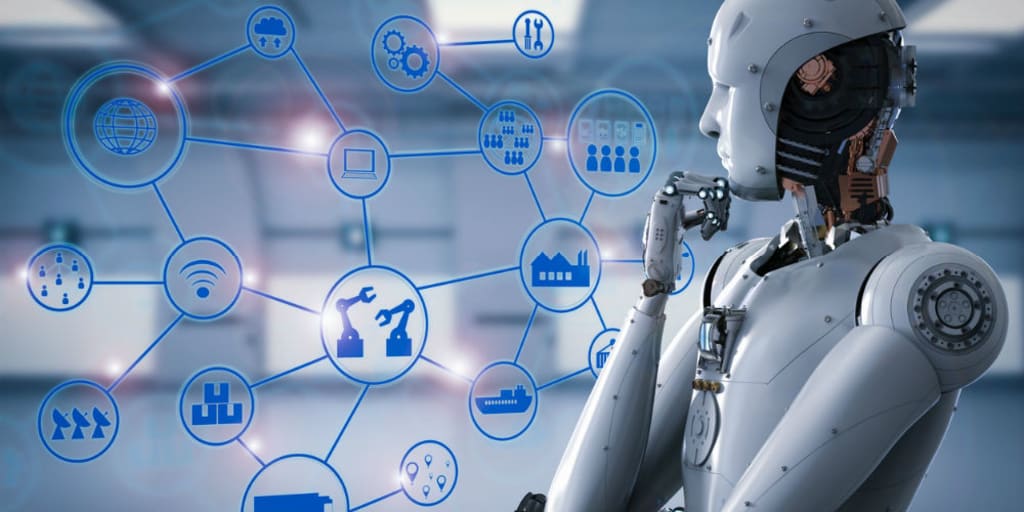
- A.I stands for artificial intelligence. A.I is one of the branch of computer science in which computers are trained as they perform any task which is typically performed by any human. This is truly an evolution for human history..
- As you all know that A.I is getting popular among people nowadays. It can perform many tasks. Nowadays people are using these A.I tools to make their work easy and fast.
- In this story I'm going to tell you about rise and evolution of A.I
EVOLUTION OF A.I(artificial intelligence)
Basically Artificial Intelligence has come a long way since its inception in the 1950s. Initially, AI focused on rule-based systems, where a set of if-then statements were used to make decisions. Over time, AI has evolved to incorporate machine learning and deep learning, allowing for more complex decision-making and problem-solving.
IN Early days of A.I:
In the early days of AI, researchers were focused on developing logic-based systems that could mimic human reasoning. These systems relied on a set of rules, such as "if this, then that," to make decisions. While effective for simple tasks, rule-based systems quickly became too complex to manage for more complex problem
ROLE of A.I in recent years::
In recent years, AI has evolved even further with the introduction of deep learning. Deep learning is a subset of machine learning that uses neural networks, which are modeled after the structure of the human brain. Deep learning has enabled breakthroughs in applications such as computer vision, natural language understanding, and even game playing.
USE Of Languages to program these A.I tools::
As AI has evolved, so too have the technologies and tools used to develop it. Today, there are a variety of programming languages and frameworks specifically designed for AI development, such as
- Python,
- TensorFlow,
- PyTorch
- There are also many pre-trained models and data sets available, making it easier than ever to develop AI applications.
Conclusion:
In conclusion, AI has come a long way since its inception, with the evolution of rule-based systems to machine learning and deep learning. As AI continues to advance, it will continue to transform industries and enable new capabilities, while also posing ethical and societal challenges that must be addressed.
Now let me explain you about the rise of A.I among peoples. There are thousands of A.I tools over internet which can be used to perform several tasks
The rise o A.I:
Artificial Intelligence (AI) has become one of the most transformative technologies of our time. From healthcare to finance to transportation, AI is revolutionizing the way industries operate, unlocking new levels of efficiency, productivity, and innovation.
EFFECT of A.I on WAY OF Working:
AI is also transforming the way we work. With the automation of routine tasks, AI is freeing up workers to focus on higher-value tasks, such as innovation, creativity, and problem-solving. In industries such as manufacturing and logistics, AI is improving supply chain efficiency and reducing costs by optimizing inventory management, scheduling, and transportation.
ROLE Of A.I in Healthcare:
In healthcare, AI is enabling new levels of precision medicine, with the ability to analyze large amounts of patient data to identify patterns and personalize treatments. AI-powered diagnostic tools are also improving the speed and accuracy of diagnoses, reducing the burden on healthcare workers and improving patient outcomes.
Customer satisfaction and better Customer experience:
AI is also transforming the customer experience. With the use of chatbots and virtual assistants, businesses can provide 24;7 customer support and personalized recommendations, improving customer satisfaction and loyalty.
CONCLUSION:
In conclusion, the rise of Artificial Intelligence is transforming industries and unlocking new levels of efficiency, productivity, and innovation. With the ability to learn, reason, and make predictions, AI is enabling businesses to make better-informed decisions, improving the customer experience, and transforming the way we work. As AI continues to advance, it's essential to address the ethical and regulatory challenges it poses to ensure that it's used responsibly and for the benefit of society as a whole.
About the Creator
Keep reading
More stories from Muhammad Abbas and writers in Education and other communities.
Purpose Driven Event Lighting Design That Unites Style, Comfort, and Safety
Event lighting design plays a decisive role in how people experience an event. It shapes the mood, guides movement, and supports safety at every step. When lighting is planned with purpose, it does more than look attractive. It creates a space where guests feel relaxed, confident, and protected.
By Brian Casella6 days ago in Education




Comments
There are no comments for this story
Be the first to respond and start the conversation.