
The Quipu Superstructure: A Cosmic Tapestry Stretching Across the Universe
Space

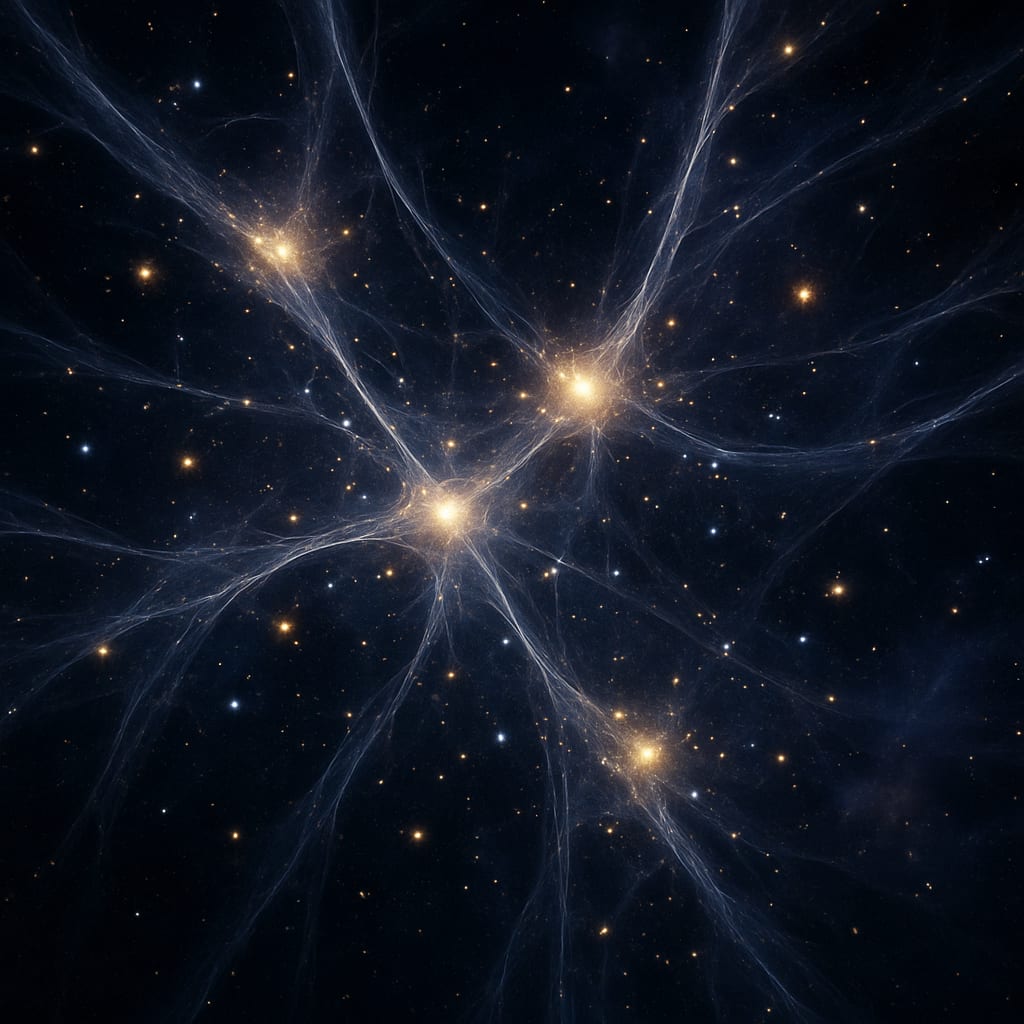
When we talk about the “largest things in the universe,” it’s easy to imagine planets, stars, or maybe even black holes. But those are only the building blocks of something far greater. In recent years, astronomers have uncovered vast, interconnected patterns of galaxies that stretch across unimaginable distances. Among these discoveries is the Quipu Superstructure, a gargantuan arrangement of galaxies and galaxy clusters spanning nearly 1.3 billion light-years. To put that in perspective: if you could travel at the speed of light, it would take longer than the entire recorded history of the universe to cross its length.
What Exactly Is Quipu?
The name “Quipu” is borrowed from the Inca civilization of South America. The Incas used knotted cords—known as quipus—to record information and keep track of trade, population counts, and stories. At first glance, the cosmic Quipu bears a striking resemblance to these ancient strands: it’s made up of filaments of galaxies, clusters, and superclusters twisted together in a colossal knot-like structure.
It’s important to remember that Quipu is not a single “object” like a star or a planet. Instead, it’s a superstructure, a vast web of matter linked together by gravity. Picture it like this: imagine glowing pearls (galaxies) strung along invisible threads (dark matter), with intersections where the pearls bunch together (clusters). Now expand this necklace to cosmic scales, and you’re beginning to grasp what Quipu looks like.
Standing Among Giants
The discovery of Quipu puts it in the company of other cosmic leviathans, sometimes called “walls” or “superclusters.” Some of the most famous examples include:
- The CfA2 Great Wall, stretching roughly 500 million light-years.
- The Sloan Great Wall, an enormous filament about 1.4 billion light-years long.
- The Hercules–Corona Borealis Great Wall, possibly the largest of them all, spanning nearly 10 billion light-years across.
Quipu ranks among these titans, both in size and complexity. What makes it particularly fascinating is its “knotted” organization, which looks less like a straight wall and more like a woven or braided network. It’s not just long—it’s intricately structured.
Why Is Quipu So Important?
1. Challenging the Cosmological Principle
For decades, cosmologists have worked under an assumption known as the Cosmological Principle: at sufficiently large scales, the universe should look the same in every direction and in every place. Beyond about 300 million light-years, we’d expect uniformity. But Quipu and other superstructures defy that expectation. If the universe has such giant “lumps,” how can it also be uniform? This question cuts to the heart of cosmology itself.
2. A Window Into the Universe’s Early Days
Structures like Quipu help scientists understand how the universe evolved from a hot, dense “soup” after the Big Bang into the cosmic web we see today. The fact that matter clumped together on such vast scales suggests that tiny quantum fluctuations in the infant universe grew into enormous filaments under the pull of gravity.
3. Probing Dark Matter and Dark Energy
Most of Quipu’s mass is invisible—hidden in dark matter. By studying how galaxies move within these filaments, astronomers can map this unseen framework. Meanwhile, the accelerating expansion of the universe, driven by dark energy, is constantly tugging on Quipu, threatening to pull it apart over billions of years. In a way, Quipu is a gigantic experiment written into the fabric of space-time.
Bringing It Closer to Home
It can be hard to wrap our heads around billions of light-years, so let’s scale down. Imagine the Milky Way as a grain of sand. In that case, the Local Group of galaxies (which includes the Milky Way and Andromeda) would be like a tiny cluster of grains in the palm of your hand. A larger cluster, like Virgo, would be a fistful of sand. Now picture Quipu: a chain of dunes stretching across entire continents. That’s the magnitude we’re dealing with.
And here’s a fun comparison: the diameter of the Earth is about 12,700 kilometers. Light takes just over 0.04 seconds to circle it. To cross Quipu, light would need more than 13 billion years—almost the entire age of the universe. That’s like comparing the blink of an eye to the entire lifetime of every human who has ever lived.
A Cosmic Tapestry
The metaphor of the quipu is more than poetic; it captures something profound. Just as ancient cords preserved the memory of civilizations long gone, the Quipu Superstructure may hold clues about the universe’s deepest history. Each filament, each knot of galaxies, is part of a cosmic code waiting to be deciphered.
Some scientists even describe the cosmic web as a “skeleton of the universe,” the scaffolding upon which galaxies and stars are built. In that sense, Quipu is not just an oddity—it’s a fundamental piece of the universe’s grand architecture.
Looking Ahead
We’ve only begun to understand Quipu. New instruments like the Euclid Space Telescope and the Vera C. Rubin Observatory will soon provide sharper, more detailed maps of the cosmos. With these, astronomers hope to see not only the outlines of Quipu but also how galaxies flow through its filaments and how dark matter shapes its structure.
Perhaps the most exciting part is that discoveries like Quipu remind us how much mystery still lurks in the universe. Even in an age of powerful computers and precise simulations, the cosmos continues to outdo our expectations. The Quipu Superstructure is a cosmic knot tying together the past, present, and future of cosmology—and unraveling it may lead us to the next revolution in understanding the universe.
About the Creator
Keep reading
More stories from Holianyk Ihor and writers in Education and other communities.
The Number of Confirmed Exoplanets Has Surpassed 6,000
Only a few decades ago, the idea of planets orbiting stars beyond our Sun lived mostly in the realm of speculation and science fiction. Astronomers could only guess at the possibility of other worlds, and the search for them seemed almost impossible. Yet today, the discovery of exoplanets—planets outside our Solar System—has become one of the most exciting and fast-growing fields in astronomy.
By Holianyk Ihor4 months ago in Education
The Madness of King Trump
In light of what Trump has done in the wake of his unlawful attack on Venezuela and his unhinged quest to take over Greenland it becomes necessary for the military to refuse any and all orders coming out of the Dept. of Defense and the Trump Administration. Trump has once again proved to the rest of the world his delusions of grandeur have taken over from diplomatic solutions that would improve the quality of life for all populations.
By Dr. Williams4 days ago in Education
Emerging Trends in Hospitality Marketplaces Driving the Next Wave of Growth
Hospitality marketplaces are changing how travel businesses connect with guests. These platforms now shape pricing, visibility, and guest trust. As technology improves and travel habits shift, hospitality marketplaces are becoming more advanced and more selective. Businesses that understand these changes can stay ahead while others struggle to adapt.
By Jason Nissen4 days ago in Education



Comments
There are no comments for this story
Be the first to respond and start the conversation.