
The Number of Confirmed Exoplanets Has Surpassed 6,000
Space

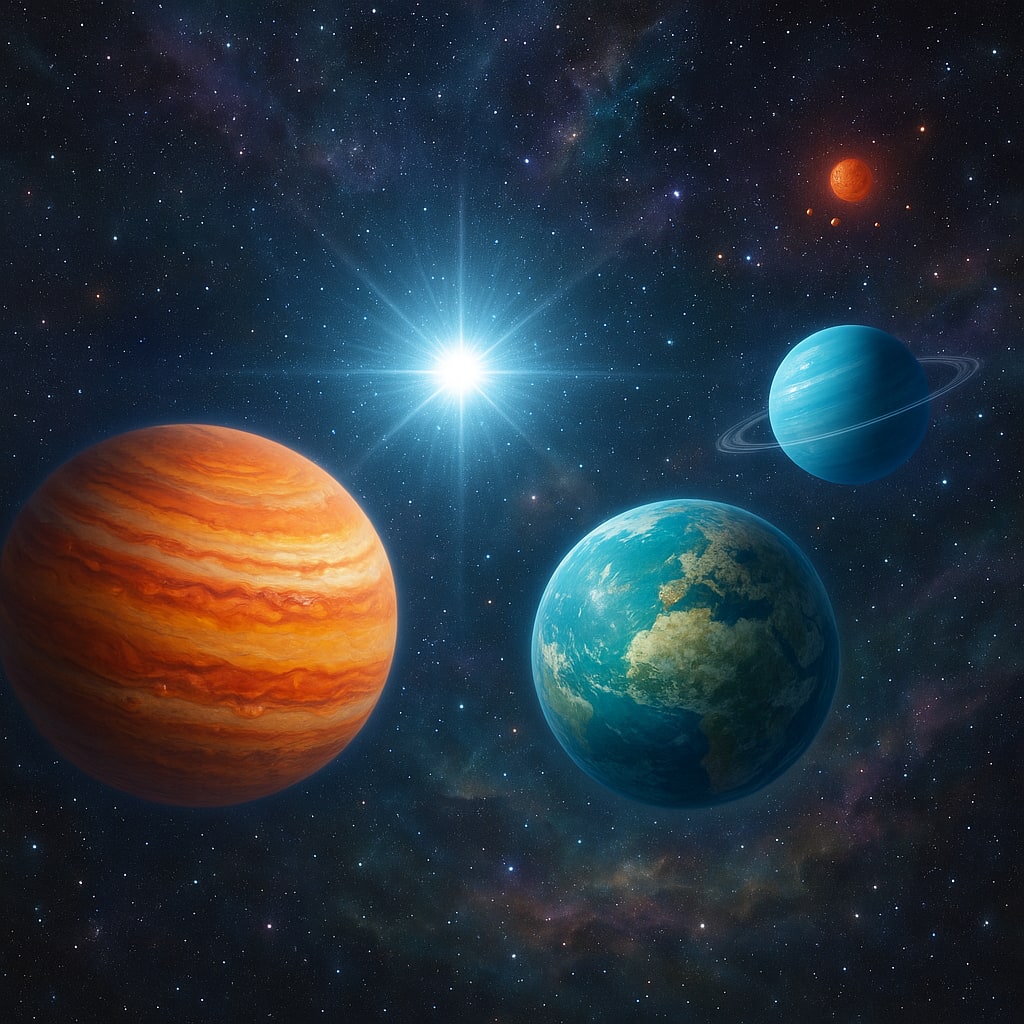
Only a few decades ago, the idea of planets orbiting stars beyond our Sun lived mostly in the realm of speculation and science fiction. Astronomers could only guess at the possibility of other worlds, and the search for them seemed almost impossible. Yet today, the discovery of exoplanets—planets outside our Solar System—has become one of the most exciting and fast-growing fields in astronomy.
Recently, scientists celebrated a new milestone: the number of confirmed exoplanets cataloged by NASA and other observatories worldwide has surpassed 6,000. This figure is more than a scientific achievement; it is a profound reminder that the universe is overflowing with worlds, many of them unlike anything we could have imagined.
From the First Discovery to a Universe of Planets
The journey toward this milestone began in the early 1990s, when astronomers announced the first reliable detection of planets orbiting another star. At the time, this was nothing short of revolutionary. The first few discoveries were giant planets orbiting their stars closely, worlds that defied the models scientists had developed based on our own Solar System.
In 2009, the launch of NASA’s Kepler Space Telescope transformed the field. By continuously observing more than 150,000 stars, Kepler detected thousands of potential planets using the “transit method”—noticing the tiny dips in starlight when a planet crosses in front of its star. From those observations alone, astronomers realized that planets are not rare at all. On the contrary, they are likely more common than stars themselves.
Kepler’s work was followed by other powerful tools. The Transiting Exoplanet Survey Satellite (TESS), launched in 2018, broadened the hunt by surveying nearly the entire sky. Meanwhile, ground-based observatories around the world, as well as the James Webb Space Telescope (JWST), continue to refine our knowledge of these planets, studying their atmospheres, compositions, and potential for habitability.
A Diversity Beyond Imagination
One of the most astonishing revelations from these thousands of discoveries is just how varied exoplanets can be. Far from finding worlds that simply mirror those in our Solar System, astronomers have uncovered an astonishing diversity:
- Hot Jupiters — enormous gas giants orbiting extremely close to their stars, often completing an orbit in just a few days.
- Super-Earths — rocky planets larger than Earth but smaller than Neptune, many of which may have solid surfaces.
- Mini-Neptunes — planets with thick atmospheres and intermediate sizes, completely absent from our Solar System but surprisingly common elsewhere.
- Potentially habitable worlds — planets located in the “Goldilocks zone,” where temperatures might allow liquid water to exist.
Some systems contain multiple planets in delicate gravitational dances, while others host worlds with bizarre properties: planets made partly of diamond, worlds where it rains molten glass, and others with years lasting only hours. Each discovery challenges the limits of our imagination and forces scientists to rethink how planetary systems form and evolve.
Why the 6,000 Milestone Matters
Reaching 6,000 confirmed exoplanets is more than a numerical milestone—it represents a shift in how humanity sees itself in the universe.
First, it confirms that planets are everywhere. Statistically speaking, nearly every star in the Milky Way likely has at least one planet. With hundreds of billions of stars in our galaxy alone, this means the number of planets could stretch into the trillions.
Second, the milestone helps scientists compare planetary systems to better understand our own. Why does our Solar System lack a “super-Earth,” when such planets are so common elsewhere? Why did gas giants like Jupiter form so far from the Sun, while other systems host “hot Jupiters” practically hugging their stars?
Finally, and perhaps most compellingly, every new discovery brings us closer to answering one of humanity’s oldest questions: Are we alone? While no signs of life have been detected yet, the discovery of planets in habitable zones gives scientists real targets for future exploration.
The Road Ahead
The catalog of 6,000 confirmed exoplanets is far from complete. Each year, hundreds of new candidates are identified, awaiting confirmation. Future missions promise to accelerate this pace even further. NASA’s upcoming Nancy Grace Roman Space Telescope, for example, will use advanced techniques to discover and image planets with unprecedented precision. Meanwhile, the JWST has already begun studying the atmospheres of distant exoplanets, searching for chemical signatures that might hint at biological activity.
In the decades to come, astronomers hope to not only count planets but also to characterize them in detail—measuring their climates, detecting weather patterns, and perhaps even identifying signs of life. The ultimate goal is ambitious but thrilling: to directly image an Earth-like planet, circling a Sun-like star, with evidence of habitability or even living organisms.
A New Cosmic Perspective
The discovery of over 6,000 exoplanets has reshaped our cosmic perspective. For centuries, Earth was considered the unique cradle of life in a vast and silent universe. But with each new world we catalog, that sense of isolation fades. Planets are not rare jewels—they are the rule of the cosmos.
It is entirely possible that among these thousands, and the countless more yet to be discovered, lies another world like ours—an “Earth 2.0,” with oceans, continents, and perhaps even its own story of life. Until we find it, the ongoing search for exoplanets will continue to inspire wonder, curiosity, and the enduring hope that we are not alone in the universe.
About the Creator
Keep reading
More stories from Holianyk Ihor and writers in Education and other communities.
Euclid’s Surprises: 380,000 Gravitational Lenses and a New Era of Cosmic Discovery
When the European Space Agency (ESA) launched the Euclid space telescope, astronomers knew it would open an unprecedented window into the dark universe. Its mission was ambitious: to map the three-dimensional structure of the cosmos, reveal how galaxies evolve, and shed light on the mysterious dark matter and dark energy that dominate our universe. But Euclid has already surpassed expectations. In one of its first major achievements, it identified around 380,000 examples of strong gravitational lensing — a discovery so vast that it may redefine how we study the cosmos.
By Holianyk Ihor4 months ago in Education
Speak and Be Heard: A Beginner’s Guide to Becoming a Podcast Host and Growing Your Audience
Becoming a podcast host is an exciting way to share your ideas, inspire others, and build a strong community. Whether you want to teach, entertain, or have great conversations, podcasting gives you a voice that can reach people around the world. But starting a podcast and growing an audience takes more than just a microphone. It requires planning, patience, and a real connection with your listeners. In this guide, you'll learn how to become a podcast host and grow your audience step by step.
By Spencer Hakimian3 days ago in Education


Comments
There are no comments for this story
Be the first to respond and start the conversation.