
The Physics Behind Wormholes: Are They Real or Sci-Fi?
Wormholes are one of the most exciting and mysterious ideas in modern physics. They appear in countless science-fiction movies, books, and TV shows as magical tunnels through space and time. But are wormholes actually real? Can they exist according to the laws of physics? Could humans ever travel through them? In this article, we explore the science behind wormholes in a clear, simple, and beginner-friendly way. We will look at what wormholes are, how they might form, what Einstein’s theory says about them, and whether they could ever be used for space travel. By the end, you’ll have a complete understanding of this fascinating concept.

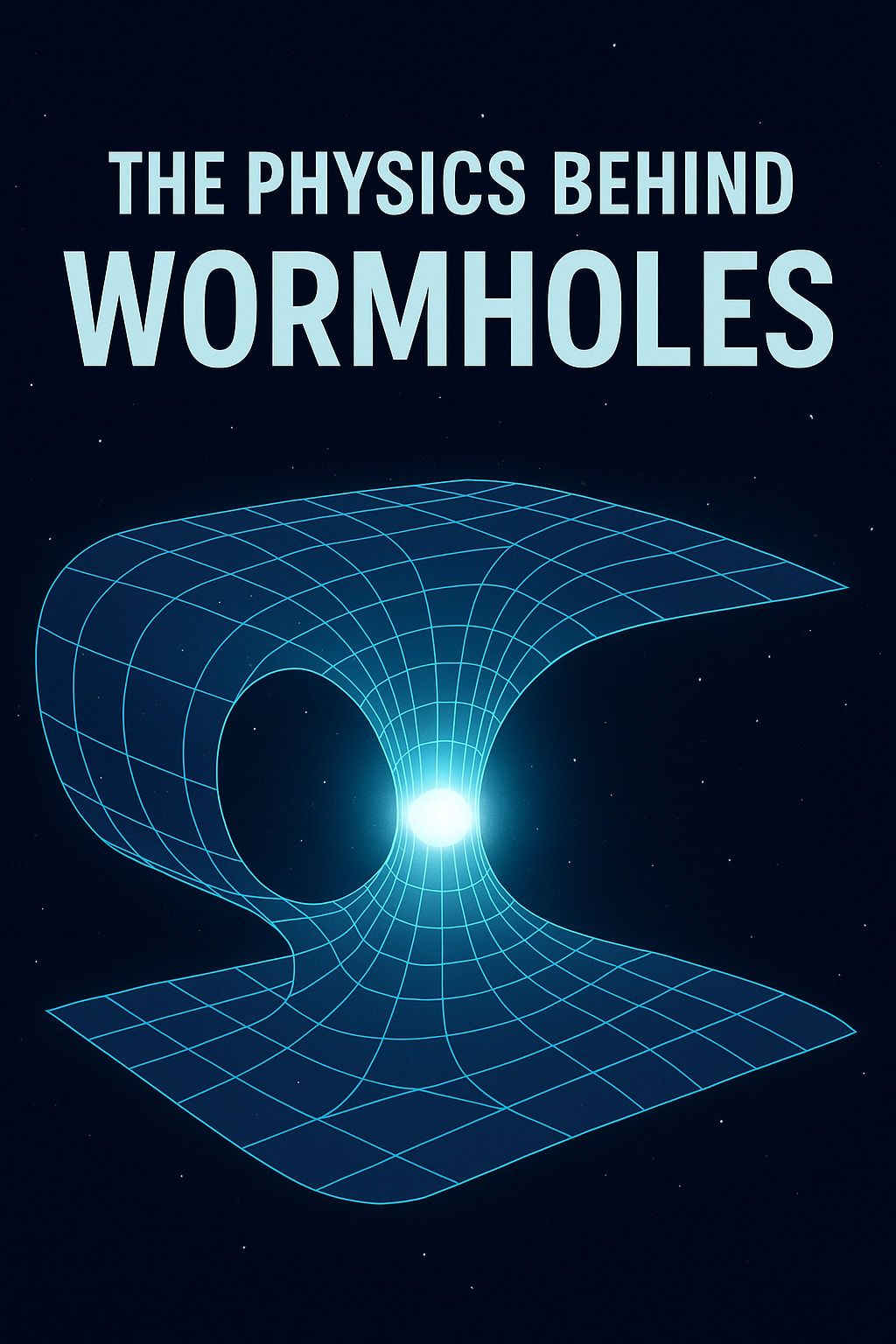
What Exactly Is a Wormhole?
A wormhole is a hypothetical tunnel that connects two different points in space and time. You can think of it as a shortcut through the universe.
Here’s a simple way to imagine it:
• Imagine space as a sheet of paper.
• Draw two dots far apart on the paper.
• If you fold the paper so the dots touch and poke a hole through, you create a shortcut.
This shortcut is what physicists call a wormhole, also known as an Einstein–Rosen bridge.
Instead of traveling years or centuries through normal space, a wormhole could let you travel instantly from one location to another. It might even connect different universes or different points in time.
But before we get carried away, let’s look at the physics behind it.
________________________________________
Einstein’s Theory and the Birth of Wormholes
Wormholes are not just a fantasy. They naturally appear in the equations of Einstein’s General Theory of Relativity, which describes gravity as the bending of space and time.
In 1935, Albert Einstein and physicist Nathan Rosen discovered that Einstein’s equations allowed the existence of bridges in spacetime. These became known as Einstein–Rosen bridges—the scientific name for wormholes.
Here’s the basic idea:
• A black hole curves spacetime inward, pulling everything toward it.
• A white hole (a theoretical opposite of a black hole) curves spacetime outward, pushing everything away.
When you mathematically connect a black hole and a white hole, you form a tunnel-like structure—a wormhole.
So, according to Einstein’s math, wormholes can exist. But there is a problem…
________________________________________
Are Wormholes Stable? The Big Challenge
The first issue with wormholes is that they are extremely unstable. According to Einstein’s equations, a wormhole would collapse in a tiny fraction of a second—too fast for anything, even light, to travel through.
This means that natural wormholes, if they exist, could appear and disappear instantly.
Physicists discovered that in order to keep a wormhole open, you would need something strange called:
Exotic Matter
Exotic matter is a theoretical type of matter that has:
• Negative energy,
• Negative pressure,
• and behaves unlike anything we find on Earth.
This negative energy could push the walls of a wormhole outward, keeping it from collapsing.
Quantum physics suggests that small amounts of negative energy may exist (for example, in the Casimir effect), but not nearly enough to stabilize a large, travel-friendly wormhole.
So the big question becomes:
If exotic matter exists in usable amounts, could we build or stabilize a wormhole?
We don’t know yet—but it’s not impossible.
________________________________________
Types of Wormholes Physicists Theorize
Scientists have proposed several different types of wormholes. Here are the main ones:
1. Traversable Wormholes
These are the famous wormholes we see in movies—tunnels that you can actually enter and pass through safely.
For this to happen, you need:
• A stable opening
• Exotic matter to keep it open
• No intense radiation or crushing gravity
Right now, these are only theoretical.
2. Non-Traversable Wormholes
These wormholes exist in Einstein’s equations but collapse instantly.
They connect two points mathematically—but nothing can pass through before they close.
3. Inter-Universe Wormholes
Some theories suggest wormholes might connect:
• Our universe to another universe
• One region of spacetime to a completely separate cosmos
This idea appears in multiverse theories and string theory, but we have no experimental evidence.
4. Time-Travel Wormholes
Because wormholes connect different points in spacetime, they could theoretically act as time machines.
If one end of a wormhole moves faster or experiences stronger gravity, time at that end would slow down. This time difference could allow someone to enter one end and come out at a different time.
This leads to questions about paradoxes—but scientifically, it is not ruled out.
________________________________________
Could Wormholes Form Naturally in the Universe?
This is one of the biggest questions in astrophysics.
There are several possibilities:
1. Wormholes formed right after the Big Bang
During the early universe, spacetime was chaotic and rapidly expanding. It is possible that tiny wormholes formed naturally. However, if any existed, they were likely extremely small and unstable.
2. Wormholes inside black holes
Some theories suggest that the center of a black hole might contain a wormhole. But:
• The extreme gravity would destroy anything trying to enter
• The wormhole would likely collapse instantly
Still, it remains a strong theoretical possibility.
3. Quantum-scale wormholes
Quantum mechanics suggests that spacetime might be made up of tiny fluctuations—what we call quantum foam. Some scientists believe this foam might contain microscopic wormholes that open and close constantly.
These would be far too small to travel through but suggest wormholes could be part of nature’s fabric.
________________________________________
Could Humans Ever Build a Wormhole?
The idea of building a wormhole is extremely challenging. It would require:
• Control over spacetime
• Enormous amounts of energy
• Exotic matter
• Advanced technology far beyond ours
However, physics does not forbid wormholes from existing or being created. That means the idea is within the realm of possibility, at least in the distant future.
Some scientists think a super-advanced civilization (far more advanced than humans) might be able to:
• Locate naturally occurring wormholes
• Stabilize them
• Or even construct them from scratch
This idea appears in the Kardashev scale, which measures the technological levels of civilizations.
Humanity is not even close yet—but that doesn’t mean it’s impossible.
________________________________________
Are Wormholes the Key to Faster-Than-Light Travel?
In normal space, nothing can travel faster than light.
But a wormhole doesn’t break this rule because:
• You don’t move faster than light
• You take a shortcut through spacetime
Imagine running around the edge of a mountain versus walking through a tunnel. You are not running faster—you just take a faster route.
If stable wormholes existed, they could allow:
• Instant travel between stars
• Travel across galaxies
• Travel to different times or universes
This is why wormholes are often seen as the ultimate solution for interstellar travel.
________________________________________
Scientific Problems Still Not Solved
Here are the main scientific challenges that make wormholes uncertain:
1. Exotic Matter
We don’t know if it exists in enough quantity.
2. Stability
Wormholes want to collapse. Keeping one open is extremely difficult.
3. Radiation
The slightest disturbance might cause a wormhole to explode or collapse.
4. Causality Problems
Time-travel wormholes could break the laws of cause and effect.
5. No evidence
So far, no observations in space have confirmed the existence of wormholes.
Even though the math says wormholes are possible, nature may not allow them in reality.
________________________________________
So… Are Wormholes Real or Just Science Fiction?
Here is the honest scientific answer:
**Wormholes are scientifically possible,
but we have no evidence they exist.**
Einstein’s equations permit them. Quantum theory supports the idea. Many scientists believe they could exist in principle.
But:
• We have not seen one
• We cannot create one
• We cannot travel through one
• We don’t know if nature allows stable wormholes at all
So for now, wormholes remain a beautiful idea—half science, half imagination.
________________________________________
Why Wormholes Continue to Fascinate Us
Wormholes represent something more than physics. They symbolize:
• Human curiosity
• The dream of exploring the universe
• The desire to go beyond our limits
• The possibility of time travel
• The mystery of the unknown
They remind us that the universe is bigger and stranger than we can imagine.
Even if we never travel through a wormhole, studying them expands our understanding of reality.
________________________________________
Final Thoughts
Wormholes sit at the edge of science—half proven by mathematics, half hidden by mystery. According to modern physics:
• Wormholes can theoretically exist
• They may require exotic matter to remain open
• They could allow instant travel or even time travel
• But we have no evidence and no technology to use them
Whether wormholes are real objects in the universe or just mathematical possibilities, one thing is certain:
They push the boundaries of what we think is possible.
As our understanding of physics grows, wormholes may one day move from science fiction into scientific reality.
About the Creator
Keep reading
More stories from shahkar jalal and writers in Education and other communities.
From Stove to Strategy: Steve Wolfe’s Take on Scaling Your Food Business from Kitchen to Boardroom
Every food business begins with passion—late nights in the kitchen, handwritten recipes, and the joy of seeing someone love what you’ve made. But when demand grows, passion alone isn’t enough. Scaling your food business from kitchen to boardroom requires a shift in thinking, planning, and leadership.
By Steven Joseph Wolfe3 days ago in Education




Comments
There are no comments for this story
Be the first to respond and start the conversation.