
The Periodic Table: Importance, Learning Tips, and What You Can Gain from It
The Periodic Table: Importance, Learning Tips, and What You Can Gain from It
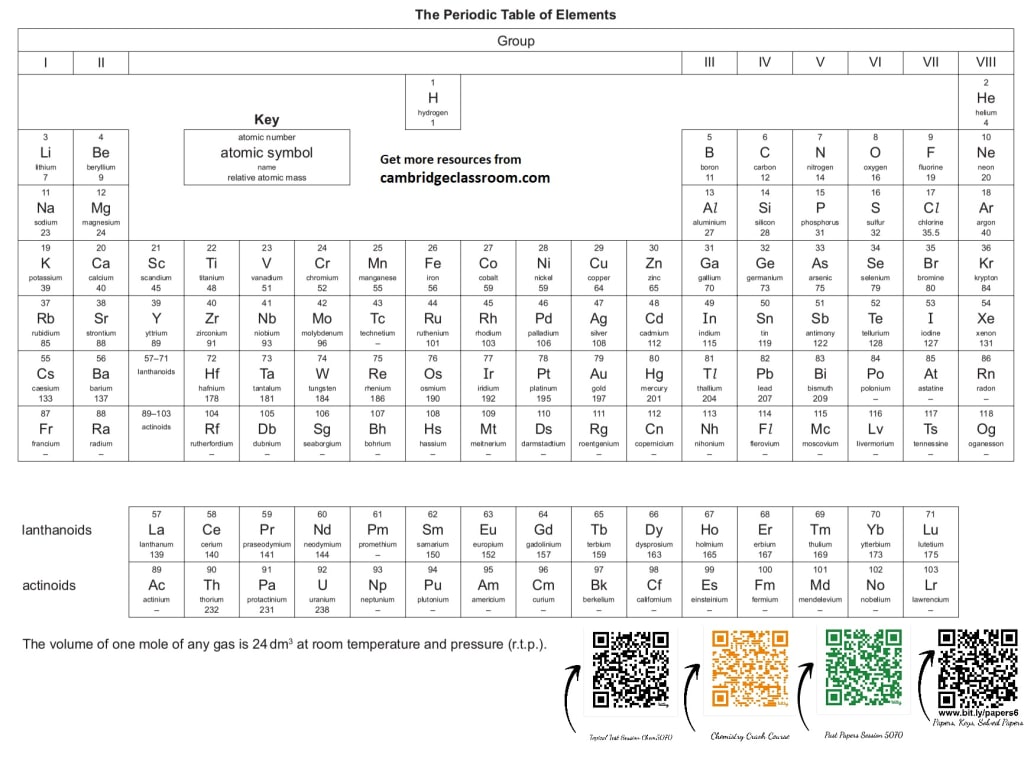
Welcome to today’s lesson on one of the most crucial tools in chemistry: the Periodic Table. Whether you’re preparing for CAIE O Level, A Level, or IGCSE Chemistry, having a solid understanding of the Periodic Table is a must. Today, we’ll explore its importance, how to learn it efficiently, and the valuable information you can extract from it for exams. Plus, I’ll guide you on how you can access resources to help you master it.
Why Is the Periodic Table Important?
The Periodic Table is more than just a list of elements. It’s a carefully organized map of chemical behavior that allows you to make predictions about elements and their compounds. It organizes elements by atomic number, electron configurations, and their recurring chemical properties. Here’s why this is important:
Atomic Structure: The atomic number of an element tells you how many protons (and electrons in a neutral atom) are present. This is key when solving chemistry problems, calculating atomic mass, or balancing equations.
Periodic Trends: Understanding the trends that run across periods (horizontal rows) and groups (vertical columns) helps in predicting chemical reactivity, electronegativity, and ionization energy. This knowledge is invaluable when answering exam questions on bonding or chemical reactions.
Classification of Elements: The table classifies elements into groups such as metals, non-metals, and noble gases. Knowing these classifications helps students understand how different elements will react in chemical equations.
Predicting Reactions: Elements in the same group behave similarly. For example, Group 1 elements (alkali metals) all have one electron in their outer shell, which makes them highly reactive.
What Information Can You Obtain from the Periodic Table?
Here’s a breakdown of some of the essential information you can extract from the Periodic Table:
Atomic Number and Atomic Mass: These tell you the number of protons, neutrons, and electrons in an atom and are crucial for solving stoichiometric problems.
Electron Configuration: The position of an element gives you insights into its electron configuration, which is key when discussing bonding or reactivity.
Reactivity Trends: As you move down Group 1 (alkali metals), reactivity increases. As you move across a period, elements become less metallic and more non-metallic.
Valency and Bonding: By looking at an element’s group number, you can determine its valency, which helps in predicting the type of bonds it will form.
Understanding these details will not only help you in theory but also in practical exams where the interpretation of data from the Periodic Table is necessary.
How to Learn the Periodic Table by Heart
Let’s be honest: memorizing the entire Periodic Table can seem daunting. But with the right strategies, you can make it manageable, and even enjoyable. Here are some tips:
Break It Down: Start by memorizing the key groups: Group 1 (alkali metals), Group 17 (halogens), and Group 18 (noble gases). Once you master these, you can move on to the transition metals and the inner transition metals.
Use Mnemonics: For instance, for Group 1 (Li, Na, K, Rb, Cs, Fr), use a mnemonic like "Little Naughty Kids Rub Cats Fur" to remember the sequence.
Interactive Learning Tools: Use online quizzes and interactive apps to reinforce your memory of element positions, symbols, and atomic numbers.
Flashcards: Create flashcards with the element’s symbol on one side and its atomic number and properties on the other. Quizzing yourself regularly is a proven method for effective learning.
Group Trends: Understanding the periodic trends, like electronegativity or atomic radius changes across periods, helps you remember not just the position of elements, but also their chemical behavior.
Accessing Resources: Downloadable Periodic Table
To support your learning journey, we offer downloadable versions of the Periodic Table in different formats that you can either print or save to your devices for easy reference.
Download Periodic Table in .JPG
Download Periodic Table in .PDF
Download Periodic Table in .DOCX
Having a printed or digital version on hand will make it easier for you to study, and you can refer to it anytime during your revision.
Ready to Master the Periodic Table?
If you want to go beyond just memorizing and really understand the concepts behind the Periodic Table, I highly recommend enrolling in our dedicated course The Periodic Table: Unlock Chemical Insights. This course dives deep into periodic trends, atomic structure, and reactivity patterns to help you master this essential tool. Enroll now at https://cambridgeclassroom.com/courses/the-periodic-table-unlock-chemical-insights/.
For those looking for comprehensive revision of all key topics in Chemistry, consider our Crash Course for Chemistry 5070/0620, which provides an intensive review of the syllabus, including the Periodic Table. You can join the crash course at https://cambridgeclassroom.com/courses/crash-course-for-chemistry-5070-0620/.
Final Thoughts
The Periodic Table is the foundation of chemistry, and mastering it will give you a significant advantage in your exams. Use the resources available to you, download the Periodic Table, and practice regularly. With the right guidance and tools, you’ll not only memorize the table but also understand how to use it effectively in chemical reactions and equations. And if you need further support, don’t hesitate to join our courses designed to help you succeed in your chemistry journey.
Happy learning!
About the Creator
Why Certification Protects Transcription Careers in the Age of AI
Artificial Intelligence has rapidly transformed the transcription industry. Speech-to-text tools now promise instant results, lower costs, and effortless productivity. For businesses focused purely on speed, AI often appears to be the perfect solution. However, beneath this promise lies a critical reality: speed without accuracy creates risk.
By Mahesh Kumar7 days ago in Education
How Japan Saved Its Biggest City from Collapse
400 years ago, modern-day Tokyo was known as Edo, and it was already one of the biggest cities in the world, with a population approaching 1 million. However, it was on the verge of ecological collapse. Years of intense logging had led to massive deforestation. The city now faced timber shortages and the impacts of severe erosion and frequent flooding that threatened food supplies. But over just a few decades, Edo will transform and become one of the most sustainable and efficient cities in history.
By Munesh Yadavabout 24 hours ago in Education



Comments
There are no comments for this story
Be the first to respond and start the conversation.