
The Past We Can Never Return
How Human Are We Compared to Our Ancestors?

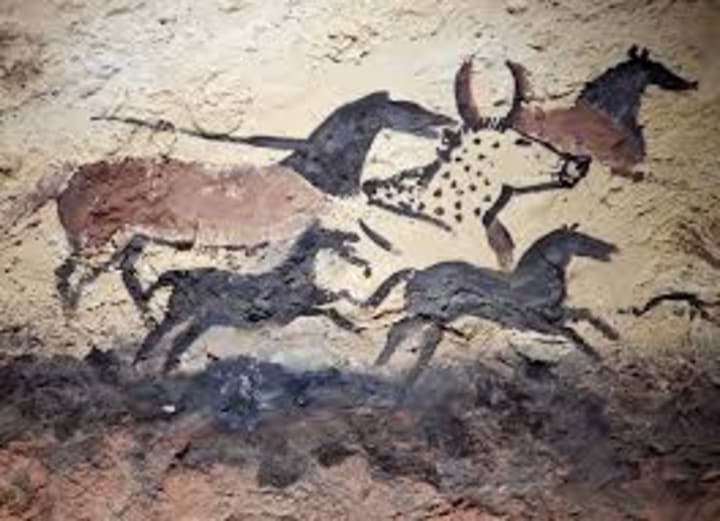
In September 1940, an 18 year old named Marcel Ravidat was walking his dog in the countryside of southwestern France. But the dog disappeared down a hole. The dog eventually returned , but the next day Ravidat went to the spot with his three friends to explore the hole and after quite about of digging they found a cave with walls covered with paintings, including over more than 900 paintings of animals such as stags, horses, bisons, and also species that are now extinct, including mammoth, sabertooth tiger, and woolly rhinoceros.
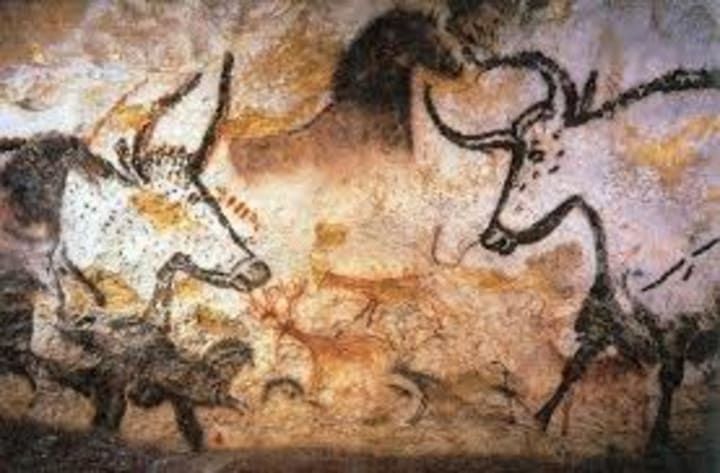
The paintings were incredibly detailed and beautiful with yellow, red and black color made from pulverized mineral pigments that were generally blown through a narrow tube, unto the walls of the cave. Archeologist eventually agreed that these artworks were at least 17,000 years old.
The boys who visited the cave that day were so mesmerized by the art they saw, that they camped outside the cave to protect it for over a year. After World War II, the French government took over protection of the site and the cave can be visited by public in 1948.
There are a lot mysteries at Lascaux. Why, for example, there are no paintings of reindeer, which according to archeologist were the primary source of food for the Paleolithic humans who lived in that cave? Why were they so much more intrested on painting animals than painting humans? Why are certain areas of the cave are full of paintings, including paintings on the ceiling that required the building of scaffolding to create, while other areas have only a few paintings? And were the paintings represent spiritual sacred animals? Or were they practical, showing some of the animals that might kill them?
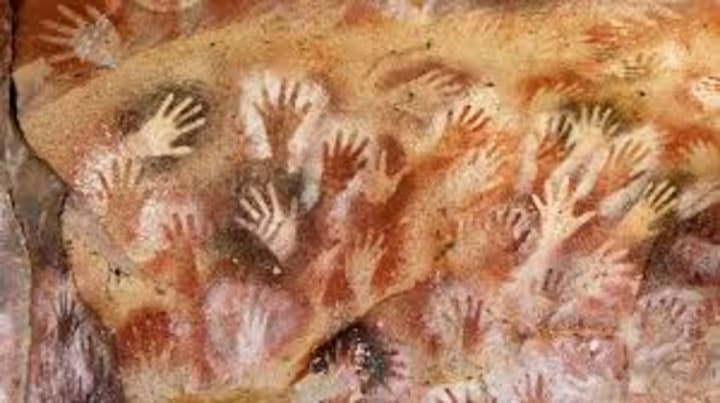
Aside from the animals, there are nearly a thousand abstract paintings that we cannot interpret, and also several “negative hand stencils” as they are known by art historians. The handprints are the paintings that most interest me. They were created by pressing one hand with fritters rayed against the wall of the cave and then blowing pigment, leaving the area around the hand painted. Similar types of hand stencils have been found in caves around the world, from Southeast Asia to Australia to the Americas to Europe to Africa. We have found these memories of hands from 20 or 30 or even 40 thousand years ago. These hand stencils remind us of how different life was in a distant past. Amputations were more likely to happened due to frostbite in Europe. So you often see hand stencils with four or even three fingers. And life was dangerous.
Around a quarter women died at childbirth, around half of children died before the age of five. But they also made us realized that the humans of the past were just as human as we are today. Their hands indistinguishable from ours. These groups of people hunted and gathered when they do not have large caloric sources. So every healthy person would have had to contribute in someway to collect food and water, and yet somehow they still made time to create these magnificent art.
We see all kinds of hands stenciled on cave walls from both children and adults, but almost always the fingers are spread. It is fascinating and a little strange at the same time that so many Paleolithic humans, who could not possibly have had any contact with humans from other parts of the world, created the same paintings the same way.
The Lascaux cave has been closed for the public for many years now. To many contemporary humans breathing inside of it led to the growth of mold and litchens, which has damaged some of the art. But tourist can still visit an imitation or should i say, a fake cave called Lascaux II, in which the artwork has been perfectly recreated. Tourists can go to the fake cave they have built, and see almost identical hand stencils. But you will know this is not the thing itself, but a shadow of it. This is a handprint, but not a hand. This is a memory of the past that you can never return to.
About the Creator
Keep reading
More stories from Rizqi Rayyan and writers in Education and other communities.
How Business Coaching Helps Founders Scale With Clarity and Control
Business coaching assists founders to scale since hustle and reactivity are substituted with structure, systems and strategic leadership. Strategic coaching provides clarity in the marketing, operations, leadership, and decision-making roles of the business, eliminating the need to use the owner as the bottleneck, instead enabling the business to expand without havoc, burnout, or firefighting.
By Alice Adams2 days ago in Education


Comments
There are no comments for this story
Be the first to respond and start the conversation.