
Euclid’s Surprises: 380,000 Gravitational Lenses and a New Era of Cosmic Discovery
Space

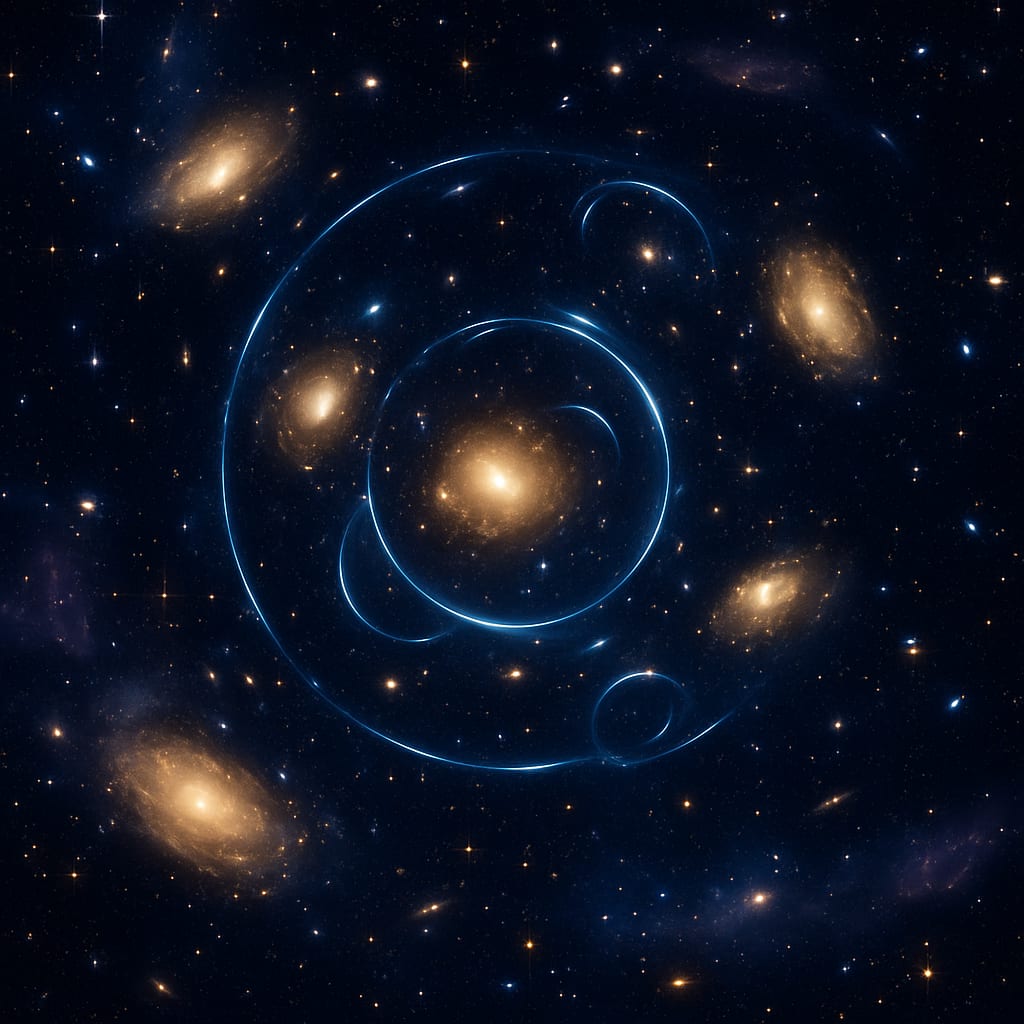
When the European Space Agency (ESA) launched the Euclid space telescope, astronomers knew it would open an unprecedented window into the dark universe. Its mission was ambitious: to map the three-dimensional structure of the cosmos, reveal how galaxies evolve, and shed light on the mysterious dark matter and dark energy that dominate our universe. But Euclid has already surpassed expectations. In one of its first major achievements, it identified around 380,000 examples of strong gravitational lensing — a discovery so vast that it may redefine how we study the cosmos.
What Is Gravitational Lensing?
Gravitational lensing is one of the most fascinating predictions of Albert Einstein’s theory of general relativity. According to relativity, mass bends space-time. When a massive object, such as a galaxy or cluster of galaxies, sits between us and a more distant object, it warps the path of light coming from that background source. To observers on Earth, this creates stunning visual distortions — arcs, rings, and mirrored copies of galaxies that lie billions of light-years away.
Imagine holding a wine glass up to the night sky. The glass bends and stretches the view behind it, creating strange shapes and magnified fragments. That’s essentially what happens in space, except the “lens” is made not of glass but of mass itself — both visible matter like stars and the invisible scaffolding of dark matter.
For astronomers, gravitational lenses are more than just cosmic spectacles. They act as natural telescopes, amplifying faint and distant galaxies that would otherwise remain hidden from view.
Euclid’s Astonishing Achievement
Until now, astronomers had cataloged only a few thousand strong gravitational lenses through painstaking observations using instruments like the Hubble Space Telescope. Euclid, however, has changed the scale entirely. With its powerful wide-field cameras and deep-sky sensitivity, the telescope has revealed hundreds of thousands of these phenomena almost effortlessly.
The discovery of approximately 380,000 examples represents an exponential leap. In simple terms, Euclid has delivered more data in months than astronomers had been able to gather in decades. And this is just the beginning. As Euclid continues its mission, the number of detected gravitational lenses could rise into the millions.
Why This Discovery Matters
1. A Map of Dark Matter
Dark matter cannot be seen directly, yet its gravity leaves unmistakable fingerprints in the cosmos. By analyzing how background light is distorted by mass, astronomers can trace the hidden distribution of dark matter. With hundreds of thousands of lenses to study, Euclid offers the possibility of building the most detailed map of dark matter ever created.
2. Peering into the Early Universe
The gravitational magnification provided by these lenses allows astronomers to study galaxies that formed shortly after the Big Bang. These faint, ancient galaxies carry clues about how the first stars and structures emerged. Euclid’s lensing data could help reconstruct the earliest chapters of cosmic history.
3. Testing the Laws of Physics
With such a vast dataset, scientists can test whether our current theories of gravity and cosmology still hold up. If patterns in lensing deviate from expectations, it could signal the need for new physics beyond Einstein’s relativity.
A Telescope Full of Surprises
Astronomers often joke that Euclid is not just a space telescope but a “discovery machine.” Its ability to capture wide fields of view at incredible resolution means that even a single image contains treasures — dozens, sometimes hundreds, of lensing events. Compared to earlier missions, where each lensing example was a hard-won find, Euclid’s data feels like an embarrassment of riches.
The telescope’s unexpected bounty has already led some researchers to reconsider their strategies. Instead of focusing on a few rare examples, they now face the challenge of sorting through a cosmic library of hundreds of thousands. Artificial intelligence and advanced machine learning are being deployed to process and classify the overwhelming flood of information.
Looking Ahead
In the coming years, Euclid will continue scanning the sky, expanding its catalog of gravitational lenses and refining its map of the dark universe. By the end of its mission, astronomers anticipate more than a million lensing events documented — a resource that will serve researchers for decades.
What makes this discovery particularly exciting is its potential to unify multiple areas of astrophysics. Gravitational lenses are not just tools for studying dark matter; they also help measure the expansion rate of the universe, probe the behavior of dark energy, and provide insights into galaxy formation and evolution.
A New Cosmic Frontier
The discovery of 380,000 gravitational lenses is more than a record-setting achievement. It marks a turning point. For the first time, scientists have a dataset large enough to explore the universe with both breadth and depth, combining statistical power with exquisite detail.
Euclid’s surprises remind us that the cosmos is full of wonders waiting to be uncovered. Just as the Hubble telescope revolutionized our view of the universe in the late 20th century, Euclid may become the defining instrument of the 21st century, guiding us closer to answers about the most profound mysteries of existence.
After all, the universe has always been generous with secrets. All it takes is the right lens — and Euclid has given us hundreds of thousands of them.
About the Creator
Keep reading
More stories from Holianyk Ihor and writers in Education and other communities.
The Discovery of “Floating Planets” in the Milky Way
The cosmos is full of surprises, and sometimes the most astonishing discoveries come when scientists are looking for something entirely different. The European Space Agency’s Euclid telescope, originally launched to study dark matter and dark energy, has stumbled upon an unexpected treasure: the confirmation of a whole population of “floating planets” drifting freely through the Milky Way, untethered to any star.
By Holianyk Ihor4 months ago in Education
Navigating the Most Complex Heart Conditions
Cardiology is advancing at a remarkable pace, thanks to next-generation imaging technologies that allow doctors to see the heart in extraordinary detail. For patients with complex or rare cardiac conditions, these tools provide insights that traditional methods often miss. By combining structural, functional, and metabolic imaging, physicians can make accurate diagnoses, plan effective treatments, and monitor progress with unprecedented precision. Modern cardiac imaging is redefining how heart disease is detected and managed.
By Nishi Patel5 days ago in Education
Navigating Economic Uncertainty with Strategic Property Investment
Economic uncertainty has become a constant presence in today’s financial landscape. From inflation and rising interest rates to global conflicts and supply chain disruptions, investors are increasingly concerned about protecting their assets and ensuring long-term financial security. Amid this volatility, real estate remains one of the most dependable investment vehicles. Its tangible nature, consistent income potential, and historical resilience make it a powerful tool for weathering financial storms.
By Accrue Real Estateabout 9 hours ago in Education


Comments
There are no comments for this story
Be the first to respond and start the conversation.