
The New Frontier of Worlds: Super-Earths, Mini-Neptunes, and Ocean Planets
Space

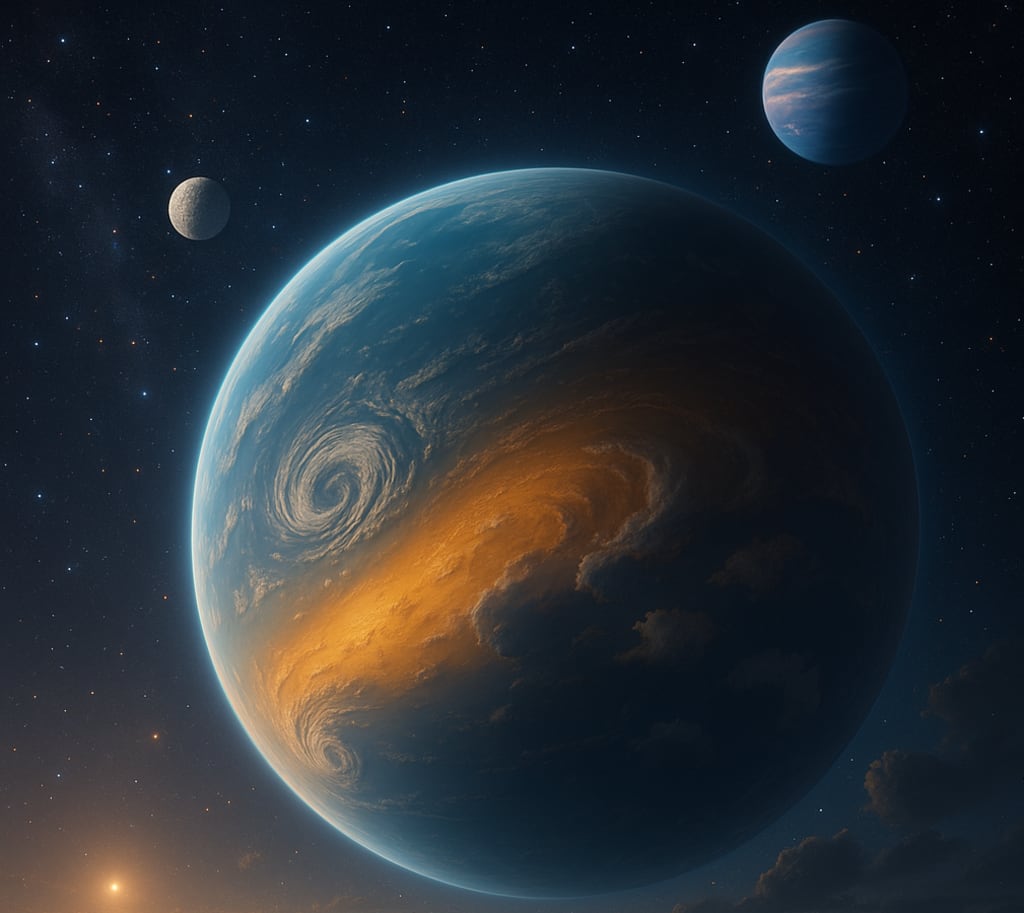
When astronomers first discovered planets orbiting other stars—so-called exoplanets—they expected to find worlds similar to those in our own Solar System: rocky like Earth, or massive and gaseous like Jupiter. What they actually found was far more surprising. The galaxy, it turns out, is filled with planets that defy our expectations—entirely new types of worlds that blur the line between the familiar and the fantastical.
Among these, three classes stand out: Super-Earths, Mini-Neptunes, and Ocean Worlds. Each represents a new chapter in our understanding of how planets form, evolve, and maybe even host life.
Super-Earths: The Titans of the Rocky Worlds
Super-Earths are planets larger and heavier than Earth, yet smaller than Uranus or Neptune—typically two to ten times Earth’s mass. Despite their name, they aren’t necessarily “super” in the sense of being more Earth-like. Some might be volcanic infernos, others frozen wastelands. But many could be perfect candidates for life.
Take LHS 1140 b, for example—a rocky world orbiting a red dwarf star about 40 light-years away. It sits in the habitable zone, the region where liquid water could exist on its surface. Another famous candidate, Kepler-452 b, has been dubbed “Earth’s older cousin” because it orbits a Sun-like star and could potentially have clouds, oceans, and continents.
What makes Super-Earths so fascinating is their abundance. Astronomers now believe that they’re the most common type of planet in our galaxy. That’s ironic, considering our own Solar System doesn’t have one. If the Milky Way were a cosmic neighborhood, our system would be the odd house on the block—the only one without a “Super-Earth” roommate.
Mini-Neptunes: The Gentle Giants
Between the rocky Super-Earths and the massive gas giants lies a mysterious middle ground—the Mini-Neptunes. These are planets with diameters between Earth and Neptune, wrapped in thick atmospheres of hydrogen and helium. Beneath their gaseous layers, they may hide icy or rocky cores, surrounded by steamy water vapor.
A perfect example is GJ 1214 b, a planet that’s baffled astronomers for years. It’s roughly 2.7 times Earth’s radius, and its atmosphere appears to be loaded with water vapor, giving rise to the nickname “the water world.” But it’s not exactly an ocean paradise—the pressure and temperature there would crush and boil anything from Earth instantly.
Mini-Neptunes intrigue scientists because they challenge our understanding of planetary formation. Why doesn’t our Solar System have one? Did Jupiter’s gravity prevent such planets from forming, or were they stripped away long ago? These questions make Mini-Neptunes key to understanding how planetary systems evolve across the cosmos.
Ocean Worlds: The Planets Without Land
Then there are the most poetic of all—Ocean Planets, or Water Worlds. Imagine a planet entirely covered by an endless, global ocean, stretching from pole to pole. No mountains, no continents—just deep, blue water as far as the eye can see.
One of the best candidates for such a world is Kepler-22 b, located about 600 light-years away. It’s more than twice Earth’s radius and may be enveloped in hundreds of kilometers of liquid water. Beneath that ocean could lie exotic layers of ice and minerals, possibly warmed by the planet’s internal heat.
But Ocean Worlds might not just exist around distant stars—they may be much closer. In our own Solar System, moons like Europa (around Jupiter) and Enceladus (around Saturn) are covered with ice that hides deep, global oceans beneath. These worlds have become prime targets in the search for extraterrestrial life. If microbes can survive in the dark oceans of Europa, then perhaps similar life could thrive on an exoplanet bathed in alien starlight.
A Universe of Possibilities
Every new telescope, from the James Webb Space Telescope to the upcoming Nancy Grace Roman Observatory, is pushing us closer to understanding these strange and beautiful worlds. With every discovery, our definition of a “planet” expands. We now know that worlds can have skies of methane, rains of glass, or oceans of boiling water.
And yet, amid all this diversity, one question keeps driving our curiosity: Are we alone?
Maybe somewhere out there, beneath the waves of a vast alien ocean or on the volcanic slopes of a Super-Earth, life has already found a way. It might not look like us, or breathe our air—but it could still share the same cosmic spark.
As astronomer Sara Seager once said, “For the first time in human history, we have the tools to find another Earth.” And when we finally do, it might not be a carbon copy—it could be something even more extraordinary.
About the Creator
Keep reading
More stories from Holianyk Ihor and writers in Education and other communities.
The Hungry Orphan of the Cosmos: A Young Rogue Planet Devours Dust and Gas in Deep Space
In a quiet corner of the southern sky, hidden within the faint glow of the Chamaeleon constellation, a young, lonely world is rewriting the rules of planetary birth. The object, known as Cha 1107-7626, is what astronomers call a rogue planet — a planetary-mass body that drifts freely through space without orbiting a star.
By Holianyk Ihor3 months ago in Education
What is Affiliate Marketing: A Beginner's Step-by-Step Guide
Affiliate marketing is a performance-based online business model that generates over $12 billion annually in the U.S. alone and continues to grow as e-commerce expands. At its core, affiliate marketing allows individuals to earn commissions by promoting products or services created by other companies. Affiliates share unique tracking links through websites, blogs, social media, email lists, or videos, and earn a percentage of each sale or action completed through those links. Because affiliates don’t handle product creation, inventory, payment processing, or customer support, it’s one of the most accessible ways to monetize an online presence.
By Mohammad Sufyaan6 days ago in Education



Comments
There are no comments for this story
Be the first to respond and start the conversation.