
The Hungry Orphan of the Cosmos: A Young Rogue Planet Devours Dust and Gas in Deep Space
Space

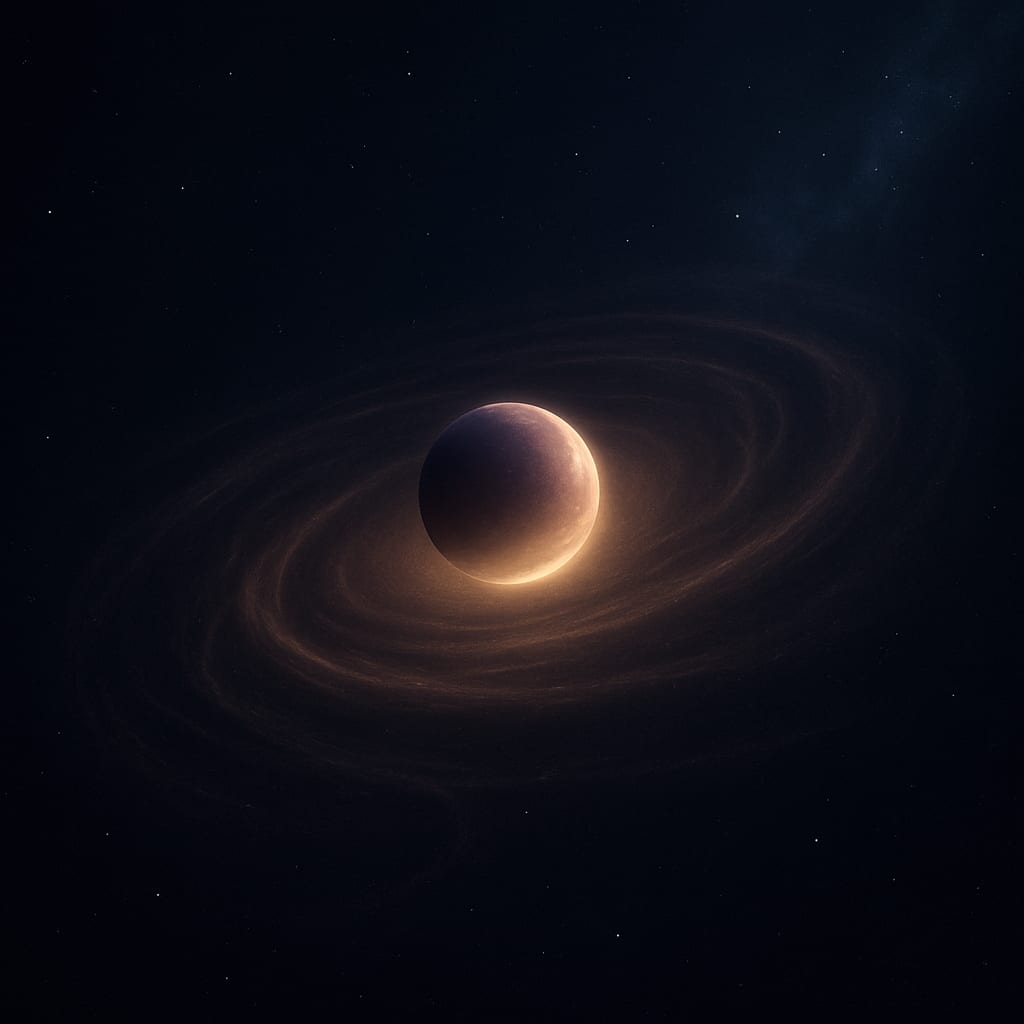
In a quiet corner of the southern sky, hidden within the faint glow of the Chamaeleon constellation, a young, lonely world is rewriting the rules of planetary birth. The object, known as Cha 1107-7626, is what astronomers call a rogue planet — a planetary-mass body that drifts freely through space without orbiting a star.
But this cosmic orphan isn’t the cold, silent wanderer one might expect. Instead, it’s astonishingly active — greedily consuming gas and dust from its surroundings at a rate that defies expectations. Like a miniature star in its infancy, Cha 1107-7626 is growing fast, revealing that even the loneliest worlds can be full of fire and hunger.
A Cosmic Baby with a Monstrous Appetite
Astronomers estimate that Cha 1107-7626 has a mass of roughly five to ten times that of Jupiter, making it much lighter than a typical brown dwarf but still too massive to be an ordinary planet like Saturn or Neptune. It’s also incredibly young — only about one to two million years old.
To put that in perspective, if the Sun were a 40-year-old adult, this rogue planet would still be a newborn — only a few days old. Yet despite its youth, Cha 1107-7626 is already devouring material at an almost unthinkable pace: six billion tons per second.
That’s the equivalent of swallowing the entire mass of Mount Everest every few minutes, or consuming a full Earth every few weeks. No other known free-floating planet shows such a ferocious appetite.
Breaking the Planetary Rules
Until recently, most astronomers believed that planets could only form within the disks of dust and gas surrounding newborn stars — the cosmic nurseries that gave rise to systems like our own. But Cha 1107-7626 challenges that assumption.
If it truly formed alone, floating freely through space from the start, it suggests that planets can be born without stars, condensing directly from collapsing clouds of gas — just like miniature stars that never ignite.
Another possibility is that Cha 1107-7626 did once belong to a young solar system but was violently ejected by gravitational chaos — perhaps after a close encounter with a larger planet or passing star. Like a child flung from its home, it now drifts through interstellar space, carrying with it a faint disk of gas and dust — a lingering memory of its birthplace.
Either scenario is revolutionary. Both imply that the universe may be filled with countless “hidden” planets, wandering between the stars, invisible unless they happen to betray their presence through faint heat or, like Cha 1107-7626, through the glow of active accretion.
The Fiery Signature of Accretion
So how do astronomers know that this lonely world is still feeding? They detect it through light — specifically, the infrared glow of the gas and dust as it spirals down toward the planet’s surface.
As the material falls inward, it heats up, releasing energy that can be seen by sensitive telescopes like NASA’s James Webb Space Telescope or the European Southern Observatory’s instruments in Chile. The rate of that glow reveals just how much matter the planet is consuming.
The measured accretion rate — those staggering six billion tons per second — is so high that Cha 1107-7626 blurs the line between planet and star. If it were just a bit more massive, nuclear fusion might begin in its core, transforming it into a brown dwarf — a “failed star.” But as it stands, it’s something rarer: a planet-sized object that behaves like a baby star.
Rethinking How Worlds Are Born
The discovery of Cha 1107-7626 forces scientists to revisit one of astronomy’s biggest questions: How do planets really form?
If this object formed directly from a collapsing gas cloud — without the guiding presence of a central star — it could represent a new class of planetary birth, one that occurs independently in the cold regions of molecular clouds. That means the galaxy might contain not billions, but trillions of such free-floating planets, wandering unseen through the darkness between stars.
It also raises another fascinating possibility: could some of these rogue worlds host moons or atmospheres capable of supporting life? While life as we know it depends on starlight, certain exotic forms of habitability — powered by geothermal heat or internal radioactivity — might exist even on planets cast adrift in space. In that sense, the discovery of Cha 1107-7626 isn’t just about how planets form, but where life might someday be found.
A Lonely Light in the Dark
Cha 1107-7626 is more than a scientific curiosity — it’s a symbol of resilience in the cosmos. Alone in the void, without a parent star to warm it, this tiny world continues to grow, glow, and shape its destiny.
Its story reminds us that creation in the universe doesn’t always follow neat rules. Sometimes, new worlds are born not in the comforting light of suns, but in the cold, silent reaches of space — thriving in solitude, carving their own paths through the darkness.
As astronomers continue to study Cha 1107-7626, they may uncover not just how planets like it form, but how many more are out there — hungry, young, and free.
About the Creator
Keep reading
More stories from Holianyk Ihor and writers in Education and other communities.
Everyday Life Aboard the International Space Station: Ordinary Days in an Extraordinary Place
When most people think about the International Space Station (ISS), they picture astronauts floating in a silent, endless void — surrounded by high-tech panels and dazzling views of Earth. But beyond the science fiction image, the ISS is also something much more relatable: a home. For the astronauts who live there, orbiting 400 kilometers above our planet, daily life is surprisingly familiar — and yet utterly unlike anything on Earth.
By Holianyk Ihor3 months ago in Education
The Importance of Strong Leadership in IT and Cybersecurity Teams
In today’s rapidly evolving digital landscape, IT and cybersecurity are no longer support functions—they are central to business success and resilience. With growing threats, complex infrastructures, and constant technological change, these departments face intense pressure to perform at the highest levels. At the heart of their performance is a critical factor that often determines whether a team succeeds or struggles: strong leadership.
By Keith Brautigam6 days ago in Education



Comments
There are no comments for this story
Be the first to respond and start the conversation.