

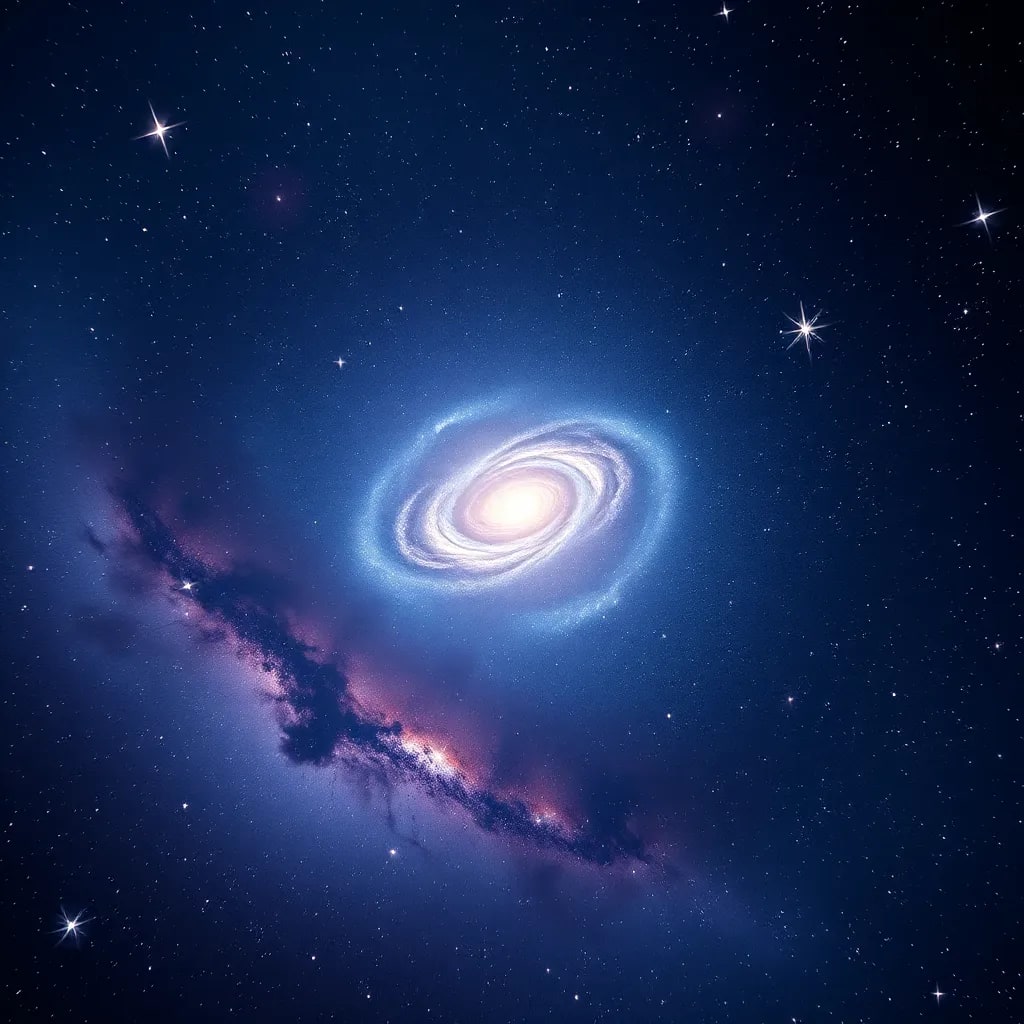
When we gaze up at the night sky, the stars appear eternal and unmoving, as though the cosmos has always been fixed in place. But appearances are deceiving. For more than a century, astronomers have known that our Universe is expanding. Even more astonishing: this expansion is not slowing down as one might expect it is speeding up. The fact that the Universe is accelerating remains one of the greatest mysteries in modern science.
The Surprising Discovery
In the early 20th century, Edwin Hubble provided evidence that galaxies are moving away from us, implying that the Universe itself is stretching. For decades, scientists assumed this expansion would gradually slow, pulled back by the immense force of gravity acting between galaxies. After all, gravity is supposed to be the ultimate cosmic glue.
But in the late 1990s, two independent teams of astronomers studying distant Type Ia supernovae a special class of exploding stars that serve as reliable “cosmic yardsticks” made a shocking discovery. The supernovae appeared dimmer than expected, suggesting that the galaxies hosting them were farther away than predicted. The conclusion was unavoidable: the Universe’s expansion was accelerating.
This revelation completely upended cosmology and earned Saul Perlmutter, Brian Schmidt, and Adam Riess the 2011 Nobel Prize in Physics.
Dark Energy — A Name for the Unknown
If gravity should be pulling everything together, what invisible force is driving galaxies apart faster and faster? Today, the leading explanation is something scientists call dark energy.
Dark energy is not something we can see, touch, or directly measure. Yet based on astronomical observations, it seems to make up nearly 70% of the total content of the Universe. By comparison, ordinary matter the stars, planets, gas, dust, and even you and me accounts for less than 5%. The rest is dark matter, another cosmic enigma.
In other words, the Universe we experience with our eyes and instruments represents only a tiny fraction of reality. The majority is hidden in forms we barely understand.
Possible Explanations
So what is dark energy? That’s the billion-dollar question. Scientists have proposed several theories:
- Einstein’s Cosmological Constant. Back in 1917, Albert Einstein introduced a “cosmological constant” to balance his equations of general relativity and keep the Universe static. When Hubble later showed the Universe was expanding, Einstein discarded the idea, calling it his “biggest blunder.” Ironically, the cosmological constant may actually describe the mysterious energy driving today’s acceleration.
- Quantum Vacuum Energy. Quantum physics teaches that “empty” space is not truly empty but filled with fleeting particle–antiparticle pairs that constantly pop in and out of existence. Some physicists think these quantum fluctuations could produce a repulsive effect on cosmic scales, fueling expansion.
- New Laws of Physics. Another possibility is that general relativity, Einstein’s theory of gravity, might not be the full story. Perhaps gravity behaves differently across intergalactic or inter-universal distances. If so, dark energy might simply be a sign that we need a deeper, more complete understanding of fundamental physics.
The Future of the Universe
The consequences of an accelerating cosmos are both fascinating and unsettling. Depending on how dark energy evolves, our Universe could face very different fates:
- Heat Death. If expansion continues indefinitely, galaxies will drift so far apart that the night sky will grow darker and colder. Stars will burn out, and the Universe will end in a state of eternal emptiness.
- The Big Rip. In more extreme models, expansion might accelerate so violently that it eventually tears apart galaxies, stars, planets, and even atoms themselves.
- A Cosmic Reversal. Alternatively, if dark energy changes its nature over time, expansion might slow and reverse, leading to a “Big Crunch” where the Universe collapses back on itself.
Each possibility sounds like science fiction, but they are grounded in real cosmological models and equations.
Why It Matters
At first glance, the fate of the Universe billions of years from now might seem irrelevant to human life. But studying the accelerating cosmos forces us to confront the most fundamental questions of existence:
- Why is there something rather than nothing?
- What hidden laws govern the Universe?
- Is our cosmos infinite, or will it come to an end?
The accelerating expansion is not just a curiosity it is a clue. A cosmic breadcrumb trail that may lead us toward a new understanding of space, time, and reality itself.
As telescopes like the James Webb Space Telescope and upcoming missions such as the Euclid spacecraft continue to probe the distant Universe, we may inch closer to answers. Until then, dark energy remains both our greatest puzzle and our greatest opportunity to rewrite the story of the cosmos.
The mystery of the accelerating Universe reminds us that the cosmos is not just vast, but profoundly surprising. In seeking to solve it, we are not only trying to understand the Universe’s fate—we are also trying to understand our place within it.
About the Creator
Keep reading
More stories from Holianyk Ihor and writers in Education and other communities.
Silicon-Based Life: Myth, Science Fiction, or the Future of Biology?
When we think of life, carbon instantly comes to mind. It is the backbone of DNA, proteins, and lipids the very molecules that make complex organisms possible. But astrobiologists and science fiction writers often ask an intriguing question: what if life could be built not on carbon, but on silicon?
By Holianyk Ihor5 months ago in Education
Co-Parenting in the Digital Age
Co-Parenting in the Digital Age: Shared Circles, Alerts, and Neutral Tech Tools Modern co-parenting requires a modern toolkit. Beyond shared calendars, technology offers powerful ways to foster cooperation, ensure consistency, and prioritize your child's safety. The right digital approach can reduce conflict and create a more stable environment for everyone.
By Olivia Martineza day ago in Education
The Power of Personalized Learning: Why Worksheets Still Matter in a Digital Age
In an era dominated by tablets, learning apps, and artificial intelligence, worksheets may seem like a relic of the past. Many assume that paper-based learning tools are outdated, inefficient, or less engaging than modern digital alternatives. However, this assumption overlooks an important truth: worksheets when designed thoughtfully remain one of the most powerful tools for personalized learning.
By Brian Decker7 days ago in Education


Comments
There are no comments for this story
Be the first to respond and start the conversation.