
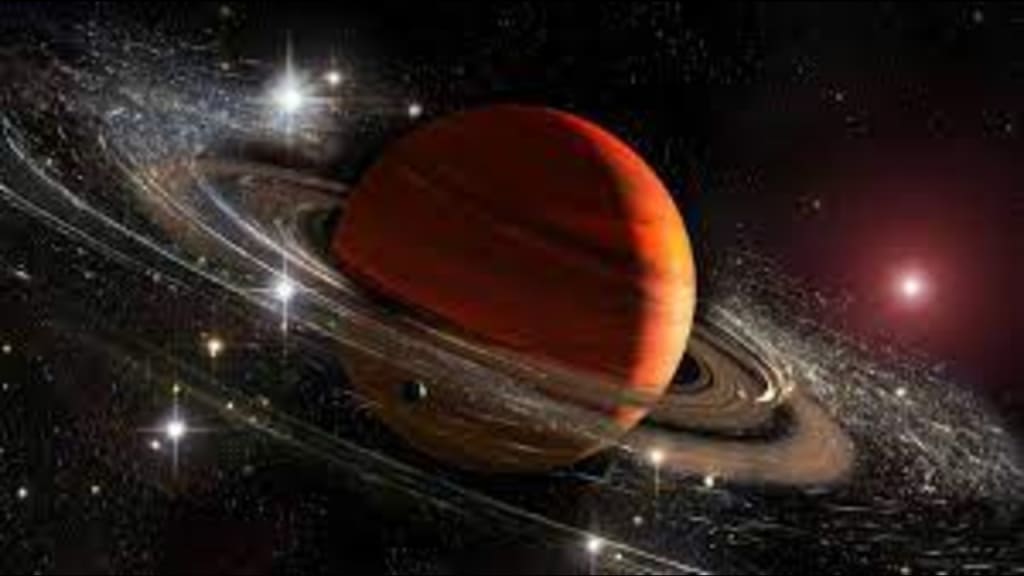
We've been focusing on trying to find Life on Mars so much while there is this gem waiting to be explored. This planet is the sixth farthest from the Sun and the second largest in the solar system, you'll find it right behind Jupiter I'm talking about Saturn or as they sometimes call it the Jewel of the solar system. It's so different from our planet. first of all you wouldn't be able to stand there while Earth consists of rock and other tough stuff this planet is like a giant ball mostly made of gases if you found a swimming pool huge enough to fit Saturn you could see the planet floating in the water no wonder Saturn is the least dense planet in the solar system it also contains a lot of helium you know the gas you put in balloons to make them hover in the air Saturn is a very windy Planet winds there are more than four times stronger than the ones we have on earth a day over there lasts 10 hours and 14 minutes because Saturn spins on its axis pretty fast the planet takes its time while going around the Sun a year there equals 29 Earth years Saturn's radius is more than 36 000 miles it means the gas giant is nine times wider than our planet if Earth was the size of a nickel Saturn would be as big as a volleyball even though some of our planets in our solar system also have rings Saturns are the most spectacular ones you can even see its rings from Earth and no you don't have to be a scientist with insanely expensive equipment all you need is a small telescope Saturn's rings are not firm they are made of pieces of dust Rock and Ice some of them are as small as grains of sand and some as big as a house or even a mountain these are actually bits of asteroids comets and shattered moons that fell apart before reaching Saturn they could be torn into pieces by the planet's powerful gravitational pull Saturn has over 50 moons and recently scientists have discovered some unusual hydrothermal activity on one of them Enceladus is Saturn's sixth biggest moon it has four tiger stripes close to one of its poles researchers have found that there is an ocean underneath these stripes water and ice erupt from that area so now we can't but Wonder maybe there's life out there in the oceans on Earth some forms of life gather around similar hydrothermal vents they feed on the chemicals there same as plants on the surface do with sunlight and not only that some of the oldest microbial life on our planet feed on the same energy as the one produced beneath the ocean's surface on Enceladus it could potentially mean there's life developing there right now of course it takes millions and millions of years for even the simplest organisms to appear but hopefully scientists will need less time to find more complex forms of life there are millions of exoplanets out there in space And scientists have been searching for those that could be potentially habitable exoplanets are planets orbiting a star outside of our solar system dwarf stars are similar less luminous than the Sun they sometimes live for more than 10 billion years that's enough time for a living organism to develop and evolve into a more complex form life might appear on the planets orbiting such dwarf stars or like with Saturn on one of their moons and here it is gliese 876b that orbits the red dwarf star gliese 876 this planet is mostly a mystery but scientists assume this is a gas giant that has no solid surface they believe its atmosphere doesn't have clouds but there might be water in its liquid form on the planet's surface Tea Gardens bee orbits a red dwarf that's around 12 light years away from our solar system the planet's mass is just a bit higher than that of Earth scientists think it may have a rocky surface the planet needs around five days to complete its orbit it means that one year on Tea Gardens B is actually shorter than one week on Earth somewhere Far Far Away there's another potentially habitable planet named Kepler 1638b okay to be more precise it's 3 000 light years away from Earth in the constellation cygnus this planet is four times as heavy as Earth and twice as wide it needs almost 260 days to complete one orbit around its star the gravity on this planet is stronger than that on Earth it wouldn't be an easy feat to jump on its surface one more Kepler coming along this time it's kepler-62e a planet that's more than one and a half times the size of Earth scientists believe this one has a warm humid and hospitable atmosphere with Cloudy Skies there are 1 200 light years between Earth and this planet kepler-62e needs 122 days to orbit its red dwarf star its neighbor kepler-62f is another potentially habitable zone it's a world around 40 percent bigger than Earth scientists think this planet might be covered in water the oceans on our planet are full of interesting creatures and organisms of all sizes so the chances are this planet also hides some intriguing living beings or at least it has the potential to develop life when we say habitable it doesn't mean life definitely exists there it just means there are conditions for some forms of life to develop lhs1140b is a planet located in one of the potentially habitable zones unlike its gas companions it's solid and quite Rocky the planet's radius is 60 percent larger than that of earth and its mass is seven times bigger it's one of the densest planets found out there since the planet has a big Mass an atmosphere there must be rather thick plus gravity on its surface is much stronger than here on Earth that's why you would likely have problems just standing on that planet hello and greetings from trappist-1 and Ultra Cool dwarf in the constellation Aquarius it's around 39 light years away from us seven earth-sized rocky planets are orbiting in the star's habitable zone all of them can potentially have some water on their surfaces the temperature on these planets is more or less similar to that on Earth on the moon gravity is only 16 percent of what we have on our home planet that's why the astronauts could hardly control their movements when they visited our natural satellite but when it comes to the gravity on trappist-1 planets you would probably feel good and comfortable there and Kepler once again this time it's kepler-452b it's a rocky planet 60 larger than Earth its parent star is similar to our sun this planet has actually spent around 6 billion years in the habitable zone while Earth has been there for a mere 4.5 billion years this planet needs 385 days to orbit kepler-452 this star is around 20 percent brighter than our sun but has the same temperature the whole system is very far from our little Oasis it would take you 28 million years to get there and now how about koi 7711.01 it's another intriguing world 1 700 light years away from us this planet is only 30 percent bigger than Earth it gets almost the same amount of heat as we receive from our sun in the future people might start colonizing the Galaxy they would be looking for new planets to live on then we'd certainly have to make really long trips and maybe one day we'd reach Proxima Centauri it's a nearby star that has a couple of planets we could potentially inhabit like Proxima Centauri B it's around four light years away from Earth and it doesn't sound that far at first but it actually is it would take about 6 300 years to travel there if we use the technologies that are available these days it would mean many many generations to make a trip like that and it would take even longer to finally inhabit that new world people would be born and raised on spaceships they would live their lives there without ever seeing either Earth or the planet they're heading to instead of trees mountains and rivers there would be only the dark nothingness of far away galaxies spreading in front of them they would never be able to wander unknown streets breathe in the fresh air feel the wind the only place for them to travel to would be another part of the ship certainly such a journey wouldn't be simple but it would pay off if people managed to build some more beautiful worlds like the one we have here on Earth is that even possible time will tell now let's pretend that Humanity faces a huge threat from outer space so we'll imagine that a giant planet-eating octopus comes to our solar system do we eat uh Venus Mars Earth Jupiter and other planets except Saturn therefore people decide to move to the big planet with giant rings fortunately they already have cool technologies that allow them to make such trips so we get into giant ships take off and fly to Saturn life on the planet itself is impossible because it has no Solid Ground the ship won't be able to land there this is a Giant Gas ball that is nine times wider than Earth to compare their sizes look at a five cent coin and a baseball and the planet's atmosphere consists mainly of hydrogen and helium so if the ship starts to land it'll never reach Solid Ground and the lower it goes the higher the pressure it will experience eventually the ship will just be crushed therefore we have only one choice the rings of Saturn they're made up of giant medium-sized and tiny particles of ice and rock flying around the gas giant at tremendous speed they were formed from comets flying by Saturn's gravity not these celestial bodies off their course and crush them with its pressure fragments of these comets began to accumulate around Saturn forming Rings now some of these particles fly faster some are slower the closer to the planet is the d-ring it's followed by Rings C and B then there's a large gap called Cassini division Rings a f g and e come after this classification is very convenient for creating a ring map so people approach the Rings but don't dare to land on them first they send test capsules with robots to scout the area the robots choose a suitable location on the e-ring in fact the distance between the Rocks is quite large and the ship can easily fly there there are tiny particles huge rocks the size of houses and comets the size of a whole Mountain the first robot flies up to a large rock at high speed at this moment a baseball-sized stone pierces the robot's body another robot gets smashed between two colliding Boulders the third robot gets caught in a rain of sharp icicles and brakes people have big engineering workshops on their ships so they build new capsules and new robots this time they're made of more durable materials so the robots reach a big rock again a few particles crash into them but don't break through the armor the machine set up a small station on a flying rock where people can live but after a couple of hours a big chunk of asteroids smashes the station well seems like we need another strategy giant ships scan the entire area of the e-ring and calculate the trajectories of billions of stones after length and calculations people finally find the perfect places in the middle of this chaos that will stay intact for a long time they land on these large rocks in their castles and begin to settle down they build stations and small houses and install powerful batteries on them Saturn is located at a distance of nine and a half astronomical units from the Sun one unit is the distance from the Sun to Earth so Saturn is a pretty cold place that's why there's so much ice flying around it but how to get the energy to heat it all up there's too little of it on large ships besides solar panels are ineffective here because of the great distance from the Sun therefore scientists create a way to generate kinetic energy from flying Stones it's like a windmill when the wind drives the fans these movements are converted into energy so engineers build panels that collect power from the moving stones but it doesn't slow the speed of rocks down because Saturn's gravity continues to move them thus people receive a source of almost Limitless energy some space stations have plants and trees that produce oxygen through photosynthesis only instead of sunlight they get energy from ultraviolet then people fill large tanks with oxygen and carry them to their homes people begin to occupy the adjacent Rings you don't need a lot of fuel to get from one place to another you can land on a rock calculate its route and wait for it to bring you to the needed point then you can move to another one and so on until you reach your destination more and more people leave their ships and move to the Rings it seems that life is getting better but then psychological problems begin constant movement in the vacuum of space drives everyone mad imagine living on a carousel that never stops you can't walk to the store whenever you want because it always flies away no one can go out for a walk even in a spacesuit because there's a chance to come across a rock flying at high speed you can't plan anything because at the moment your plans can be ruined by a giant piece of ice computers don't help either they can't calculate the trajectories of all space bodies rocks tend to break and split into hundreds of smaller ones also new comets fly by and also become part of the Rings all this creates uncertainty and causes a sense of anxiety in people besides it's dark cold and very lonely on the Rings nothing about building a base on a space object but your best friend lands on another one a few miles away then a giant icicle crashes into his Rock and increases its speed and a few days later your friend is too far away and it happens all the time the only way to change your life is to settle on one of Saturn's moons the planet has 83 of them people have already confirmed and named 63 and the existence of 20 others has yet to be confirmed they're all like different worlds some of them may be habitable and the best candidate among them is Titan there may be water on it and its atmospheric pressure is only one and a half times greater than Earth's its atmosphere consists of Nitrogen and a little methane forming carbon smog in Titan's upper layers for this reason we can't study this Moon from Earth but the coolest thing is that Titan flies outside the rings of Saturn this means people can lead a quiet life there there's also satellite Phoebe covered with craters like our mode this giant Celestial body looks more like a gigantic meteorite people have a lot of choices of where to start a new life during a couple of hundred years spent on ships near Saturn Humanity would learn everything about its satellites but why did they try to live on the Rings why didn't they land on one of the moons from the very beginning because well then this video would be less fun and a whole lot shorter but what if we were initially born inside the rings of Saturn let's say a massive meteorite with frozen water got caught by the planet's gravity there were the simplest life forms inside the eyes and then this life began to acquire more developed forms imagine that the large Rock managed to remain untouched for hundreds of millions of years and during this time humans appeared but of course they would be very different there firstly they wouldn't experience gravitational forces this would make them taller but weaker people's skin would be pale because of the lack of light but very Hardy thanks to cold temperatures particles of ice and grains of sand flying in space would roughen people's skin in such biological armor without gravity they would jump from one rock to another in search of food and water and by the way that would be the main problem how would people survive without oxygen in the vacuum of space where would they get their food Saturn's rings are a pretty lifeless and dangerous place if there are not even the simplest forms of life there then how could such a complex one as the human appear therefore even in theory the appearance of people would be impossible there this planet's called The Jewel of the solar system made up mostly of gases it could float on water should you find a reservoir 75 000 miles across and just as deep but what makes the planet so recognizable is its beautiful Rings gray tan and beige they consist of dust rocks and eyes some bits are as Tiny as grains of sand others as large as skyscrapers the planet I'm talking about is Saturn and right now Earth is hurtling toward it at Breakneck speed it all started on a regular day over half a year ago all of a sudden Earth changed the course it had been following for several billion years but instead of rushing towards the sun it started to move away from the star on second thoughts it might be for the better we've got more time to find a solution Earth used to move around the Sun at a speed of 67 000 miles per hour for some mysterious reason when it left its orbit the speed remained the same it means we're going to cover 746 million miles separating our planet from Saturn within a year and three months at first no one realized what had happened but a couple of hours later it became obvious despite the Panic that engulfed Earth's inhabitants nothing seemed to be out of the ordinary but all too soon it started to get colder and colder astronomers forecasts were pessimistic people started to leave their homes at the poles move close closer to the Equator most plant and animal species were having a hard time some of them went extinct even though we were trying to save them in greenhouses and special conservation parks the sky changed dramatically in a week we could see Mars clearly it looked like a big reddish spear hanging low over our heads Jupiter became as bright as the moon once Earth was as far away from the Sun as Mars days became twice dimmer than they used to be at first our planet's atmosphere was acting as a barrier between people and space that's why we didn't feel the cold immediately but seven days later everyone who dared to leave their home had to be cocooned in heavy winter clothing by that time the temperatures had already dropped down to minus 145 degrees Fahrenheit it got even colder once our planet passed Mars and hurried through the asteroid belt it's been one of the most dangerous regions on our way so far yes people could admire awesome meteorite showers streaking the sky but several space bodies managed to get through the Earth's atmosphere they slammed into the ground flattening mountains and leaving behind gigantic craters they caused tsunamis and triggered earthquakes right now most of the planet including the oceans has already turned into an icy desert there's a lack of food and natural resources we've built underground towns and tunnels connecting them our scientists work day and night to find a way out of this situation if they don't that's what's going to happen the closer our planet will be to Saturn the more the ring planet will Loom Over the Horizon and the larger it'll look soon it'll already shine brighter than the full moon the massive yellowish Brown orb will be visible even during the day but it'll look especially impressive at night instead of sleeping millions of people will spend hours watching Saturn grow larger and larger one day the distance between the two planets will become the same as the distance between Earth and Mars used to be Saturn's disk will be about a quarter the size of the full moon its rings will be as large as two-thirds of our natural satellite soon after that our planet's speed will start to increase under the influence of Saturn's gravitational pull the ringed planet is nine times wider than earth and its mass is almost 100 times greater that's why instead of moving at a speed of 29 miles per second we'll be dashing through space at almost 40 miles per second that's 2400 times the average car speed Saturn's gravity will influence the moon more than that of Earth in no time we'll lose our satellite it'll get catapulted into outer space likely to go into an elliptical orbit around the sun if Earth wasn't about to crash into Saturn in the nearest Future the moon could one day cross paths with our planet again no good would come out of such an encounter but what's happening on Saturn's side of things Saturn is one of the largest planets in the solar system second only to Jupiter even though the Rings surrounding the planet are huge they're rather thin less than a mile thick still the main rings are large enough to stretch from Earth to the moon but how did the planet get these breathtaking accessories on the outer edge of the main Rings a b and c there's something astronomers call the F ring several million years old it's the weirdest one this constantly shifting ring is made up of icy material and is incredibly complex its curves twists and clumps of brighter substance make it look as if it's braided Saturn has more than 50 confirmed moons two of them Pandora and Prometheus flank the F ring on either side they weave outside and inside the ring acting like Shepherds they heard ice particles into a 60 mile thick band but why are they performing this elaborate dance no one knows what scientists do know is that when Saturn's rings were evolving icy material clumped together and form moonlets some of them grew and turned into the planet's largest moons but two of them collided that's how the mysterious ring F appeared if the moonlets had only been made up of small icy particles the space Collision would have left a ring and nothing else but they had dense Rocky cores those remained intact and turned into Pandora and Prometheus people don't have any evidence Saturn's ever collided with another space body our Earth might be the first but before crashing into the planet itself we'll have to get through its rings including the ring F and no our planet won't just punch a hole in them drinks are made of small particles Earth's gravity will start to pull some of them out of their orbit once we're close enough it'll result in a long plume that will reach our planet and later when we squeeze through the cloud of icy particles will drag After Earth it won't have enough power to rid Saturn off its rings completely though they'll continue to move around their home planet but their orbits will change and become more elongated there will be no more stunning bands over time the Rings could probably settle down again but Earth won't give them such a chance the collision with our planet won't leave Saturn unscathed if there's still a possibility to sneak a peek at the sky people will be able to see the Rings disappear into nothingness but not for long soon the largest chunks of rock will start hitting the surface of our planet leaving behind lifeless land dotted with craters in the worst case scenario Earth might even collide with one of Saturn's numerous moons but let's imagine we've passed through this region in one piece and now our planet's very close to Saturn the gas giant might seem Airy but there's no way Earth can fly through the huge sphere and leave from the other side gravity is what keeps all that gas together the very gravity that make our planet speed up the closer it is to the much bigger space body the stronger the pull is it'll cause the fault lines on Earth to rupture it'll also set off powerful volcanic eruptions all over the world and then with enormous Force our planet will crash into Saturn the planet's atmospheres will get compressed this will cause a dramatic and fast temperature rise and in no time the air will be on fire scientists claim that Saturn's core is dense made up of iron and nickel and surrounded by a rocky layer but we'll never make it there Earth will burn and the bigger planet's atmosphere after being literally torn apart our beautiful blue-green world will turn into billions of trillions of tons of vaporized Rock pity maybe Earth will become yet another Saturn's ring instead of the ones it's ruined sounds Grim I know yeah we can't save Earth from Saturn but that's only a bad dream so maybe we take that effort and save us from a real threat climate change
About the Creator
Keep reading
More stories from writers in Education and other communities.
Mobile Driver’s License Verification in 2026
As digital identity technologies evolve, mobile driver’s license verification is emerging as a practical and secure way to confirm identity in both physical and digital environments. Mobile driver’s licenses (mDLs) represent a shift away from plastic cards toward cryptographically protected credentials stored on smartphones — combining convenience for users with stronger security for businesses and authorities.
By Regula Forensics5 days ago in Education
How Data and Analytics Are Powering Hospitality Marketplace Growth
The hospitality marketplace is evolving fast, and success now depends on more than great service and competitive pricing. Platforms, hotels, vacation rentals, and travel brands are leaning on data and analytics to make smarter decisions, improve guest satisfaction, and stay ahead of shifting demand. From pricing to personalization, analytics is shaping how businesses attract customers and increase revenue.
By Jason Nissen4 days ago in Education



Comments
There are no comments for this story
Be the first to respond and start the conversation.