
The Mind’s Eye: Aphantasia and Hyperphantasia
The Spectrum of Human Imagination
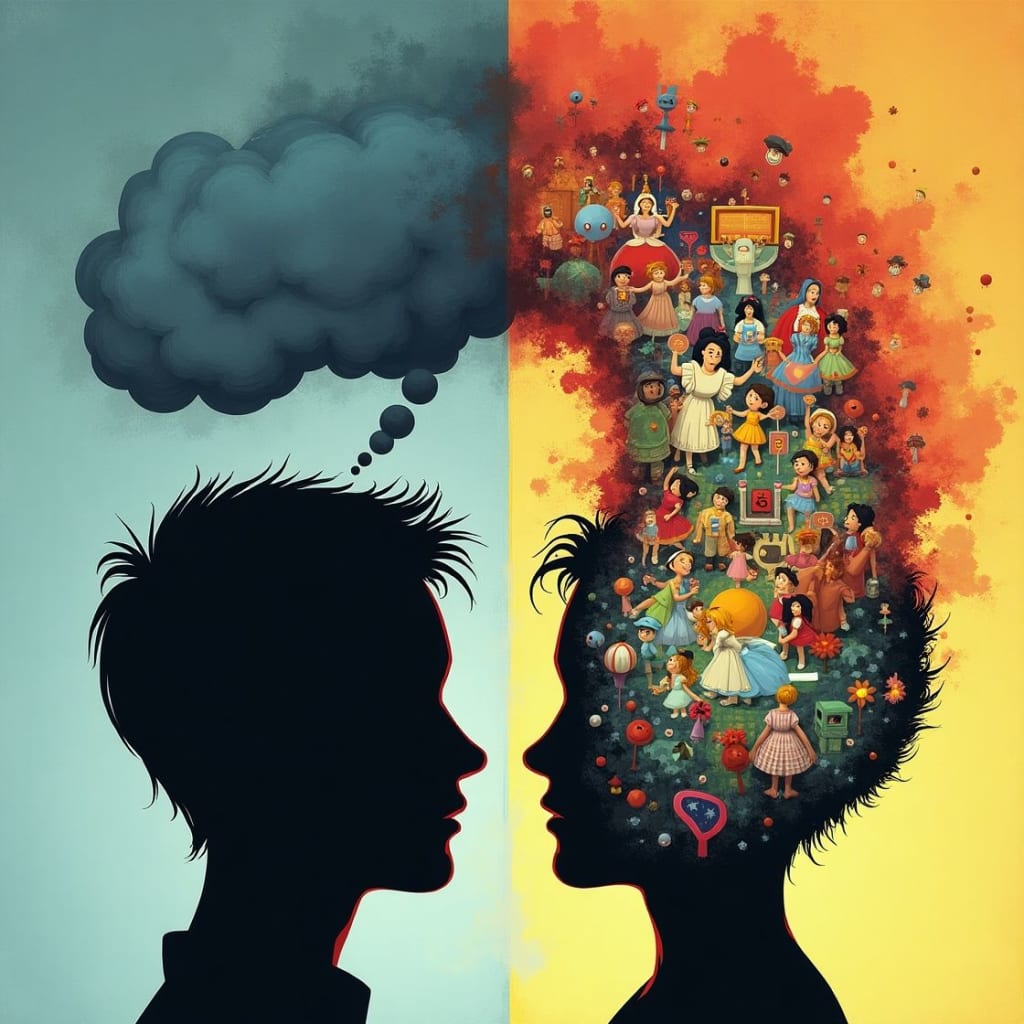
When you read Alice’s Adventures in Wonderland, can you vividly picture the Queen’s chaotic croquet game? Do you see the ridges and furrows of the grass, the curled-up hedgehogs rolling as balls, and the flamingos bending as mallets? Perhaps you can even make out the fine details—the sharpness of the hedgehog’s quills or the furious flush of the Queen’s face. But what if you saw nothing at all?
For a small percentage of the population, this is reality. While most people experience some level of mental imagery, those with aphantasia—about 4% of the world’s population—cannot summon visual images in their mind’s eye. On the other end of the spectrum are those with hyperphantasia, whose mental images are so vivid they rival real-life perception. Most people fall somewhere between these extremes, experiencing varying levels of mental visualization.
Aphantasia was first documented in the 19th century when a psychologist asked people to visualize their breakfast table and rate how vividly they could “see” it. His findings revealed that mental imagery exists on a spectrum, from complete absence (aphantasia) to hyper realistic mental pictures (hyperphantasia).
But how do scientists objectively measure something as private as mental imagery? One clever experiment looked at the pupillary light reflex—the way our pupils shrink in response to bright light. Surprisingly, even imagining a bright light can cause pupil constriction—but only in those who have mental imagery. For people with aphantasia, their pupils remain unchanged, offering a rare, measurable difference between those who can visualize and those who cannot.
One of the most puzzling aspects of aphantasia is that people who cannot visualize while awake can often see vivid images in their dreams. How is this possible? The answer may lie in the different ways the brain generates images.
When we consciously summon a mental picture, multiple brain regions coordinate in a top-down process, starting with cognitive control areas and activating memory and vision-related regions. People with hyperphantasia tend to have stronger neural connections between these areas. Dream imagery, however, is thought to be generated by a bottom-up process—where deep brain activity spontaneously triggers visual and memory centers, bypassing the usual conscious effort needed for visualization.
Why do some people have hyper-real mental imagery while others see nothing at all? Aphantasia often runs in families, suggesting a genetic component. While most people with aphantasia are born with it, some can develop it later due to brain injury or psychological conditions. However, neither aphantasia nor hyperphantasia is classified as a disorder—just unique variations in how the mind works.
Interestingly, aphantasia might offer protection against certain mental health conditions, particularly those involving distressing mental imagery, such as PTSD. People who cannot visualize might be less prone to experiencing intrusive, emotionally charged images. Conversely, those with hyperphantasia tend to have richer, more detailed memories and can mentally “relive” past events with striking clarity.
Could your ability to visualize influence your career path? A study of over 2,000 people found that individuals with aphantasia are more likely to work in STEM fields, while those with hyperphantasia gravitate toward creative industries such as the arts, media, and design. The way we experience mental imagery may subtly guide our professional and creative choices.
Even emotions might be shaped by mental imagery. When reading an intense story, most people experience subtle physiological reactions—like an increased heart rate or a slight sweat response.
But those with aphantasia tend to lack this reaction, likely because emotional responses are often tied to the ability to imagine events vividly.
We may never fully grasp what another person’s inner world looks like. Some people’s minds are filled with rich, immersive images, while others think in words, concepts, or abstract ideas without pictures. The human experience is deeply varied, and the way we visualize—or don’t—adds another layer of mystery to how our minds work.
Whether you live in a world of vivid imagination or complete mental silence, one thing is certain—perception, memory, and creativity are far more diverse than we ever imagined.
About the Creator
Keep reading
More stories from writers in Education and other communities.
Building Risk-Ready Organizations Through Holistic Planning
In today’s volatile and interconnected business world, risk can emerge from virtually any direction. Economic instability, supply chain disruptions, cyber threats, or shifting regulations can affect operations in ways that ripple across departments and geographies. To manage these challenges effectively, organizations must move beyond traditional, siloed risk management tactics. Holistic planning offers a forward-thinking alternative by integrating risk awareness into every layer of an organization’s structure and strategy.
By James Burleson4 days ago in Education



Comments
There are no comments for this story
Be the first to respond and start the conversation.