
The Math Behind Bitcoin’s 21 Million Supply Cap
Break down the geometric progression of rewards and why the total converges to ~21 million.


1. Block Rewards and Halving
Bitcoin miners are rewarded with newly minted coins for validating transactions and securing the network. Initially, the reward was 50 BTC per block. However, Bitcoin’s code enforces a halving event every 210,000 blocks (roughly every four years), reducing the reward by 50% each time.
This follows a geometric series:
First halving (n=0): 50 BTC per block
Second halving (n=1): 25 BTC per block
Third halving (n=2): 12.5 BTC per block
...
Final halving (n=32): 50 / 2³² ≈ 0.00000001 BTC (1 satoshi, the smallest Bitcoin unit)
2. Summing Up the Total Supply
The total Bitcoin supply is the sum of all block rewards until the last halving. Mathematically, this is a finite geometric series:
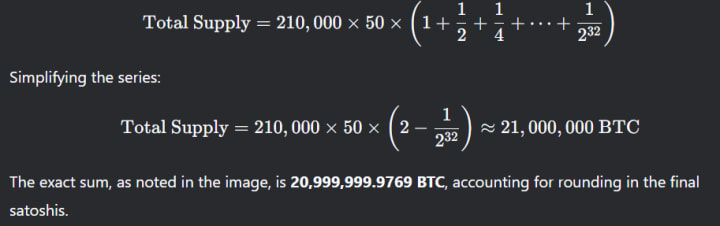
3. Why 21 Million?
Satoshi Nakamoto never explicitly explained why 21 million was chosen, but possible reasons include:
Divisibility: Bitcoin’s smallest unit (1 satoshi = 0.00000001 BTC) allows microtransactions.
Predictable Scarcity: A fixed supply prevents inflation, mimicking scarce commodities like gold.
Computational Feasibility: The halving schedule ensures mining remains profitable for decades before rewards phase out.
Benefits of a Fixed Supply Cap
1. Anti-Inflationary Design
Unlike fiat currencies, which lose value when central banks print more money, Bitcoin’s supply is algorithmically enforced. This makes it deflationary by nature, preserving purchasing power over time.
2. Transparent and Predictable Issuance
Every participant knows exactly how many Bitcoins exist at any given time and when new coins will be minted. This eliminates uncertainty and manipulation.
3. Incentivizes Early Adoption
Early miners and investors were rewarded with higher block payouts, encouraging network growth before Bitcoin reached mass adoption.
4. Digital Scarcity as a Value Proposition
Scarcity is a key driver of value (as seen with gold). Bitcoin’s hard cap makes it a hedge against currency devaluation.
Future Prospects: What Happens After the Last Bitcoin is Mined?
The final Bitcoin is expected to be mined around the year 2140, after which:
1. Miners Rely on Transaction Fees
Since block rewards will be near-zero, miners will depend on transaction fees for revenue. Bitcoin’s security model must remain robust even without new coin issuance.
2. Potential for Fee Market Adjustments
If fees alone are insufficient, Bitcoin may need protocol upgrades to ensure miner incentives stay aligned with network security.
3. Bitcoin as a Settlement Layer
Some believe Bitcoin will evolve into a base-layer reserve asset, with secondary layers (like Lightning Network) handling everyday transactions.
Conclusion
Bitcoin’s 21 million supply cap is not arbitrary—it’s the result of precise mathematical design. By halving block rewards every four years, Bitcoin ensures controlled, predictable issuance while maintaining scarcity. This deflationary model positions Bitcoin as "digital gold", offering a hedge against inflation and centralized monetary policies.
While challenges remain (such as miner incentives post-2140), Bitcoin’s fixed supply remains one of its most compelling features, reinforcing its role as a store of value in the digital age.
FAQ
1. Will Bitcoin’s supply ever exceed 21 million?
No. Bitcoin’s code enforces a strict limit of ~21 million. Any attempt to change this would require consensus across the entire network, which is highly unlikely.
2. What happens if Bitcoin loses coins (e.g., lost private keys)?
Lost coins effectively reduce circulating supply, increasing scarcity. Estimates suggest 3-4 million BTC may already be permanently inaccessible.
3. Why not just increase Bitcoin’s supply if demand rises?
Doing so would undermine Bitcoin’s core value proposition—scarcity and predictability. Inflationary changes would likely face massive resistance from users and miners.
4. How many Bitcoins are left to mine?
As of 2024, over 19.5 million BTC have been mined, leaving ~1.5 million to be gradually released via mining rewards until ~2140.
5. Could Bitcoin’s halving schedule change?
Only through a near-impossible network-wide consensus. The halving mechanism is a fundamental part of Bitcoin’s economic policy.
By understanding the math behind Bitcoin’s supply, we gain deeper insight into why it remains one of the most revolutionary financial assets in history.
About the Creator
Jacky Kapadia
Driven by a passion for digital innovation, I am a social media influencer & digital marketer with a talent for simplifying the complexities of the digital world. Let’s connect & explore the future together—follow me on LinkedIn And Medium
Keep reading
More stories from Jacky Kapadia and writers in Education and other communities.
Photon Pivot: US Debuts World’s First Quantum Router to Wire Up Qubits
Introduction Quantum computing has long promised to revolutionize industries—from cryptography to drug discovery—by leveraging the bizarre properties of quantum mechanics. However, one major hurdle has been efficiently connecting quantum processors to form large-scale quantum networks.
By Jacky Kapadia11 months ago in Education
Comprehensive Curriculum of a Reliable Online Pharmacy Technician Course Explained
If you’re planning a career as a pharmacy technician, choosing the right online course is crucial. A well-structured pharmacy technician course not only helps you prepare for certification exams but also equips you with the practical knowledge and skills needed for real-world pharmacy settings.
By Meaghan Howe5 days ago in Education
The First UK Baby Born from a Deceased Donor’s Uterus
In a historic medical breakthrough, a baby boy named Hugo was born in the United Kingdom just days before Christmas 2025, weighing 7 pounds and making global headlines. His birth was not only a moment of joy for his family but also a landmark achievement in modern medicine. Hugo is the first baby in the UK to be born using a uterus transplanted from a deceased donor, marking a new era in reproductive science and offering hope to millions of women around the world.
By Irshad Abbasi 6 days ago in Education
Trickle Them Down, But Not Out
The thing about smart people is that they should know better, but alas, intelligence is not the same as wisdom. Not only do the mistakes of experts too short on vision—when they are not corrected—have the potential to do great and far-reaching damage, but they also undermine public confidence in the very notion of expertise. This is particularly so when expertise is wielded in defence of the rich and powerful as a cudgel against those laid low. As an academic, this lack of faith in “so-called experts” is painful to see as it plays out in the spread of dis-/misinformation, conspiracy theories, and anti-intellectualism writ large. But it is also an understandable impulse given the catastrophic failure of an economic ideology pushed by certain economic experts. Supply-side economics has shaped a broken system for the last half-century and has arguably done more to undermine the fabric of the American Dream than any policy framework of the past century.
By Cory Wright-Maley7 days ago in Humans




Comments
There are no comments for this story
Be the first to respond and start the conversation.