
The Man Who Built the World
Isambard Kingdom Brunel

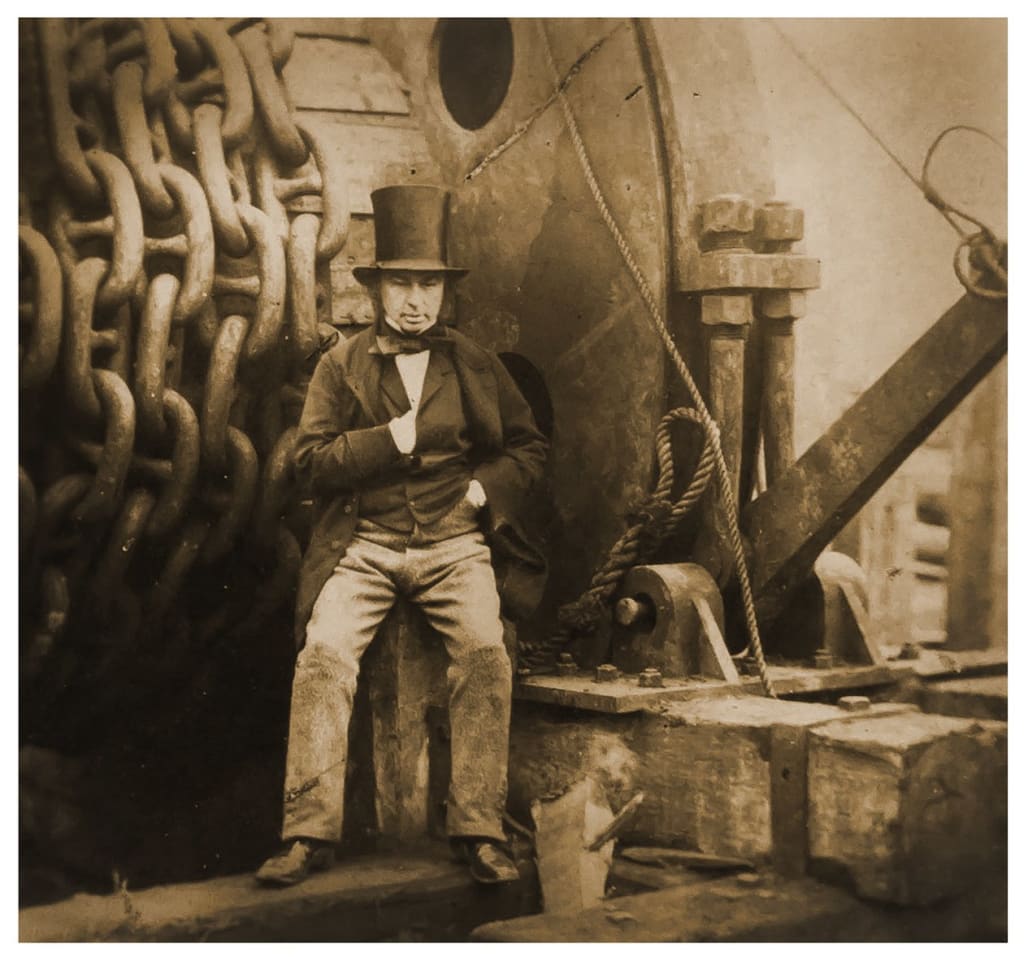
Isambard Kingdom Brunel, born in 1806, was a visionary engineer whose groundbreaking projects in railways, bridges, and ships transformed modern engineering and infrastructure. His innovative designs and relentless pursuit of excellence established him as one of history's greatest engineers.
Early Life and Education
Brunel's engineering journey began under the tutelage of his father, Marc Brunel, a prominent engineer in Britain. Despite studying at a prestigious secondary school in France, specializing in math and science, Isambard’s most valuable education came from working alongside his father. Together, they tackled diverse projects, from printing presses to paddle tugs for boats. However, Marc's financial mismanagement often led to significant debts, culminating in a humiliating ten-week imprisonment for debt.
The Thames Tunnel
The most famous collaboration between Marc and Isambard was the construction of the Thames Tunnel in London. This ambitious project aimed to connect the north and south banks of the Thames, alleviating the traffic congestion on London Bridge. Digging a tunnel through soft ground was perilous, with previous attempts resulting in collapses and floods. Marc Brunel's innovative tunneling shield, inspired by shipworms’ tunneling method, laid the foundation for modern tunnel-boring machines.
When Marc fell ill, Isambard, still a teenager, took over the project. The work was grueling, with poor ventilation causing workers to frequently faint and vomit. Isambard himself nearly drowned during the construction. After two decades, including several years of financial pauses, the Thames Tunnel was completed in 1843, becoming the world's first tunnel beneath a major body of water.
The Clifton Suspension Bridge
After the Thames Tunnel project, Isambard moved to Bristol, where his design for the Clifton Suspension Bridge was selected. Originally intended for horse-drawn carriages and pedestrians, the bridge continues to serve modern traffic, accommodating 12,000 vehicles daily. This project highlighted Brunel’s ability to create enduring infrastructure that meets contemporary demands.
The Great Western Railway
Brunel's most significant contribution to transportation was the Great Western Railway, which aimed to facilitate the movement of goods and passengers between Bristol and London. His choice of a route through less populated areas, avoiding steep hills and sharp curves, earned the nickname "Brunel’s Billiard Table" for its smoothness. This design allowed for higher speeds and more efficient travel compared to his competitors.
Brunel also challenged the standard gauge of 4 feet 8.5 inches, advocating for a broader gauge of 7 feet ¼ inch to accommodate larger wheels and provide greater stability and comfort at higher speeds. Although the Gauge Act of 1846 standardized the smaller gauge, Brunel's questioning of established norms had a lasting impact on engineering practices.
Innovations in Ship Design
Brunel extended his innovative thinking to ship design. Contrary to contemporary beliefs, he demonstrated that larger ships could move more efficiently with optimized hull designs. The SS Great Western, launched in 1838, was the largest ship of its time, designed to cross the Atlantic with minimal fuel consumption.
Brunel's subsequent project, the SS Great Britain, was the first large ship with an iron hull and a screw propeller. Despite the immense pressure and working up to 20 hours a day, Brunel successfully launched the Great Britain, which became a milestone in ship design.
The Great Eastern
Brunel’s ultimate engineering challenge was the Great Eastern, a ship intended to travel to India or Australia without refueling. At 692 feet in length and with a displacement of 32,000 tons, it was nine times larger than the Great Britain. The ship featured both a screw propeller and paddle wheels, exemplifying Brunel's ambition and innovative spirit.
However, the project faced numerous financial and logistical difficulties. The cost far exceeded initial estimates, leading to bankruptcies and immense personal stress for Brunel. Although the Great Eastern never fulfilled its intended purpose, it laid transatlantic telegraph cables, highlighting its engineering prowess.
Legacy
Brunel's legacy extends beyond the structures he built. His son, Henry, continued the engineering tradition, contributing to the design of London’s Tower Bridge. Brunel's innovative thinking and ambitious projects have inspired countless engineers, demonstrating the importance of daring to dream big and challenging established norms.
As Steven Brindle, author of Brunel: The Man Who Built the World, aptly summarized, “By his death, the greatest of England’s engineers was lost, the man of the greatest originality of thought and power of execution, bold in his plans but right. The commercial world thought him extravagant, but although he was so, great things are not done by those who sit down and count the cost of every thought and act.”
Closing
Isambard Kingdom Brunel’s impact on modern engineering is immeasurable. From pioneering tunnels and railways to designing iconic bridges and revolutionary ships, his work continues to influence contemporary infrastructure and engineering practices. Brunel’s life and achievements are a testament to the power of innovation, perseverance, and the enduring legacy of visionary engineers.
For those inspired by Brunel and seeking to improve their skills in math, science, and engineering, platforms like Brilliant offer interactive learning opportunities. Brilliant’s courses provide a hands-on approach to STEM education, helping learners build foundational skills and explore advanced concepts. By leveraging such resources, the next generation of engineers can continue to innovate and transform the world, just as Brunel did.
About the Creator
Horace Wasland
Research analyst, writer & mystical healer. Exploring the edge where science meets mystery. From mystery/the mystical, to facts, news & psychology. Follow for weekly insights on all four and please leave a tip if you like what you read :)
Reader insights
Nice work
Very well written. Keep up the good work!
Top insights
Eye opening
Niche topic & fresh perspectives
Masterful proofreading
Zero grammar & spelling mistakes
Keep reading
More stories from Horace Wasland and writers in Education and other communities.
Nikola Tesla the Forgotten Genius
In the pantheon of history's greatest inventors, few names resonate with the same blend of admiration and mystique as Nikola Tesla. While figures like Henry Ford, the Wright brothers, and Thomas Edison are frequently celebrated, Tesla's profound contributions to technology often remain underappreciated. His innovations, from alternating current (AC) electricity to early radio technology, form the backbone of contemporary electrical systems. This is the story of Nikola Tesla, whose life concluded in obscurity but whose legacy is more relevant today than ever.
By Horace Wasland2 years ago in Education
Smart Healthcare Systems: Transforming Medical Operations Through Digital Innovation
The healthcare industry is undergoing a profound transformation as digital technologies reshape the way medical organizations operate. Hospitals, clinics, and healthcare networks are increasingly adopting advanced technological solutions to enhance efficiency, improve patient outcomes, and reduce administrative burdens. As healthcare demands continue to rise globally, technology has become an essential tool for streamlining operations and supporting better coordination among healthcare professionals.
By Brady Beitlich4 days ago in Education
Why the Sun Appears Yellow: The Science Behind the Color of Our Star
The True Color of the Sun Although people often describe the Sun as yellow, scientists classify it as a white star. The Sun emits light across the entire visible spectrum, including red, orange, yellow, green, blue, and violet wavelengths.
By shahkar jalal7 days ago in Education




Comments (1)
Thank you for the history