
The Magpie-Robin
"Exploring the Intriguing Life Cycle, Natural Habitat, Feeding Behavior, and Nesting Patterns of the Magpie-Robin"
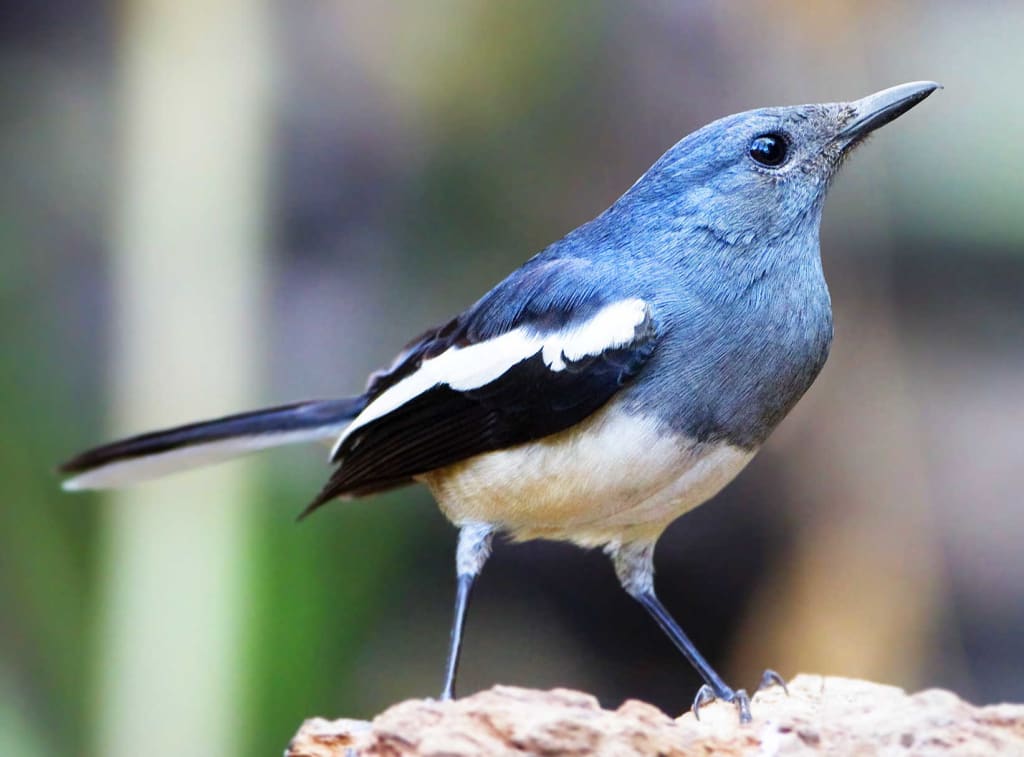
**Introduction**
The Magpie-Robin, known for its melodious song and striking appearance, is a bird that captivates nature enthusiasts and birdwatchers alike. Found across South Asia, this small bird carries a big presence with its vibrant behavior and ecological significance. Let's explore the life history, living environment, diet, and nesting practices of this remarkable bird.
The Magpie-Robin, specifically the Oriental Magpie-Robin (*Copsychus saularis*), is primarily found across South and Southeast Asia. Here are the regions where it is commonly found:
1. **Indian Subcontinent**:
- **India**: Widely distributed across the country, from the Himalayan foothills to southern regions.
- **Pakistan**: Found in the northern and eastern parts of the country.
- **Bangladesh**: Common throughout the country, where it is also the national bird.
- **Nepal**: Found in lower elevations and the Terai region.
- **Sri Lanka**: Inhabits forests, gardens, and urban areas across the island.
2. **Southeast Asia**:
- **Myanmar**: Common in forested areas and urban gardens.
- **Thailand**: Widely spread across rural and urban environments.
- **Malaysia**: Found in both Peninsular Malaysia and East Malaysia (Borneo).
- **Singapore**: Common in parks, gardens, and wooded areas.
- **Indonesia**: Distributed across the islands of Sumatra, Java, and Bali.
- **Vietnam, Laos, Cambodia**: Present in forested regions and agricultural areas.
3. **China**:
- Found in southern and southeastern regions, including the provinces of Yunnan, Guangdong, and Guangxi.
4. **Philippines**:
- Occurs in various islands, including Luzon and Mindanao.
5. **Andaman and Nicobar Islands**:
- A subspecies of the Oriental Magpie-Robin is found in these Indian territories in the Bay of Bengal.
6. **Southern China and Taiwan**:
- Found in southern parts of China and on the island of Taiwan.
**Habitats**:
The Magpie-Robin is highly adaptable and thrives in a variety of habitats, including:
- Tropical and subtropical forests
- Mangroves
- Urban gardens and parks
- Agricultural fields
- Lightly wooded areas
This adaptability allows the Magpie-Robin to maintain stable populations across its range, even in human-modified environments.
**Life History**
The Magpie-Robin, scientifically known as *Copsychus saularis*, belongs to the family Muscicapidae. These birds are known for their striking black and white plumage, with males typically being more vibrant than females. Magpie-Robins have a relatively long lifespan, living up to 15 years in the wild. They are highly territorial and are often seen perched prominently, singing to establish their presence and attract mates.
**Living Environment**
Magpie-Robins are versatile in their habitat choices. They thrive in a variety of environments, from dense forests and mangroves to urban gardens and parks. These birds are commonly found in the Indian subcontinent, Southeast Asia, and parts of China. They prefer areas with plenty of vegetation, which provides them with ample cover and nesting sites. Their adaptability to different habitats, including human-modified landscapes, has helped them maintain stable populations across their range.
**Diet**
The diet of the Magpie-Robin is primarily insectivorous, but they are also known to consume fruits and seeds. Their feeding behavior is agile and active, as they forage on the ground or in low shrubs, often flicking their tails in characteristic fashion. They primarily feed on insects like beetles, grasshoppers, and caterpillars. In urban areas, they have been observed eating kitchen scraps and small invertebrates, showcasing their adaptability in diet as well.
**Nesting and House**
Magpie-Robins are cavity nesters, meaning they prefer to build their nests in tree hollows, crevices, or even abandoned man-made structures. The female is responsible for building the nest, which is a cup-shaped structure made of grass, leaves, and twigs, lined with softer materials like feathers and moss. The nesting season typically occurs from March to July, during which the female lays 3 to 5 eggs. Both parents take part in feeding the chicks, ensuring they grow quickly and fledge within two weeks of hatching.
The Sexuality, Mating, and Growth of the Magpie-Robin
Mating Season and Courtship
The Magpie-Robin, Copsychus saularis, enters its breeding season typically from March to July, coinciding with the warmer months when food is abundant. During this time, male Magpie-Robins become more vocal and territorial, using their melodious songs to attract females and ward off rival males. The males perform elaborate displays, often puffing up their chests, spreading their tails, and hopping energetically from branch to branch to showcase their strength and vitality.
Courtship also involves mutual preening and feeding, where the male may offer food to the female as a sign of his ability to provide for the future family. These behaviors strengthen the bond between the pair, which is crucial for the cooperative raising of their offspring.
Mating and Egg-Laying
Once a pair bonds, they engage in mating, which usually takes place in the safety of dense foliage. After mating, the female searches for a suitable nesting site, often choosing tree cavities, crevices, or even niches in human-made structures like buildings or walls.
The female Magpie-Robin typically lays 3 to 5 eggs, which are pale green or bluish with brown speckles. These eggs are laid at intervals of one day, ensuring that the chicks will hatch sequentially rather than all at once.
Incubation and Hatching
The incubation period lasts about 12 to 14 days, during which the female primarily incubates the eggs, while the male guards the territory and brings food to the nest. Both parents are involved in protecting the nest from potential predators and rivals.
Once the eggs hatch, the chicks are born altricial, meaning they are naked, blind, and entirely dependent on their parents for warmth and food. The parents are attentive, feeding the chicks a diet rich in insects, which provides the necessary protein for rapid growth.
Growth and Development
Magpie-Robin chicks grow quickly, developing feathers within a week. By the end of two weeks, they are usually ready to leave the nest, although they may still be dependent on their parents for food and protection for some time after fledging. During this fledgling period, the young birds learn essential survival skills, such as foraging and avoiding predators.
The parents continue to care for the fledglings, feeding them and guiding them as they learn to navigate their environment. Within a few more weeks, the young Magpie-Robins become more independent, eventually leaving the parental territory to establish their own.
**Conclusion**
The Magpie-Robin is not just a beautiful bird but also an important part of its ecosystem, controlling insect populations and delighting people with its melodious songs. Understanding its life history, habitat, diet, and nesting habits offers a deeper appreciation for this remarkable bird that thrives both in the wild and in our gardens. By preserving their natural habitats and fostering environments where they can thrive, we ensure that the songs of the Magpie-Robin continue to fill the air for generations to come.
About the Creator
Keep reading
More stories from Md. Ashraful Azad and writers in Education and other communities.
Dimensional structure of nucleon resonances
Analysing the three-dimensional structure of nucleon resonances is a critical aspect of nuclear physics and our knowledge of the essential constructing blocks of depend. Nucleon resonances are excited states of protons and neutrons, which can be together known as nucleons. These resonances play a crucial position in knowledge the sturdy pressure, which binds protons and neutrons collectively in atomic nuclei.
By Md. Ashraful Azad2 years ago in Education
The Executive Mindset Shaping the Future of Health Technology
The healthcare industry is entering a new era defined by digital innovation, and the organizations that will thrive are those led by executives who understand the profound impact of technology. Digital transformation is no longer an optional upgrade or a series of isolated projects; it has become a fundamental shift that requires a complete rethinking of how healthcare is delivered, managed, and experienced. Artificial intelligence, telemedicine, wearable devices, and cloud-based systems are redefining the landscape, but technology alone is not enough. The success of health tech innovation depends on leaders who can cultivate a mindset focused on adaptability, strategic vision, and patient-centered care.
By Craig Kent7 days ago in Education



Comments
There are no comments for this story
Be the first to respond and start the conversation.