
How the Sun’s Gravity Dominates the Solar System
The Sun’s gravity is the dominant force that shapes the structure, motion, and long-term stability of the entire solar system. Without it, planets would drift into deep space, asteroids would scatter unpredictably, and comets would never return.

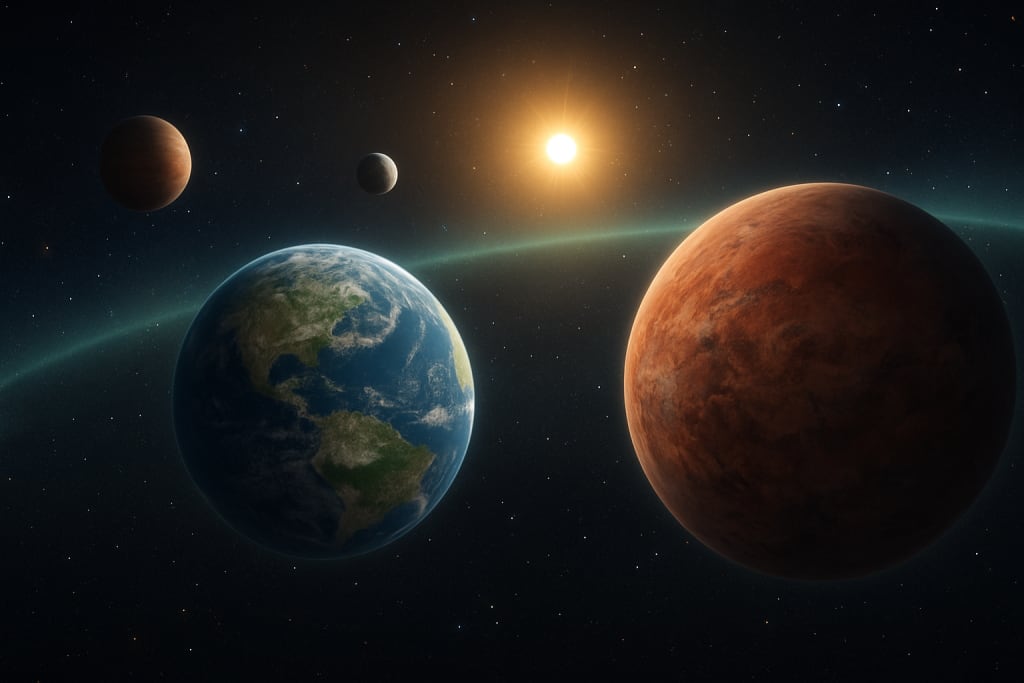
The Sun Contains Nearly All the Solar System’s Mass
Gravity depends directly on mass. The more massive an object is, the stronger its gravitational pull.
The Sun contains approximately 99.8% of the total mass of the solar system. Everything else — including massive planets like Jupiter — makes up less than 0.2%.
Because gravity increases with mass, the Sun’s enormous mass gives it overwhelming influence. Even Jupiter, which is more than twice as massive as all other planets combined, cannot compete with the Sun’s gravitational dominance.
________________________________________
Understanding Gravitational Force
Gravity is described by Isaac Newton’s Law of Universal Gravitation, which states:
• Every object with mass attracts every other object.
• The force increases with greater mass.
• The force decreases with greater distance.
The formula shows that gravitational attraction depends on both mass and distance. Since the Sun is extraordinarily massive and centrally located, it exerts a powerful gravitational pull on every object in the solar system.
This force keeps planets in orbit and defines the architecture of our cosmic neighborhood.
________________________________________
The Sun as the Gravitational Anchor
The Sun acts as the gravitational anchor of the solar system. All major bodies — including Earth, Mars, and Saturn — orbit around the Sun rather than around each other.
Although planets exert small gravitational forces on one another, these forces are minor compared to the Sun’s influence.
The center of mass of the solar system, called the barycenter, usually lies inside or very close to the Sun because of its enormous mass.
________________________________________
Why Planets Stay in Orbit
Planets remain in orbit due to a balance between two forces:
1. The Sun’s inward gravitational pull.
2. The planet’s forward motion (inertia).
If a planet had no forward motion, it would fall directly into the Sun. If there were no gravity, the planet would move off in a straight line into space.
The combination of gravitational attraction and forward velocity creates a curved path — an orbit.
This balance allows Earth to orbit the Sun once every 365 days and maintain stable seasons and climate.
________________________________________
Kepler’s Laws and Solar Dominance
Johannes Kepler formulated three laws that describe planetary motion. These laws demonstrate the Sun’s gravitational control.
1. Elliptical Orbits
Planets orbit the Sun in ellipses, not perfect circles. The Sun sits at one focus of the ellipse.
2. Equal Areas in Equal Time
Planets move faster when closer to the Sun and slower when farther away. This occurs because the Sun’s gravitational pull increases at shorter distances.
3. Orbital Period Relationship
The farther a planet is from the Sun, the longer it takes to complete an orbit.
For example:
• Mercury completes an orbit in 88 days.
• Earth takes 1 year.
• Neptune takes 165 years.
These patterns clearly show that solar gravity dictates orbital speed and distance.
________________________________________
Controlling Asteroids and the Asteroid Belt
The Sun’s gravity also governs the asteroid belt located between Mars and Jupiter.
Although Jupiter influences asteroid paths, it is still the Sun’s gravity that keeps these rocky objects in orbit around the solar system’s center.
Without the Sun’s gravitational pull, asteroids would not maintain stable orbits.
________________________________________
Shaping the Kuiper Belt and Oort Cloud
Beyond Neptune lies the Kuiper Belt, a region filled with icy bodies and dwarf planets such as Pluto.
Even farther away is the Oort Cloud, a distant spherical shell of icy objects.
Although the Sun’s gravitational influence weakens with distance, it still dominates these regions. Objects in the Oort Cloud remain gravitationally bound to the Sun despite being trillions of kilometers away.
This demonstrates just how far the Sun’s gravitational reach extends.
________________________________________
The Sun’s Gravitational Sphere of Influence
The region within which the Sun’s gravity dominates is called its Hill sphere.
The Sun’s Hill sphere extends roughly 2 light-years from its center. This means its gravitational dominance reaches nearly halfway to the nearest star system.
Within this region, the Sun’s gravity overpowers the gravitational effects of neighboring stars.
________________________________________
Gravitational Interactions Between Planets
While the Sun dominates, planets do exert gravitational influence on each other.
For example:
• Jupiter slightly alters the orbits of nearby asteroids.
• Saturn influences the structure of its rings and nearby moons.
However, these planetary interactions are minor compared to the Sun’s gravitational force.
Even Jupiter, the most massive planet, orbits the Sun — not the other way around.
________________________________________
Solar Gravity and Comet Orbits
Comets often follow highly elliptical orbits that take them far beyond Pluto.
When they approach the Sun, its gravity accelerates them dramatically.
Some comets travel for thousands of years before returning. Yet they remain bound to the Sun’s gravitational field.
Without solar gravity, comets would escape into interstellar space permanently.
________________________________________
General Relativity and Curved Space-Time
Albert Einstein’s theory of general relativity refined our understanding of gravity.
According to relativity, massive objects like the Sun curve space-time itself.
Planets follow these curved paths, which appear as gravitational attraction.
One famous example is the slight shift in Mercury’s orbit, which could not be fully explained by Newton’s laws alone but was accurately predicted by general relativity.
This confirms that the Sun’s mass literally shapes the fabric of space around it.
________________________________________
Maintaining Long-Term Stability
The solar system has existed for about 4.6 billion years. The Sun’s steady gravitational force has maintained orbital stability for billions of years.
If the Sun suddenly lost a significant amount of mass:
• Planetary orbits would expand.
• Some objects could escape the solar system.
However, the Sun loses mass very slowly through solar wind and radiation, so orbital changes are extremely gradual.
________________________________________
The Sun’s Role in Solar System Formation
The Sun’s gravity shaped the solar system from the very beginning.
About 4.6 billion years ago, a collapsing cloud of gas and dust formed the Sun at its center.
As the cloud collapsed:
• Gravity pulled material inward.
• A rotating disk formed around the young Sun.
• Planets formed from this disk.
The Sun’s gravity gathered the majority of the material, leaving the remaining fraction to form planets.
From the start, gravity established the Sun as the dominant object.
________________________________________
What If the Sun Disappeared?
If the Sun suddenly vanished (hypothetically):
• Its gravitational pull would instantly cease.
• Planets would travel in straight lines at their current speeds.
• The solar system would disperse.
This thought experiment highlights how dependent planetary motion is on solar gravity.
________________________________________
Why Jupiter Doesn’t Take Over
Because Jupiter is extremely massive, some wonder whether it could dominate the solar system.
Although Jupiter has strong gravity, it has only about one-thousandth the mass of the Sun.
Therefore:
• Jupiter influences nearby objects.
• But it cannot compete with the Sun’s central gravitational force.
The Sun remains the primary controller.
________________________________________
Solar Gravity and Space Exploration
Modern space missions rely on precise calculations of the Sun’s gravitational pull.
Organizations like NASA use solar gravity to plan spacecraft trajectories.
Gravity assists, also called slingshot maneuvers, use planetary gravity — but all calculations are based on the Sun as the central gravitational reference point.
Without understanding solar gravity, interplanetary travel would not be possible.
________________________________________
Key Ways the Sun’s Gravity Dominates
Here is a summary of how the Sun’s gravity dominates the solar system:
• Holds 99.8% of total mass
• Keeps all planets in orbit
• Governs asteroid belt motion
• Controls Kuiper Belt objects
• Binds the distant Oort Cloud
• Curves space-time around it
• Maintains long-term orbital stability
No other object in the solar system comes close to this level of influence.
________________________________________
Conclusion
The Sun is the undisputed gravitational ruler of the solar system. Containing nearly all its mass, the Sun’s gravity shapes planetary orbits, controls asteroids and comets, maintains cosmic stability, and defines the solar system’s structure.
Planets like Earth and Jupiter may be massive in their own right, but they remain bound to the Sun’s gravitational field.
From the innermost orbit of Mercury to the distant edges of the Oort Cloud, solar gravity dominates every corner of our cosmic neighborhood.
Without the Sun’s immense gravitational power, there would be no organized solar system — only scattered debris drifting through space.
About the Creator
Keep reading
More stories from shahkar jalal and writers in Education and other communities.
Leading With Purpose: Cultivating a Philanthropic Mindset in Modern Medical Leadership
Medical leadership today extends far beyond supervising clinical teams or managing hospital operations. Physicians in leadership roles influence institutional strategy, community engagement, research priorities, and public policy. In an era marked by health inequities, rising costs, and global crises, medical leaders must adopt a broader vision of responsibility. Developing a philanthropic mindset is no longer optional. It is a defining characteristic of effective and ethical leadership in healthcare.
By Dr. Seth Eidemillera day ago in Education
🌅🌅The Survival Guide to the Zombie Epidemic 🌅🌅
🌅🌅Part I: Personal Reflections of the Mirrors within the Mirror Mind of Mushin Welcome to the dueling parallel pandemics. From panicking psychosis to poisoning paranoia, I enter into a slow and long discord of death and doom. However, here is my tale of redemption as I fought my way back out of the cycle of daily doomsday body counts, as I fought to regain my dignity within this land of absurd corruptions, and as I fought the impossible: to regain my sanity during the famous stressful Zombie Pandemic of 2021. I know you have another name for it, but this is how I remember it. Listen well.
By SAMURAI SAM AND WILD DRAGONS8 days ago in Education
Flower Bloom 369
FLOWER Bloom 2/25/26 Wednesday By Mariann Carroll Karen had been with Tony for 7 years. Tony started acting strangely after her surgery. He would mow the lawn in the rain and be on his cellphone. He started pushing Karen away. Tony came clean about seeing someone. Karen moved out two months later. Karen moved in with a friend. She felt betrayed.
By Mariann Carroll6 days ago in Fiction


Comments
There are no comments for this story
Be the first to respond and start the conversation.